

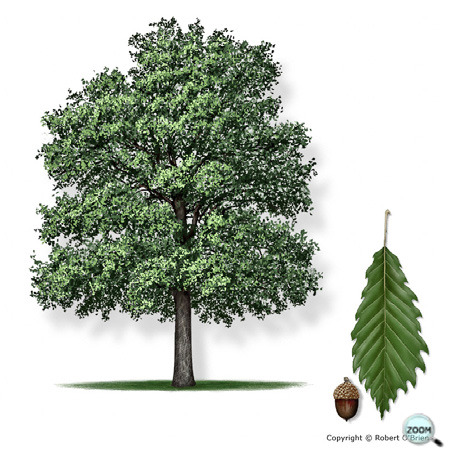
Walk through the neighborhood or take a hike in the forest, and it is hard to not step on fallen acorns.
Acorns are the fruit of an oak tree. Inside the tough shell of an acorn are one or two seeds. Surrounding the seed is the fleshy, white tissue of the kernel. Shapes, sizes, and colors vary by the kind of oak from which they fall. Most acorns have cup-shaped caps called cupules that sit atop an outer shell.
Cupules can be covered with short or long hairs or with scales, or may be entirely smooth. The outer shells usually have either a rounded bottom or may be oval with pointy bottoms. Then there are those with colors that may be reddish, light or dark brown.
There are over 400 species of oaks, all the same genus, Quercus. In the United States there are about 60 species that can be grouped into either the white oak group or the red oak group. Oaks are assigned to one of the groups based upon their morphology. Trees in the white oak group have leaves with rounded lobes, while trees in the red oak group have deeply incised, pointed lobes. Acorns from the white oak group are oblong or oval, while acorns from red oak group tend to be rounder and flatter.
Common trees in the white oak group are live oak and post oak. Common trees in the red group are Shumard red oak and pin oak. Acorns from the red oak group require two years to mature versus one year for the white oak group.
The wood of the trees in the two groups are different also. Wood of white oaks is resistant to rot, while red oak wood is not. White oak wood is the preferred wood for exterior tasks. The ray fleck patterning of oaks is found in both red and white oak wood, but the patterning found in white oaks is considered to be superior and is known as ‘tiger oak’ by antiquarians (wood-database.com).
But back to the acorns. The largest acorn is that of the Bur oak ( Quercus macrocarpa), 2 to 3 inches in diameter, while the smallest acorn is from Chinkapin oak ( Quercus muehlenbergii), a tiny 0.5 inch in diameter.
If you don’t have your own acorns, they can be ordered at nativewildflowers.net.
Some information from Technology of Quercus
Ellen Peffley Harp, a retired professor of horticulture at Texas Tech University, writes about gardening for several Texas newspapers.
- Log in or Subscribe to post comments.
