

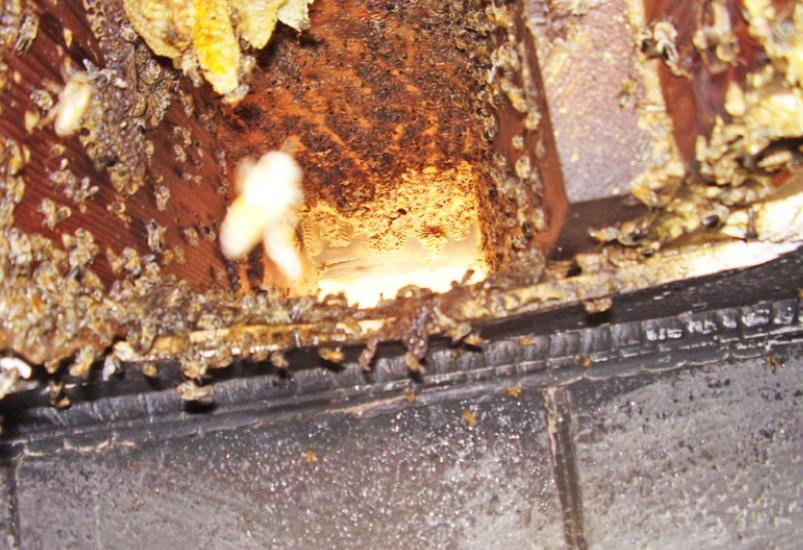
Honeybees are one of nature’s most important plant pollinators, among other benefits they provide—but hives growing in hidden crevices of homes and commercial buildings can pose a serious threat, as those working on the new Spur fire station project discovered recently.
The cinder-block garage next door to the old Godfrey Motors building on West 3rd Street harbored a hive, as evidenced by bees in the vicinity, said Spur fire chief Wess Abbott. Local beekeeper Jon Shipp, who’s often called in to remove and re-home colonies, was aware of the hive after doing a partial removal a few years back.
But what they discovered Monday morning was a colony of up to 50,000 bees. The hive extended below ceiling level of the roof and up into the rafters, as Shipp’s photos revealed. Beginning around 6:30 a.m., and with the fire department’s truck and bee suit on standby, Shipp entered the garage and successfully brought out the large hive. Even with protective gear and techniques, Shipp was stung about ten times in the process.
The hive will be relocated to a rural area of the county, Shipp said.
“Bees must be relocated more than three miles away,” he explained, “or they’re likely to return.”
Abbott said that the presence of bees had halted work on the firehouse project for a while until Shipp could move them. “We were gathering up to start demo,” he said, “but we couldn’t do anything because motors and heavy equipment attract bees.” (Abbott, who is also emergency services coordinator for Dickens County, recalled an incident a few years ago in which a resident died from a bee attack when out mowing.)
The property owner gave permission for access, and on Monday within a couple of hours Shipp had the main portion of the colony out. He and Abbott estimated that 90% of the colony, including the queen, had been removed.
Abbott said they will monitor the situation for a few days longer, then resume work. Rolloff containers will be arriving this week, and within a couple of weeks that block of 3rd Street will be closed to traffic for the duration of demolition and construction.
In the meantime, Abbott urged those who are out mowing or shredding in high grass to take precautions, because the vibration of heavy equipment may make nearby bees defensive and cause them to attack. “If you are getting attacked, get out of there,” he said. Tractors in the field may sometimes hide old well casings where colonies live, or there may be swarms in outbuildings.
Shipp added that when a hive of bees is discovered, “the last thing you want to do is spray them—they get aggressive if even a few are killed.”
Have there been many occurrences of swarms, or requests for removals this spring? Shipp said he’d had a regular stream of calls after a few recent rainstorms.
“When pollen and nectar are there, things went crazy,” he said.
- Log in or Subscribe to post comments.
