

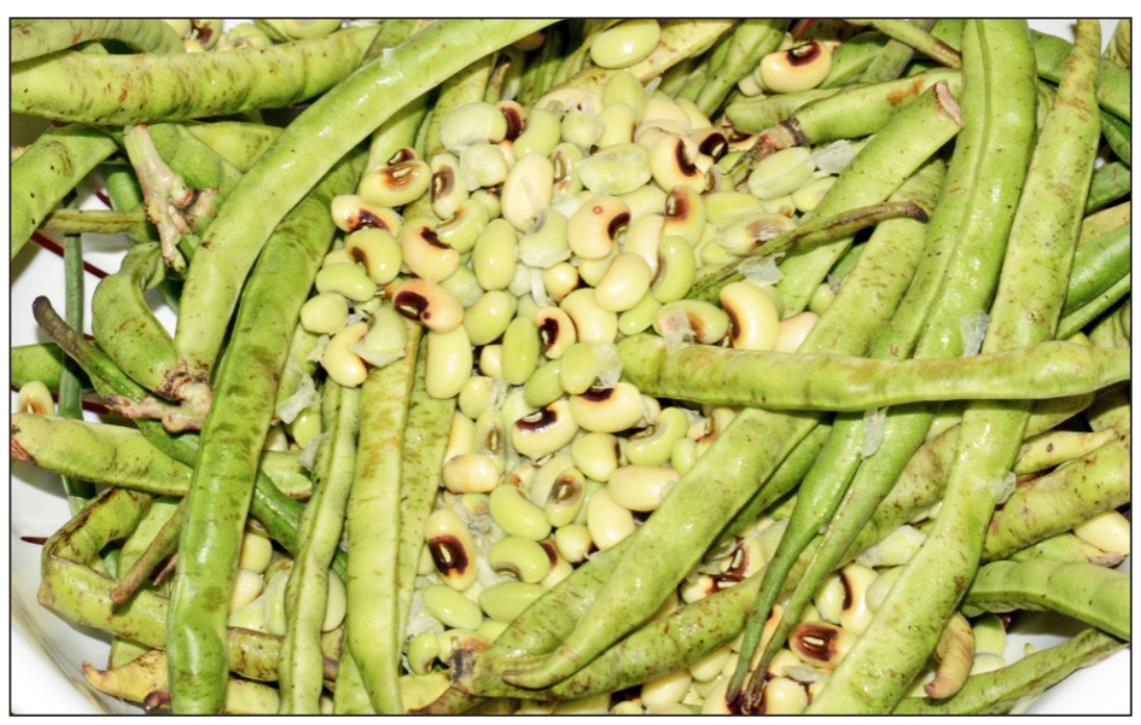
Black-eyed peas are plentiful right now. They are easy-“peasy” to grow in the garden and easier to harvest.
Black-eyed peas are members of the Fabaceae family, the legume or pea family. Its scientific name is Vigna unguiculata, which classifies it in the bean group, since the term bean is given to legumes whose edible portions are seeds or pods. The scientific name for peas is Pisum sativum.
The two vegetables are further distinguished by season in which they are grown: Beans originated in West Africa and are warm season legumes, while peas originated in the Mediterranean region and are cool season legumes.
Black-eyed peas can be eaten at three stages of growth: 1) as snaps, which are small immature pods similar to a thin green bean; 2) pods allowed to stay on the plant expand in size and develop into larger yellow pods that are still soft and can be easily shelled, peas inside are plump and moist and can be cooked as a black-eyed pea; 3) the third stage of development is the dry edible stage when pods and seeds are fully mature signaled by pods becoming brittle and the seeds have fully dried down; at this stage the seeds can be rehydrated for cooking or stored for later use. As a warm season crop, black-eyed peas are planted after the
As a warm season crop, black-eyed peas are planted after the last freeze; seed can be planted as late as July for the soft-shelled stage harvest. Snaps have the shortest days to maturity, about 60 days to harvest, while the soft shell or dry edible stages can be as long as 90 to 100 days to maturity.
Plant seed about 1 inch deep, thinning to a final stand of 12 to 18 inches spacing with 2 to 3 feet between rows. Plant in full sun in soil amended with organic matter. Water well until emergence. Irrigate when soil is dry to a depth of 1 inch. Since a legume, it is not necessary to fertilize.
Black eye-peas are disparaged by some because they are known as cowpeas — grown as feed for cows. But, like all legumes, they are a nutritious crop. They are high in fiber and complex carbohydrates, vitamins A and C, and are a good source of protein, omega-3-fatty acids; minerals calcium, copper, iron, magnesium, phosphorus, and potassium; and folate, niacin, riboflavin, and thiamin.
Some information from Publications International, Ltd.
- Log in or Subscribe to post comments.
