
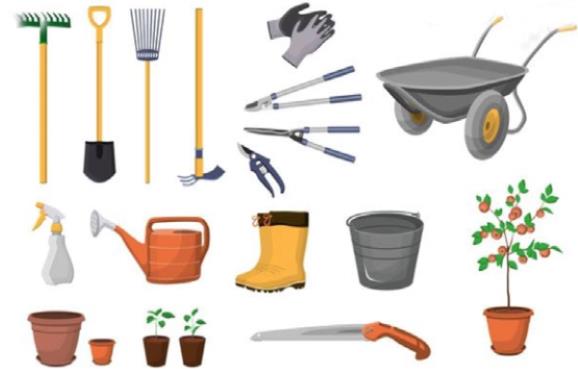
January gives gardeners downtime to take care of garden tasks that in busy times get “put on the back burner” while waiting for a better time. Cleaning tools is one of those tasks.
Here are some suggestions for caring for shovels, trowels, hoes, pruner, and loppers.
The first and most important suggestion is to purchase the best quality tools that can be afforded. Purchasing inexpensive tools may seem like a good buy, but when a trowel folds onto itself when hitting hard soil, or pruners or loppers that cut the first two times they are used but then come apart or become so dull they don’t cut anything, these are not bargains.
Care of shovels, trowels, and hoes. Purchase with stainless steel blades that will not rust. After each use knock dirt off the blades, washing the blades to remove any hardened, caked-on dirt. Dry the blade and wipe with rags sprayed with a lubricating product like WD-40. Handles can be either fiberglass or wood. Wood handles should be treated occasionally with an oil-based stain, like Penofin, that keeps wood from drying and splintering. Follow with a yearly coat of varnish.
Blades will dull with use. Sharpen blades with either a flat file or a whetstone. If using a flle run the file on both sides of the entire edge of the blade then run the file at a 45-degree angle on the inside of the blade to sharpen the edge. Run the file at the same angle in one direction only, not back and forth. Soak the whetstone in water for about 5 minutes, enough time for water to penetrate the porous surface. Water will keep the whetstone lubricated. Face the shovel or trowel blade away from you, run the side of the whetstone at a 15- to-20-degree angle on the blade. Draw the stone down in a circular motion using moderate pressure. Cover the entire edges of the blade. Keep blade flush against the stone 10 times on one surface of the blade, turn blade over and repeat on the other side.
Care of pruners and loppers. Use these cutting tools for only botanics; never cut wire with them. Follow the same cleaning method as above to remove residual living matter. Special sharpeners can be purchased or use a flat file or a whetstone as above.
Ellen Peffley Harp, a retired professor of horticulture at Texas Tech University, writes about gardening for several Texas newspapers
- Log in or Subscribe to post comments.