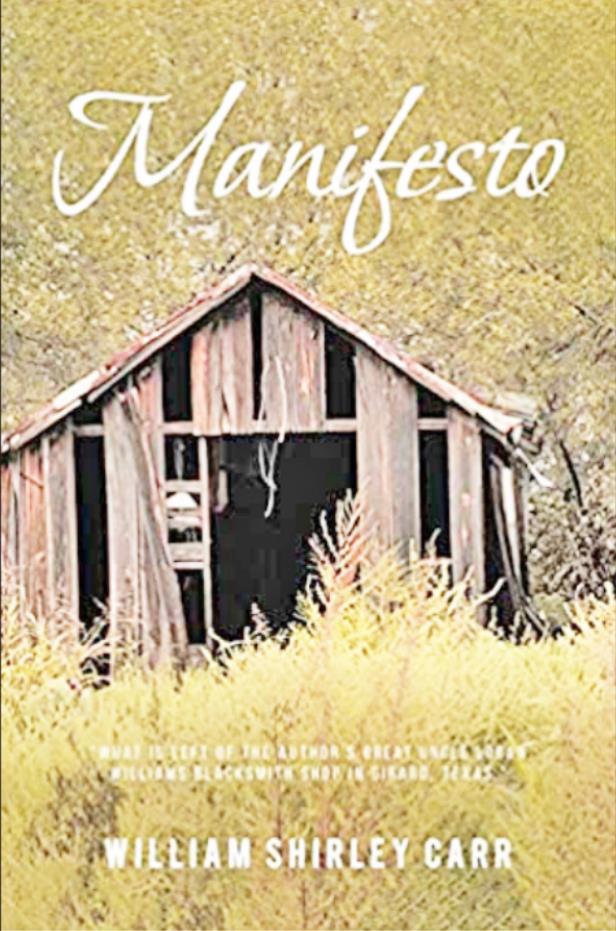
“Manifesto”
William Shirley Carr
Covenant Books, 2020
ISBN 978-1-64670-637-2 (paperback),
978-1-64670-638-9 (digital), 160 pages.
William Shirley Carr grew up in Girard, Texas, at a time when the Kent County town still had a school of its own.
Of course, the Girard School’s been gone for more than half a century now, but Carr brings it back to life with colorful remembrances of this farm-and-ranch community, peppered with jests and jabs of the sort one can imagine being told back then, too.
“Manifesto” is an appropriate title. The work, which melds 52,026 words (the author mentions this statistic near the end) of anecdotes, autobiography, inspiration, and humor, is arranged in no definite thematic order that might steer it toward memoir. And since some of Carr’s adventures (such as that of the local guy who shot a hole right through a drinking buddy’s hand but ended up best chums with him later) prove the adage that truth is stranger than fiction, it isn’t a novel, either.
The book is more like a ramble through the fields with an uncle who’s forgotten more about the land and its people than you will ever hope to know. You can follow along beside him at an amiable pace and listen to him pick up where he left off a few days earlier . . . winding up with an escapade involving hogs getting loose, or a tale about learning Morse Code in order to gain employment at Western Union, or an admission about liberating watermelons from a local farmer’s patch. And then head out on on another day, without caring much whether or not that day’s episode picks up where the other one left off. It’s pleasant enough regardless.
“Manifesto” does have a forward trajectory that, off and on, follows the course of the author’s life from birth (at home in Girard, on Nov. 21, 1937) through his education, military service, family, work with the Veterans Administration followed by a second career as an appraiser, up through his eighty-third year on earth. While Carr says in the back-cover copy that his life has had “numerous ups and downs, but thankfully mostly ups,” he seems sincere, but he doesn’t gloss over difficulties and tragedies, in particular one sad and painful episode about halfway through the volume.
This account, and the facts and foibles connected with his ancestors and kin, will be valued by his own family for the colorful portrayals of characters they wish to remember, or never had the chance to meet.
A work like this can prove quite valuable to others unrelated to the author, too, as local history. Figures such as politician George H. Mahon, Texas Tech football coach Spike Dykes, former Texas governor Dolph Briscoe, and guitarist Weldon Myrick make cameo appearances. Bits of the past such as when a certain house burned, or when a particular neigbhor lived where, or what it was like to hoe cotton in the years before World War II could help historians piece together a larger sociological and historical puzzle. Such recollections would’ve served better had they been organized into chapters, or, better still, indexed.
Those don’t seem to have been the aims of author or publisher in this case.
If you enjoy an afternoon’s walk with a voluble stranger who may grow to become your friend, thumb through Carr’s brief book. Its subtitle, “A Public Delcaration” (which appears on the title page and folio but oddly not on the cover) makes the author’s intentions clear, and its honest sharing is the result of his “very best recollections.”
- Log in or Subscribe to post comments.