
Whether we have a little of it or a lot, money is something those of us living in 21st-century Texas are well accustomed to spending. As coin, currency, check, credit card, or, increasingly, the bits and bytes of digital transactions, we can quite literally count on it.
With it we pay our power bills, purchase our gas and groceries, buy real estate or pay rent, remit taxes, compensate our employees, reward the babysitter. Here in Dickens County, money is being mined these days in the form of Bitcoin, but it’s not the first time currency has been issued locally.
Money in the “olden days.” If you had come to the frontier of Texas a century and a half ago, right after the state’s readmission to the Union in March 1870, you might have arrived at Parrish’s Store in Espuela with a handful of Spanish silver, some worthless Confederate scrip, and perhaps a few trimes (yes, a three-cent coin really did circulate in the U.S. back then). You might have tucked away a wad of Canadian shinplasters (small-denomination paper notes) or national bank notes issued in U.S. cities (including Houston); if you were hedging your bets, you might possess a quanitity of California gold dollars hidden out of sight. You might have simply bartered your purchase with seed or services.
By 1891 Dickens County was organized with tiny Espeula as its seat, though the following year the town of Dickens won the county seat race and a few years later had a bank of its own. The Dickens First National Bank closed in 1913; there is no evidence it ever distributed its own currency.
The upstart townsite of Spur, however, did.
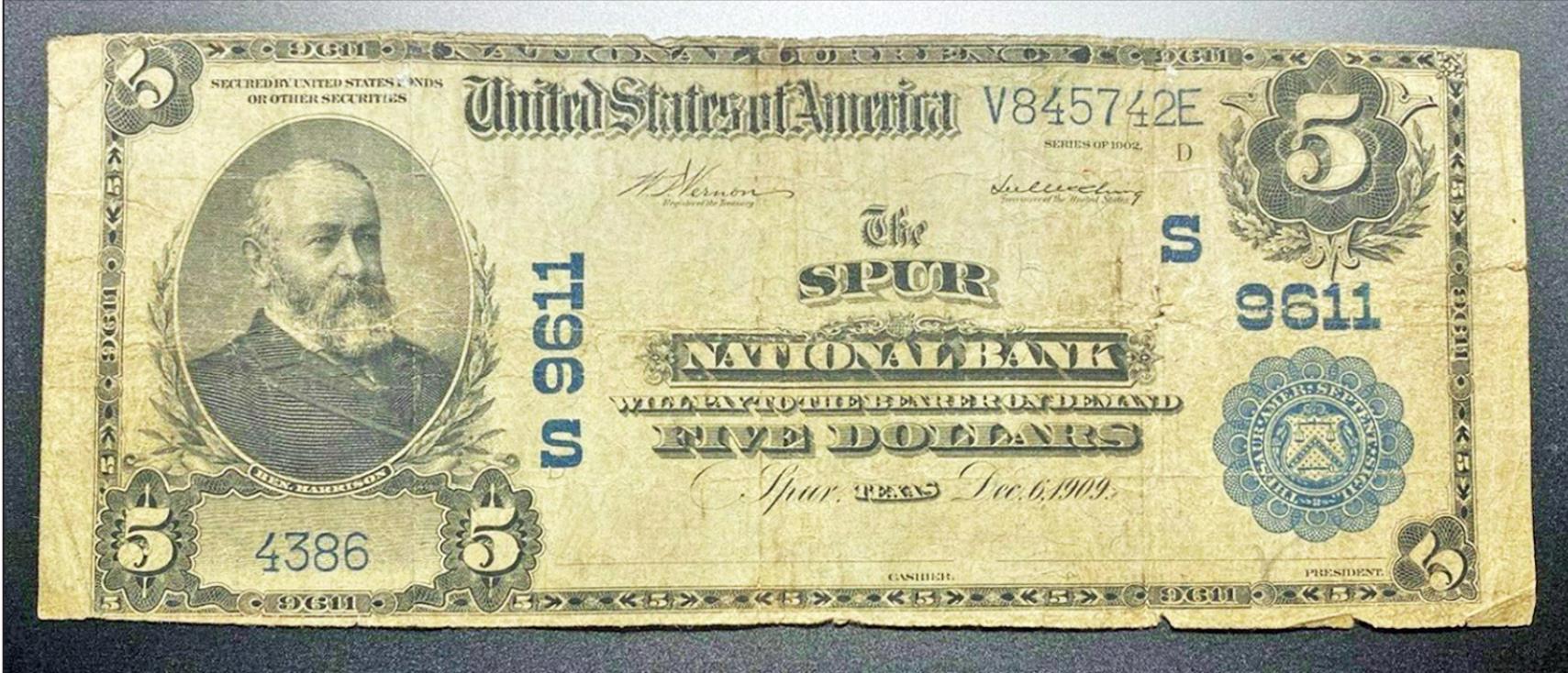
Spur National Bank organized. According to www. antiquemoney.com, the Spur National Bank printed $539,230 worth of national currency. Chartered in 1909 as one of Spur’s first business entities, the bank ceased printing money in 1934. During its lifespan, the Spur National Bank issued nine different types and denominations of national currency.
Eric Swenson of Spur, recently retired as chairman of the bank’s state-chartered successor, Spur Security Bank, has collected examples of these notes. Swenson’s family ties link to the original investor in the Spur Townsite Company, S. M. Swenson of New York City, who in the late 19th century saw the potential for creating an agrarian community out of former cattle rangelands and natives’ buffalo hunting grounds.
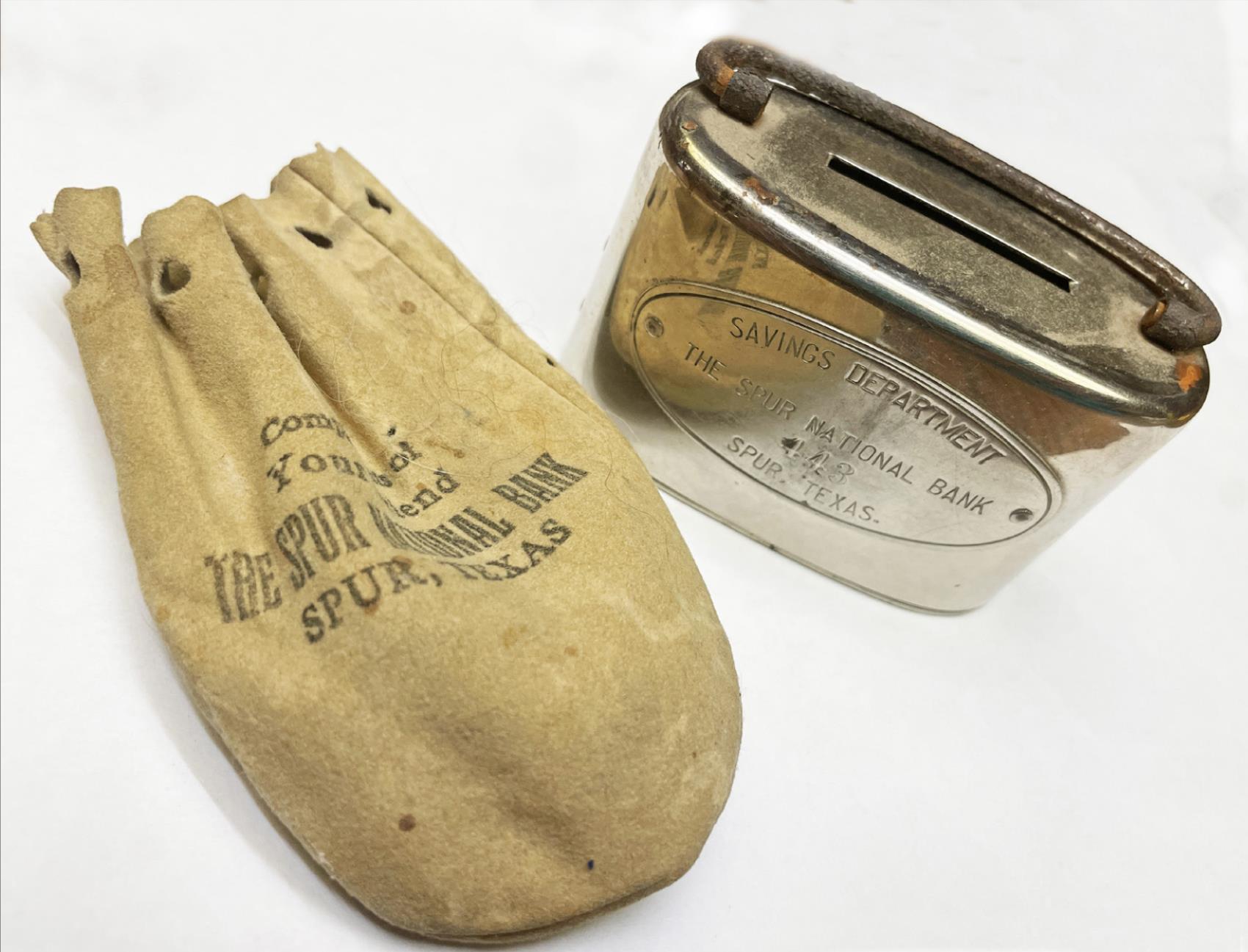
“A lot of people have approached me . . . to ask if I would be interested in buying these,” Eric Swenson said as he displayed several financial artifacts across the bank’s conference table a few weeks ago.
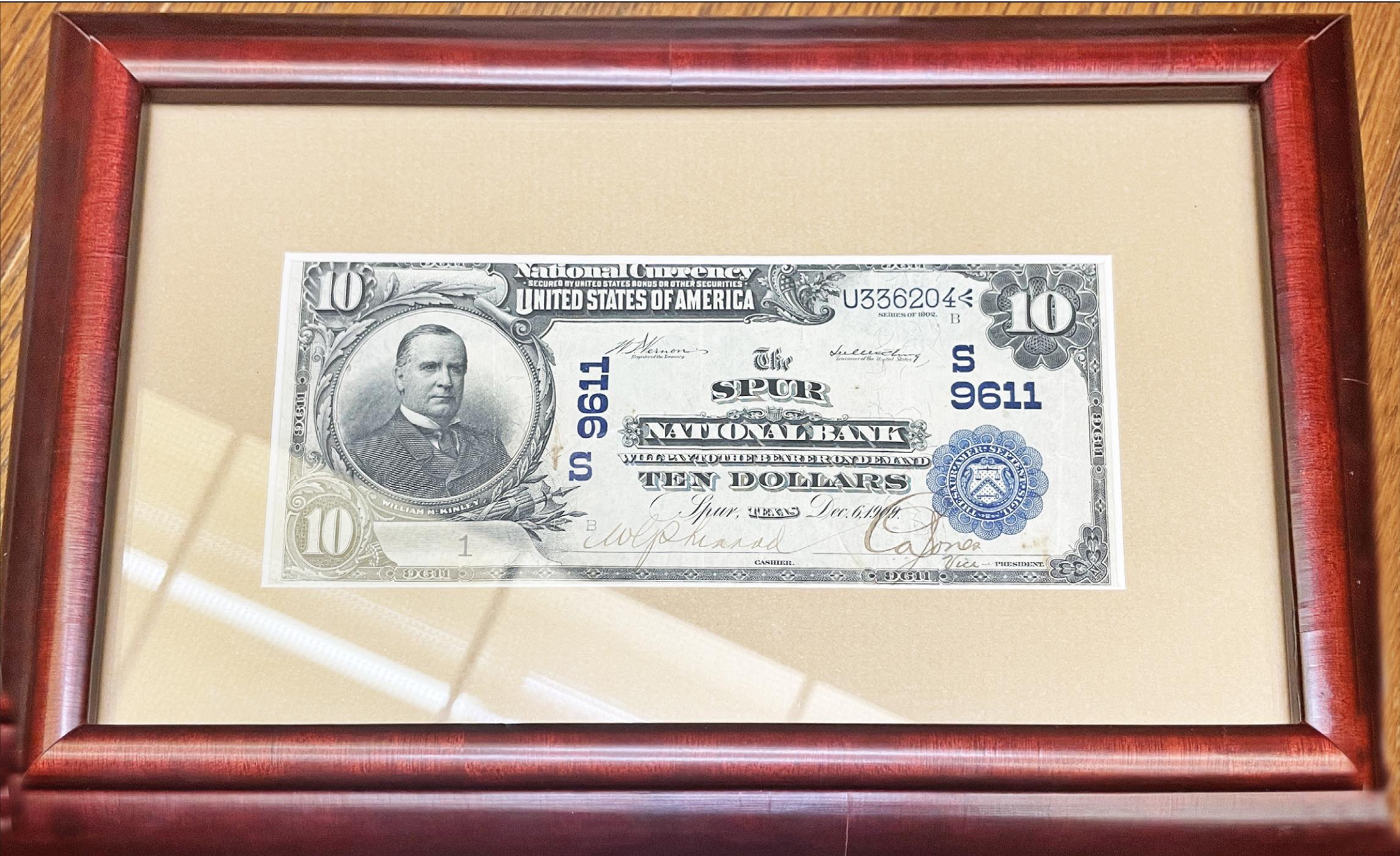
One ten-dollar note, bearing serial number 1, came through an agent for the Clifford B. Jones estate. Framed as a memento now, it also carries the inked signatures of bank president W. B. Sherrod, who Swenson says was also president of the bank in Stamford, and C. A. Jones.
Swenson recalls learning that uncut sheets of bills arrived at the bank from the Bureau of Printing & Engraving in Washington, D.C., to be stored in the vault until cut apart, signed and placed into circulation. This was the requirement, according to learning aids at www.uscurrency.gov, after Congress mandated in 1877 that the U.S. Department of the Treasury be the sole engraver and printer of notes, bonds, and other securities of the United States.
Paper money in the vault. But such printed currency could be issued locally. Here’s how it worked from 1863 to 1935, according to Wikipedia. com. National bank notes were issued by banks throughout the country and in U.S. territories. Banks with a federal charter would deposit bonds in the U.S. Treasury. The banks then could issue banknotes worth up to 90 percent of the value of the bonds. The federal government would back the value of the notes—the issuance of which created a demand for the government bonds needed to back them.
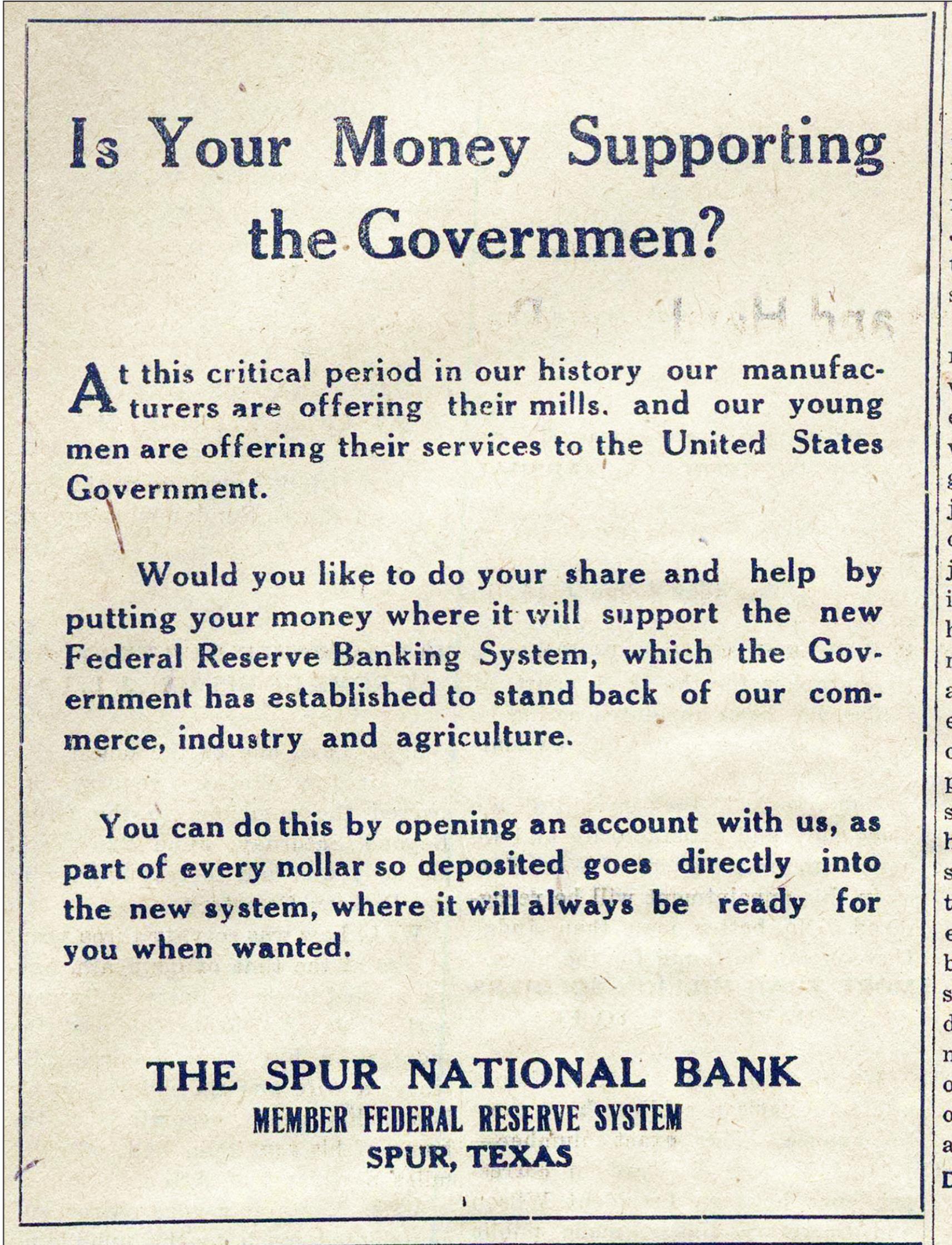
Following the Federal Reserve Act of 1913, the first $10 federal reserve notes were issued in 1914. The system, as with previous and subsequent fiscal actions by the nation’s government, was not without controversy. While Spur National Bank touted the benefits of its participation in the Fed with newspaper advertisements, editors nationwide weighed in on the matter. In the December 2, 1921, issue of the Texas Spur, a long, unsigned editorial, presumably by editor and perennial town booster Oran R. McClure—explained the benefits of the Federal Reserve Banking System.
Eric Swenson still doesn’t know all the reasons Spur National Bank might have signed on. “This does not make the bank any more money to have your name printed on it,” he said, positing that the practice might have had some promotional value that gave a local bank a competitive edge.
Swenson pointed to several other Spur National Bank notes from his collection bearing different signatures. “I knew many of the people who signed these notes,” he said. Cashier Bill Andrews, whose brother Henry was the Swensons’ attorney in Stamford and went on to serve as president of the Muleshoe bank, was one of these. And although Swenson was not personally acquainted with bank president W. B. Lee, he said, his brother Sturmand Lee was still working there when Swenson joined the firm in the 1960s. When and why did Spur
National Bank’s currency issue come to an end? As many banks throughout the nation and world faced reverses during the Great Depression, Spur National Bank reorganized under a state charter as Spur Security Bank in 1933.
And in case you were wondering . . . . All U.S. currency issued since 1861 is valid and redeemable at its full face value. But according to online auction sites, Spur bank notes still turn up from time to time, and have been valued from $40 to $10,000.
NEXT WEEK: Crypto comes to West Texas
- Log in or Subscribe to post comments.
