Texas high school sports fans are known for their loyalty—often willing to drive for hours to watch their favorite local team in an eagerly awaited matchup. And whatever the sport, from fall football to spring track, social media scammers know it.
If you can’t make it to the game in person and want to tune in to an online livestream, don’t fall for fake links on Facebook or other sites, warned the Better Business Bureau and AARP recently.
During the Covid-19 pandemic, when many supporters were unable to attend games in person, legitimate organizations such as the National Federal of State High School Associations (NFHS) began streaming video and/or audio of competitions as an alternative. The service remained popular afterward, even more, as a greater number of schools sign up. Fan networks such as ScoreStream and MaxPreps—just a couple of examples‚have also provided ways to share information. And schools themselves may post their But spoofs (fakes posing as legitimate services) or scams (fraudulent sites, often with an intent to steal data or funds) have begun popping up like toadstools anytime an athletic event is mentioned on social media.
For news outlets like this newspaper, scrubbing them from our Facebook feeds every Friday night is like a full-on game of Whac-A-Mole, distracting us from sharing highlights and legitimate links with our readers.
According to the April 2023 issue of AARP Magazine, here’showtospotand avoidthesefakehighschool sports streaming links.
Some high school athletic associations have become so concerned, they’ve put out news alerts.
“Examplesofthestreaming scam can be found on Facebook Events,” according to McAlester (OK) High School last fall. “The post containsalinkwherescammers hope the would-be viewerinputstheirinformation and pays to watch the event.”
The school noted some ways to spot a fake profile posting a scam link. “On Twitter especially, take notice of account names and photos, which often seem to be random, and look at their follower and following numbers. Low follower counts indicate the account likely was just started. Look at the content of their posts as most are nothing but tweets to stream games.”
If you did actually enter your information, the school advised, “Stay calm. Consumers are not liable for fraudulent charges on stolen account numbers. Monitor credit card and bank statements carefully and if fraudulent charges are found, contact the card issuer immediately.”
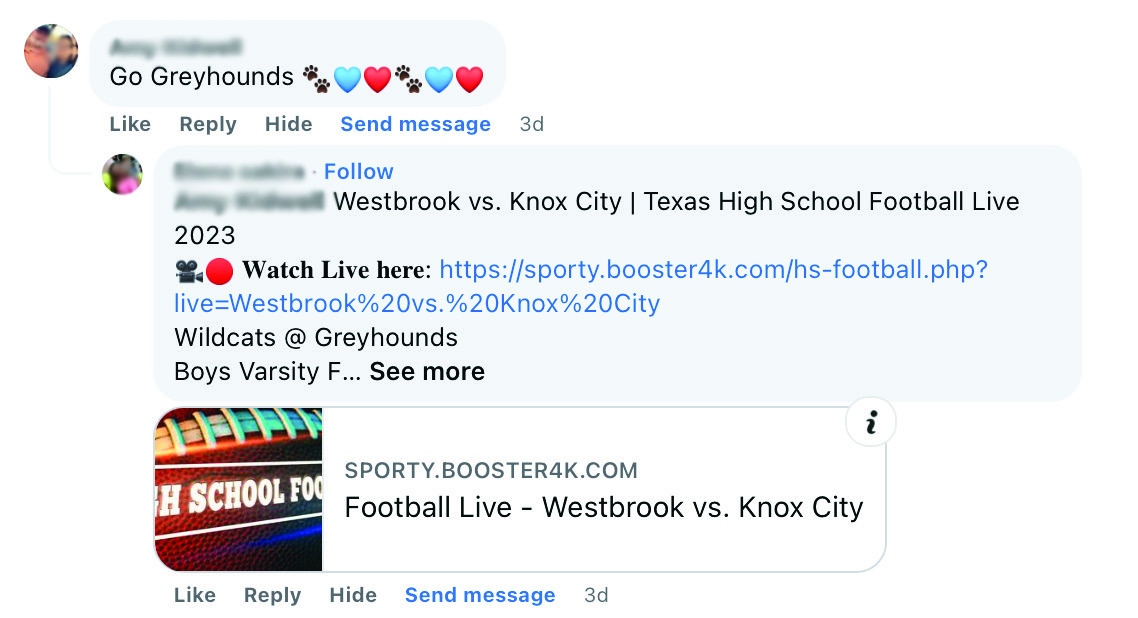
Be aware that such scams often tag schools— and even individual athletes, whose names can be found easily on fan and school sites—and may even offer up chatty comments to appear legitimate.
To avoid getting taken in, some organizations advise, call the school in advance and ask where a contest is being streamed.
“Fans need to remain diligent in where and how they find the stream of a high school contest,” Matt Troha, an assistant executive director with the Illinois High School Association, told the BBB, according to coverage the association shared at the start of the 2022 school year. “On Twitter especially, take notice of account names and photos, which often seem to be random, and look at their follower and following numbers,” Troha said. “Low follower counts indicate the account likely was just started. Look at the content of their posts as most are nothing but tweets to stream games.”
A request for updated guidance from the NFHS did not yield a response in time for this story. Games streamedontheirservicemay be verified at /www.nfhsnetwork. com/watch-events
- Log in or Subscribe to post comments.