
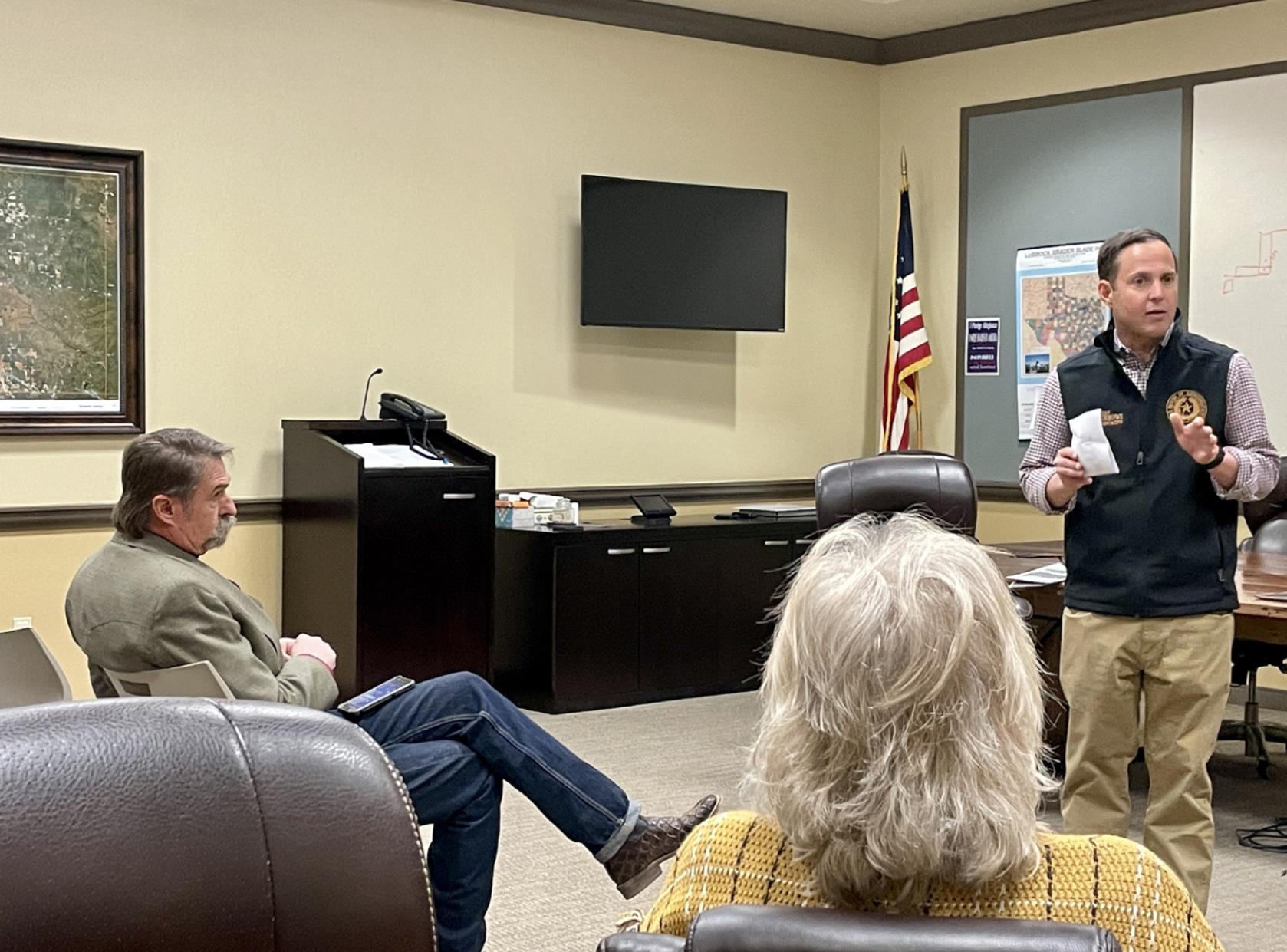
On January 20, Texas House District 83 representative Dustin Borrows (R-Lubbock) made his first get-acquainted visit to the county seat of Dickens, which will move into his district next January 1.
A handful of courthouse personnel and citizens from Dickens and Spur turned out at the county annex building to learn about Burrows’ background and legislative positions, before Burrows and his chief of staff, Matt Crow, accompanied Judge Kevin Brendle on a brief visit to the Argo Blockchain site in northern Dickens County.
Burrows, a Lubbock native and a Monterey High School graduate now in his fourth term in the House, summarized what he considered his key achievements in the most recent legislative session.
In a session dominated by Covid-19 concerns, said Burrows, the legislature sought to fully fund public education. “We got rid of small school adjustment and increased the state’s share going into public education,” he said.
Legislators also pushed through a constitutional amendment preventing mandated closures of churches during emergencies such as the pandemic, and succeeded in another constitutional amendment to allow nursing homes to permit visitation by a designated caregiver.
In addition, the legislature approporiated an additional $75 million for rural hospitals and funded a 13th monthly benefit check for retired teachers.
In the matter of energy supply, especially in the wake of last February’s Winter Storm Uri (which hit during the middle of the session, Burrows said there was a need to populate Texas’s ERCOT board with Texans who understood the state’s needs.
“What concerns me the most” going forward, said Burrows, “is the hot summer months, instead of rare extreme winter storm.” ERCOT is not a capacity business, he said, and there is not enough power for covering a predictable high demand for cooling.
“I like renewables,” Burrows said, btut expressed that he believed not enough thermal energy was going into the grid today. “Everybody is building wind or solar because they can negative-bid and claim the subsidy. But how are we going to get more natural gas, goal, even nuclear? Should we incentivize thermals and other power sources? There’s lots of discussion going on.”
Other issues Burrows touched on were backing of the police force in Austin, election restrictions, Second Amendment Sanctuary designation, and health care transparency, and a state program to resell pharmaceuticals to public at state’s own cost.
Burrows also discussed incentivizing development of technical solutions for recycling ad reuse of water used in oil and gas fracking; continuing support of improved broadband infrastructure.
He discussed action to suppress illegal immigrantion on Texas’ border with Mexico, citing measures to
erect temporary fencing that enabled local arrests on grounds of trespassing.
“We also passed eminent domain reform, requiring bona fide bids, and also advance notice before coming on your land,” said Burrows.
In response to one audience question regarding his position on the spike in the cryptocurrency industry in Texas, Burrows said, “I am pro-job, pro-growth; we are always excited for that.” He cited needs for higher educataion and career readiness in the state.
County judge Kevin Brendle urged Burrows to consider long-term impacts on local law enforcement of state lending out local personnel such as sheriffs and game wardens to support border operations. “We need to keep those resources here,” Brendle said, urging longer-term solutions for border issues.
Even a small city like Lubbock, Burrows replied, “has big-time crime problems” such as cartels, drugs and human trafficking” and hopes those problems stemming from outside the state can be dealt with more stringently.
- Log in or Subscribe to post comments.
