

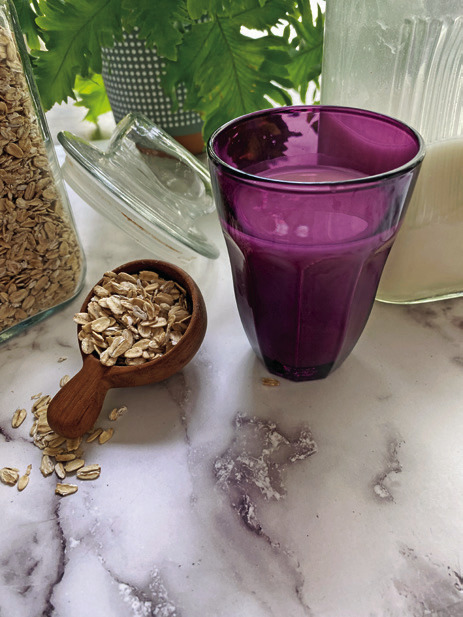
I must admit, I kind of agreed with the naysayers who claimed the term “milk” should not be used to describe a beverage that is derived from plants. Nut milks like cashew and almond, oat milk, and soy milk are only a few of the many varieties that have gained popularity of late.
The markets have endless varieties of these milk-like beverages. I’ve decided to embrace the term, as I recall a plant when I was a kid that we used to see when we were out playing that had a milky substance which we simply called milk. It’s all in the marketing, and I can understand why the dairy industry doesn’t like it. But when folks are looking for options, be it due to a lactose intolerance, or for other health reasons, I’m happy to accept these plantbased varieties of milk.
Making plant-based milk at home is a super simple process, especially with the use of a good high-speed blender, or a fancy nut milk machine. From what my research shows, the special machine is not necessarily required to achieve optimum results.
If you are inclined, start with an oat milk for an easy, very inexpensive plant milk. The cleanest versions are simply made with filtered water and oats. That same theory applies to any of the nut milks. I haven’t taken on soy milk just yet but will most likely try it at some point.
Other than a high-speed blender, the only other supply needed is a fine strainer/sieve, a piece of cheesecloth, or a nut milk bag. Nut milk bags are inexpensive, starting at $4 or $5, and can be washed and used over and over. Any of these options will strain out solids that would keep the milk from being silky smooth.
I store the milk in a glass jar or container for up to a week. I prefer to make the milk in small batches, and I always shake it up good before serving, as a little powdery sediment is expected.
There are several big benefits to making plant milk at home. It is less expensive, and cleaner than most of the prepackaged ones. When I do purchase it premade, I read the labels carefully. Many times, there are added sugars and other ingredients. If you prefer flavored milks, that is easy to achieve too. You can get creative and make flavors you would like to add to coffee and tea, sweetened with maple syrup, date syrup, or coconut sugar. Vanilla is a popular flavor as well. And of course you can make sweetened chocolate milk with cocoa or cacao, and your favorite sweetener.
The milk can basically be used for anything you would use cow’s milk for. I use it for coffee, tea, cereal, smoothies, and I add it to mashed potatoes. I even sip on a cold glass of plant milk from time to time.
Adventures like this in the kitchen can be very rewarding, especially when they save money, and do not take a lot of resources to create. Enjoy food made fresh!
Natural Oat Milk
3 cups filtered water ½ cup organic whole rolled oats Optional: couple teaspoons date or maple syrup and a teaspoon vanilla extract Place water, oats, and any additions to a highspeed blender. Pulse 2 or 3 times, then blend on medium-high for about 30 seconds.
Pour the mixture into a nut milk bag, cheesecloth, or strainer/sieve over a bowl. Press out all the liquid, and if using a nut milk bag or cheesecloth, squeeze out as much liquid as you can ring out into the bowl. Discard any solids. Funnel the milk into a jar and cover with a lid. Chill in the fridge for up to 1 week. Shake to mix well before serving. Makes about 3 cups.
Angelina LaRue, author of “The Whole Enchilada: Fresh and Nutritious Southwestern Cuisine,” grew up at White River Lake, lives in Idalou and writes a weekly food column for local newspapers.
- Log in or Subscribe to post comments.
