

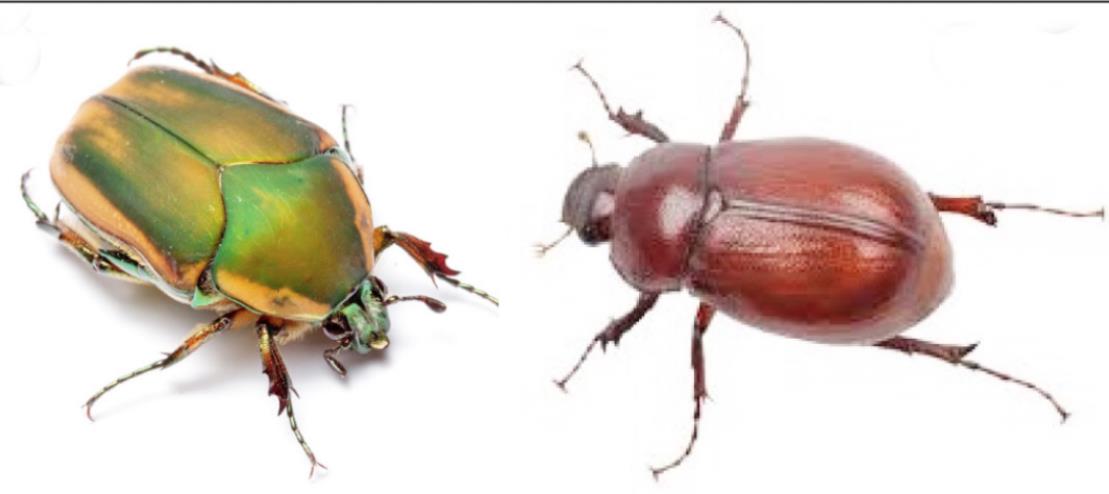
We love June, with warming days that call us to get in the garden. With the arrival of June also expect to see June bugs. But before the annoying small brown, hard-shelled June bugs appear come the grub, the immature stage of the adult June bug. While they are known as June bugs, they are actually beetles—and what’s more, they can be called either the May or June beetle. For us today, they’ll be June beetles.
Grubs are usually found a few inches down into the soil. They are pure white translucent immature insects with short little legs and a brown head, always curled up like the letter ‘j’.
The adult June beetle is a type of scarab beetle in the Scarabaeidae family. Scarab beetles have the shared characteristic of squatty, compact, hard bodies. Scarab beetles are insects that undergo complete metamorphosis as they complete their life cycle. The life cycle of all scarab beetles has four stages: egg, larva, pupa, and adult. The larval stage of scarab beetles is called a grub.
The June beetle has a two-to four-year lifecycle, so there could be multiple life stages in a garden or lawn at the same time. There might be the adult small brown, ½-inch June beetles clustering around the patio while grubs are busy chewing roots in gardens and lawns.
The adult June beetle feeds on leaves, but the grub causes the most damage because it feeds on root systems. Grub populations in gardens may be high enough to affect plant growth but their feeding on turfgrass root systems causes the most serious damage.
High grub populations prune roots of turfgrass causing large brown patches of dead or dying grass, progressing to areas becoming spongy. Grub damage will be evident from May into late summer. Signs of grub infestations will be the presence of birds scratching the soil as they seek larvae.
Sample suspected areas for grub density by digging a one square foot section of soil of the affected areas. If grass comes up easily, grubs are the likely culprits. Examine the soil and inspect the root system. Grubs will be close to the root/soil interface. The grub density threshold to consider treating the affected area is generally 10 to 12 grubs per square foot. If chemical treatments are considered always follow manufacturer’s instructions.
Some information from Grounds maintenance magazine; scarabaeidae.com
- Log in or Subscribe to post comments.
