The first and only time I met Aaron Latham was on the day he was buried.
I wish I had known him in life. The only way I came to understand anything about the famous writer and Spur native—other than the ubiquitous epithet “screenwriter of ‘Urban Cowboy’”—was at second hand. But that turned out not a bad way to get acquainted with a dead man, after all.
At Latham’s graveside funeral in Spur last Thursday his widow, the acclaimed broadcast journalist Lesley Stahl, took charge of remarks. She was no stranger to the town, she said, having visited periodically with her husband of four and a half decades though they’d met and lived on the East Coast.
She was no stranger to the Spur cemetery, either, as both of Latham’s parents are buried there. Annie Launa Cozby Latham, a schooteacher and writer of children’s books, died in 1992. Clyde, a football coach who was born in Spur and coached the Bulldogs for a few years, died in 2003 after marrying again at age 84.
The group of mourners was small and close but welcomed a clutch of locals who had come to honor a Spur luminary. We stood as Lesley Stahl sat under the canvas canopy and talked with her family about her departed husband.
She shuffled papers, adjusted her sunglasses, and began with a quote. “Life is an act of courage,” she said, and indeed, Aaron Latham’s later years, marred by Parkinson’s disease, represented a courageous determination to meet debilitating symptoms and carry on.
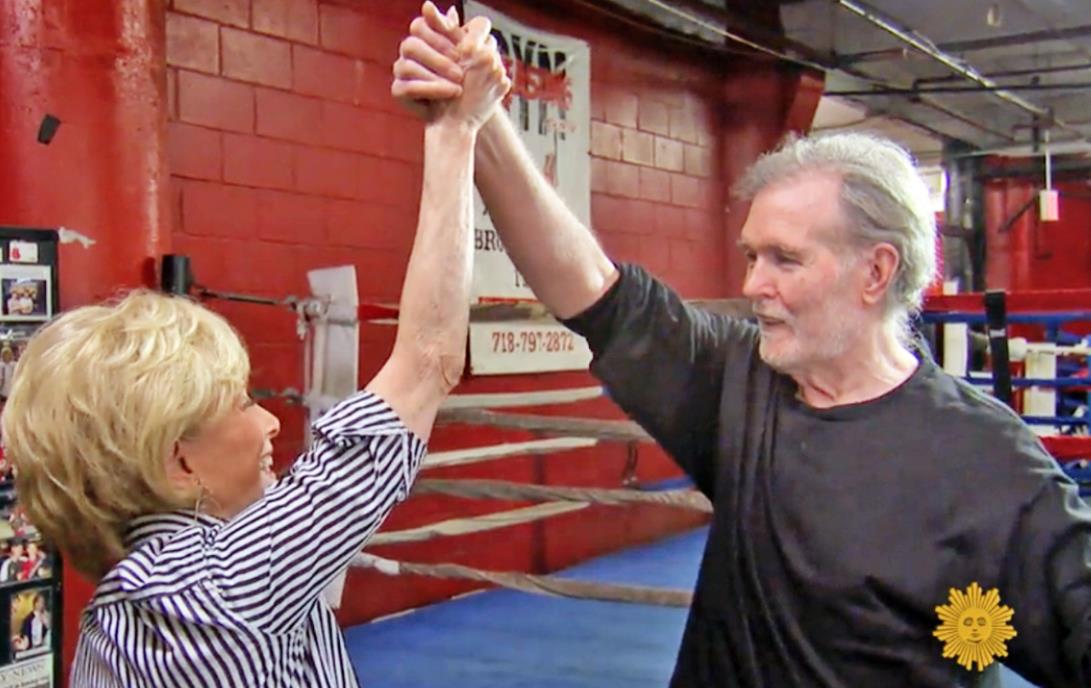
He’d taken up boxing as therapy. His red gloves, she said, made him bigger, even as Parkinson’s shrank his proud handwriting down to nearly nothing. I tried to imagine what it would be like for a six-four Texan in Stetson and cowboy boots to deal with such a decline.
Stahl read a bit from a 2015 broadcast interview she’d done with him, about the disease and the groundbreaking physical therapy that involved boxing.
In the piece, Latham had described Parkinson’s as “the incredible shrinking disease. Not that PD itself is shrinking. Rather, it shrinks its victims. . . . Your body seems to shrink because you slouch and stoop,” he’d told his wife. (He’d admitted to being nervous, interviewed on camera by her.)
Stahl read from her pages, quoting him. “Your voice gets softer and softer until people can’t hear you. (Just ask my wife.) All of which seems to marginalize you. Eventually people don’t seem to be able to see you. You’re invisible.”
Boxing, he’d said, “is just the opposite. It makes you bigger. Literally bigger because boxing gloves give you the hands of a giant. Boxing gloves make you visible once again.”
Family members offered up their tributes and fond memories: an almost-sidelined girls’ basketball team that Latham, knowing nothing about coaching the sport, led to undefeated seasons; boating excursions off Nantucket with family; SCUBA certification alongside daughter Taylor at 12; a late-night pizza order and TV football that broke the ice with the son-in-law.
The idea to play the “Urban Cowboy” soundtrack for Latham during his dying hours in the hospital had been Taylor’s.
The Spur locals shared their words too. The librarian who’d admired his novels, proudly displayed on the Local Authors shelf; the newspaper publisher who recalled the recent “Urban Cowboy” anniversary showing at Spur’s theater; the retired park ranger who’d known Latham’s father. It was as though the quartet of us who’d been moved to bring our condolences instead received the benison: on this quiet morning, in an intimate setting, we were given the blessing of glimpses into a fine mind, into the life of a family man now freed from the diminshment of disease.
Stahl took pride in Latham’s literary accomplishments, commenting that his outstanding talent was often overshadowed in the public by her more visible fame.
She recalled on one previous trip to West Texas dropping into a local bookstore where his works weren’t readily in evidence. Where were Aaron Latham’s books? she’d asked a flustered clerk. The woman quickly retrieved copies—which rather than consigned to the Local Authors table had been spread widely among fiction, nonfiction, Texas, subject areas.
Stahl thanked her. And in return the clerk assured her, “Anything for you! I’m such a huge fan of yours, Ms. Sawyer.”
On this trip the family wanted only one other thing after the burial, they said. Where was that Dairy Queen they recalled from earlier visits? (It had been a touchstone for Latham’s father, though they didn’t mention this outright; anyone who’s read his 1997 “The Ballad of Gussie and Clyde” will know why.)
The Dairy Queen’s gone, sad to say. It burned to the ground a few years back.
When Stahl and her family stopped by The Texas Spur office shortly after the service to visit the theater and to pick up a handful of newspapers with the obituary, I knew I would have to face up to my own “Ms. Sawyer” moment.
I’d already discovered a mistake—only three little letters, but my big mistake—in the article.
I had to confess.
“Ms. Stahl,” I said, “All the information about Aaron Latham is right . . . but here in this sentence about you I typed NBC instead of CBS.” I had to explain to one of the most distinguished journalists of our time that I’d been on the phone with NBC News to request a photo for our story at the same time I was copyediting the obit. That error would persist in black and white in every copy of the printed edition they clipped out for their scrapbooks or shared with friends back home. Forever.
“It happens,” she said with grace. “And after all, I did start out at NBC.”
But what she said next helped me feel a little closer to the writer to whom we’d all bid farewell that morning. The Spur writer I never got to know. The writer who lay in his boots and Stetson in the sleek black casket.
“Did you know Aaron started as an obit writer at the Washington Post?” she asked. I should’ve realized he’d been a rookie once, of course, before the Watergate days when he’d met Stahl, before the Esquire assignment that had become “Urban Cowboy,” before the many stories and novels and screenplays.
She told me he’d once run a notice in which he confused the names of the murderer and his victim.
I could breathe again. A little.
We handed over the bag of newspapers and saw the group out to their Suburban, directing them where to find the next Dairy Queen on their route to the airport.
Latham’s granddaughter Jordan put it best, though. The eleven-year-old didn’t know her grandfather well before his health declined, she said tearfully. But hearing people talk about all those books and stories gave her assurance she would always be able to know him better.
As we all will.
John Aaron Latham was born in Spur, Texas, October 3, 1943. He died in the hospital at Bryn Mawr, Pa., July 23, 2022 and was buried in Spur beside his parents July 28, 2022. In addition to the Esquire article that inspired the movie “Urban Cowboy, he co-wrote the filmscript with director James Bridges and also co-wrote the book for the 2003 Broadway musical version. A graduate of Amherst College and a PhD graduate of Princeton University, he published “Crazy Sundays: F. Scott Fitzgerald in Hollywood” (1971) based on his dissertation.
His other book-length works include “Orchids for Mother: A Novel” (1977), “Urban Cowboy: A Novel” (1979), “Texas Blood” (1980), “Perfect Pieces” (1987), “The Frozen Leopard: Hunting My Dark Heart in Africa” (1991), “The Ballad of Gussie & Clyde: A True Story of True Love” (1997), “Code of the West” (2001), “The Cowboy with the Tiffany Gun” (2004) and “Riding with John Wayne” (2006).
Screenplay credits include “Urban Cowboy” (1980), “The Program” (1993) and “Perfect” (1985).
- Log in or Subscribe to post comments.