

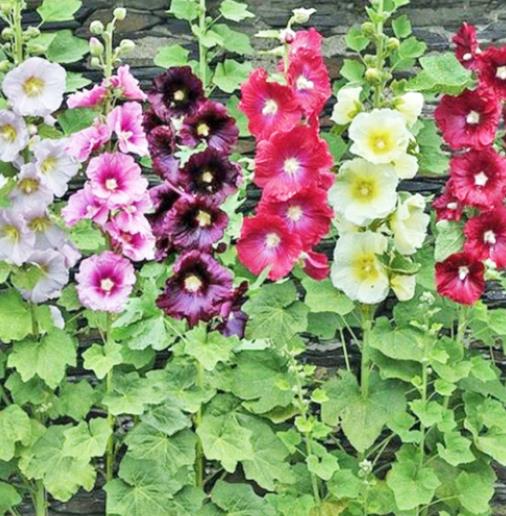
Hollyhocks seem to announce, “summer is here.” They bloom in the heat of the summer, and blossoms on the erect stalks brighten any garden. Enjoy hollyhocks while they are here, because once their bright blossoms are spent, they are gone for the season.
The growth pattern of a hollyhock is that of a “hardy biennial perennial.” Conflicting patterns? Well, yes and no. Biennials require two seasons to shift from the vegetative to reproductive stage and bloom; after a biennial flowers, the foliage dies back. Perennials, however, persist for many years after flowering. The puzzle of assigning a growth pattern to hollyhocks comes because they reseed copiously, giving the appearance of a perennial nature because they reappear in the garden year after year in the same spot. So, the accurate answer to the question of growth habit is, hollyhocks are biennials.
Year one of a hollyhock is the vegetative phase; the lowg-rowing foliage has broad, scalloped-shaped leaves that die back in winter. In the spring, when the hollyhock has shifted into its reproductive phase, a tall, erect seed stalk covered with multiple flower buds bolts upright. Funnel-shaped blossoms can be white, yellow, creamy, pink, rose, purple or almost black in color. The floral display lasts for over a month as the bottommost buds open first and blossoms progressively open toward the top.
Hollyhocks are member of the family Malvaceae, the marsh mallow family. The scientific name of hollyhock is Alcea rosea. Alcea (al-KEE-ah) is from the Greek for a kind of mallow, and rosea (ro-SEE-ah), Greek for rose-colored. Other well-known members of this family are hibiscus, okra, and cotton. All have the distinctive, showy, large blossoms.
The true marsh mallow plant, Althea officinalis, in Greek means to heal; it was called “the official healer” or the healing touch plant because it was ingested to soothe irritated tissues but was also applied topically to the skin. Roots of some Malvaceaes have been boiled and their liquidy syrup beaten to a froth and sugar added. The finished product resembles whipped cream, which is formed into balls (wildflowers-and-weeds.com).
For a continuous display of hollyhocks in bloom in the garden, allow plants to reseed either from volunteers or from self-harvested seed from mature flower stalks. Seed sown in the summer months will germinate, establish in the autumn and be of sufficient size to bloom the following summer.
- Log in or Subscribe to post comments.
