
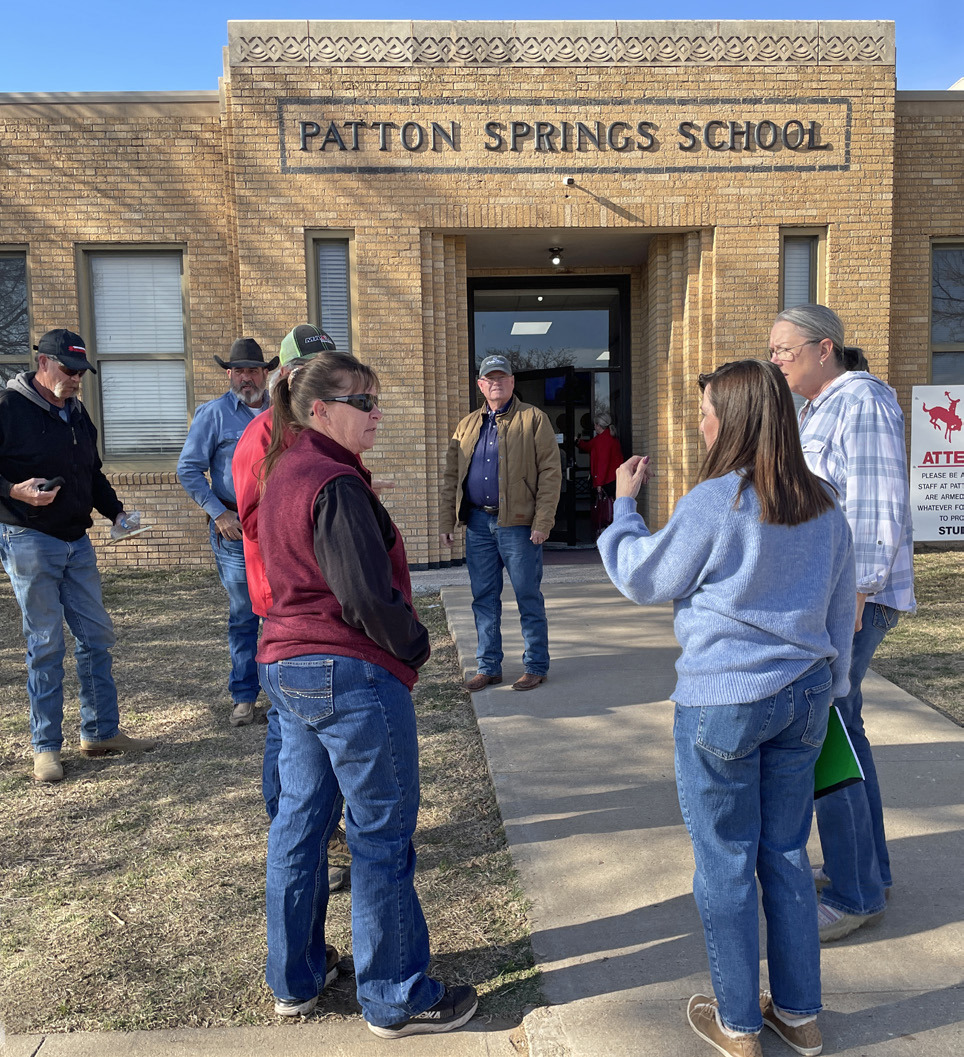
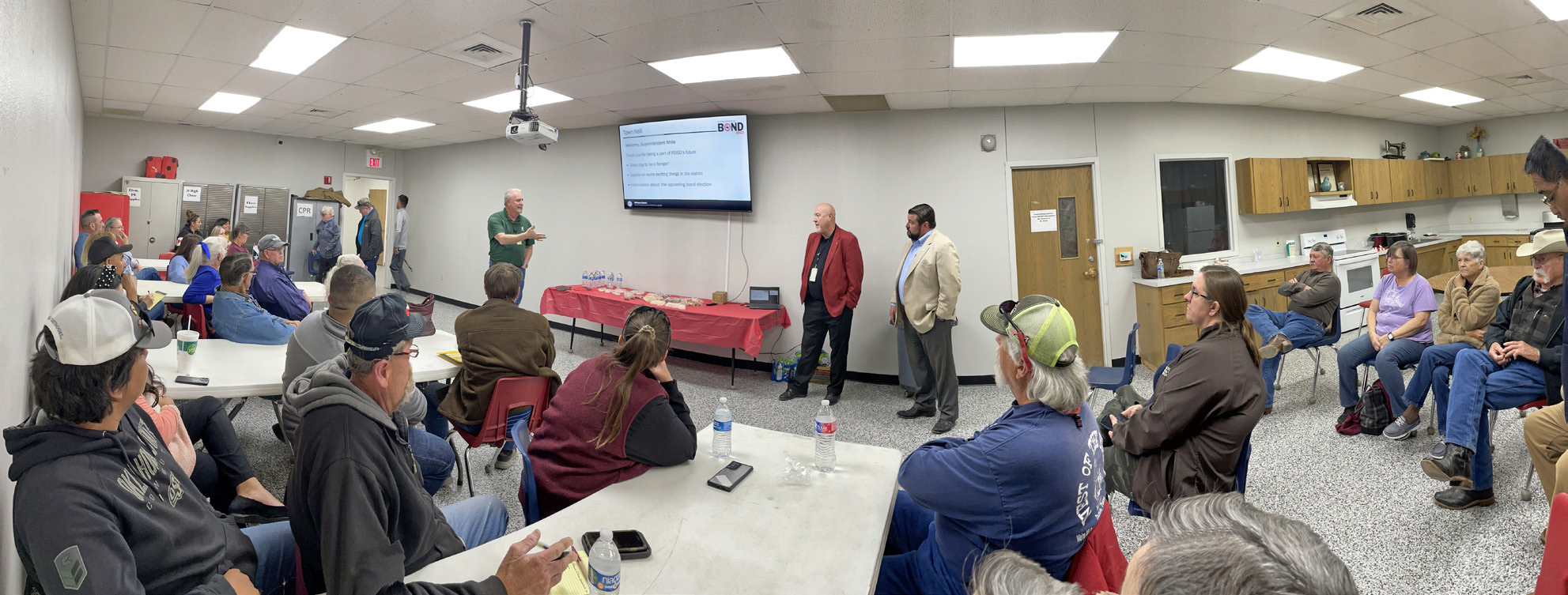
A capacity crowd packed into the conference room at Patton Springs School last Tuesday night to hear a presentation on the district’s plan to raise more than $9 million in bonds for safety, security, and expansion of classrooms, teacher housing, and land acqusition that could sustain its future. In a rural district with a total enrollment of 80 students and a base of approximately 220 taxpayers, questions focused on how tiny Patton Springs could responsibly take on significant debt— and benefit sufficiently for it.
As consultant John Blackburn, managing director at Live Oak Public Finance, put it in his opening remarks, the arrival of cryptocurrency mining and solar energy development in the district poses a unique opportunity. Across the dry, scrubby rangelands between Afton and McAdoo in northern Dickens County, where the Patton Springs schoolhouse is one of the few public buildings on the map, “it’s the first time in forever we have some tax base to work with,” he said.
That base has already yielded an increase in its first year, Blackburn said, with $17 million in taxable value recently certified from Argo Blockchain’s Helios crypto mining plant. Although Argo sold the Helios assets to financial backer Galaxy Digital on Dec. 28 to avoid bankruptcy after the crypto market took a downturn in 2022, Galaxy appears to have brought even bigger financial muscle into the equation. A few years out is also the HE Cottonwood Solar development, which has secured a Section 313 payment-in-lieu of-taxes arrangement in Dickens County and whose valuation, if it grows, will further boost the district’s tax base. That project, said Blackburn, would be the “icing on the cake when it shows up.”
Blackburn, along with Patton Springs superintendent Bryan White and guest Todd Wilson, a retired superintendet from Chillicothe now serving as interim at Throckmorton, fielded numerous questions about the increases local taxpayers could expect to see in their bills, the risks if the Galaxy or Cottonwood projects were to fail, and the actual needs for improvements to Patton’s facilities.
White explained that a major component of the physical plant construction would bring existing classrooms and other spaces under one roof with a single point of entry for security purposes, while also expanding to provide private areas for testing, a STEM Center, a music room, storm shelter space, PE Storage and a PE multipurpose
Parent and taxpayer Ronda Dalton asked whether security measures were likely to be mandated at some point in the near future anyway—without accompanying funding. Such mandates are already being discussed at the state level, said Blackburn.
White further said that the bond sales would proceed in increments—“We wouldn’t sell all the bonds at once,” he said, but would take on indebtedness gradually and only as backed by certified values.
Teacher housing, White said, would provide a key recruitment tool for the district. As Wilson explained, in small rural districts like the ones he’s served, “We’re struggling to get teachers to even talk with us.”
But what ultimately seemed to click was the observation that if the worst were to happen for Patton Springs—that lacking amenities and sufficient enrollment, down the road it would be forced to consolidate with another district— any of those neighboring districts would surely jump at the chance to pursue a bond measure based on the northern Dickens property values. And were that to happen, area taxpayer’s rates would be even higher.
“The (Patton Springs) board and administration consider the timing to be optimal set of circumstances to call the bond to be considered,” Blackburn said to the audience. “If it wasn’t for a property tax boost from the outside, you wouldn’t be having this opportunity.”
Wilson added, “Do we invest in longevity, or do we just say, let it ride?”
Patton Springs, in summary, has the chance “to get the outside investors to foot the bill for your expenses,” said Blackburn. “If you don’t support the bond, it’s opportnuity lost.” The outside investors, he said, would make the lion’s share of the payments on the bond — some 40%—while the district would take “as conservative an approach to this as we possibly can.”
Early voting begins April 24, at the Patton Springs School. Residents have until April 7 to register to vote, if they have not already done so; this includes those who will turn 18 before the May 6 election day.
And if the vote doesn’t come out in favor of the bond propositions?
That tax revenue from the district’s corporate players would be pooled statewide rather than staying local, said Blackburn.
Of course, Patton Springs could always approach those same industries for donations, down the road, he added. “They may build you a scoreboard.”
Earlyvoting begins April 24, at the Patton Springs School.
Residents have until April 7 to register to vote, if they have not already done so; this includes those who will turn 18 before the May 6 election day
- Log in or Subscribe to post comments.
