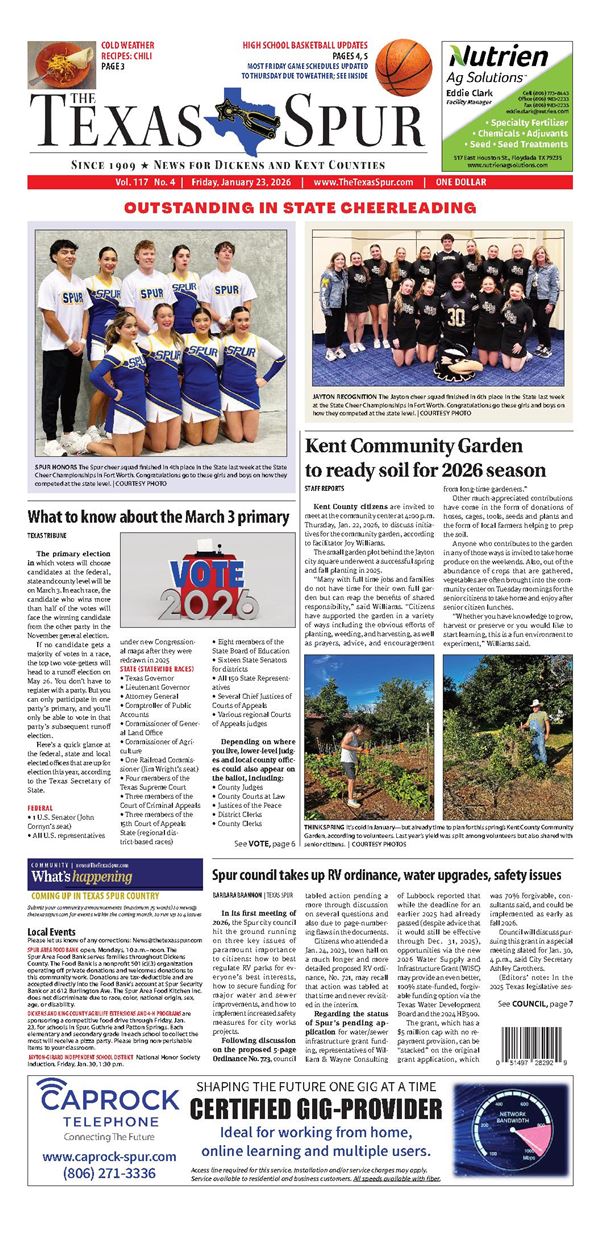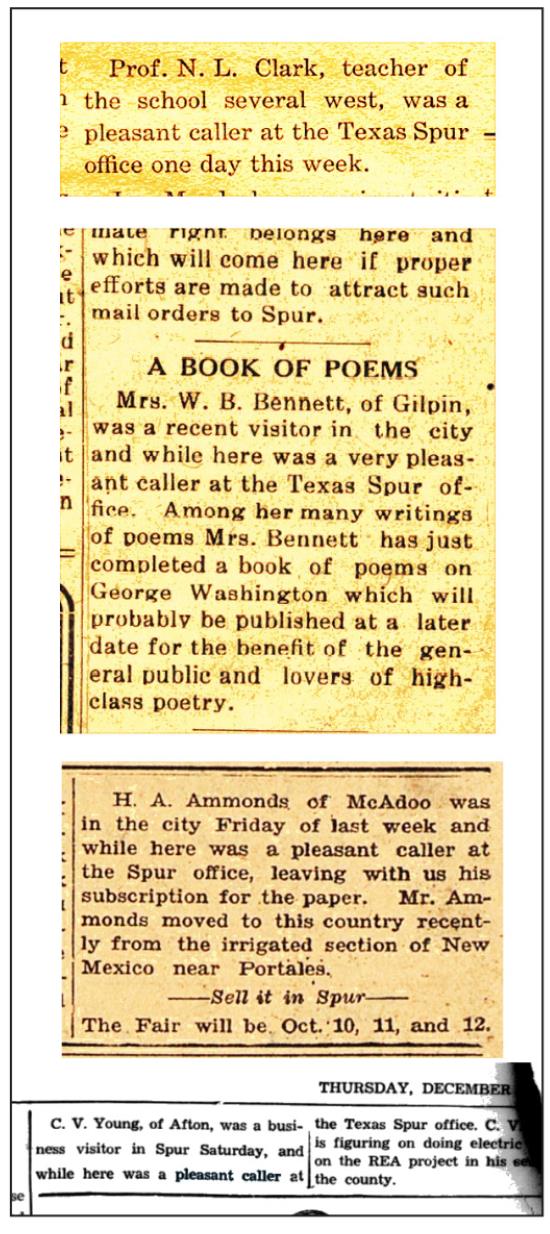

Back in the day, when this West Texas weekly was young and this 64-year-old editor’s parents were not yet a glimmer in their own parents’ eyes, dropping in at the newspaper office was the most common way to share news of any sort.
Allow your imagination to drift into the past.
It is 1910—only a few weeks after Spur’s founding—and a pot-bellied stove warms the backshop where a linotypist bangs out slugs of lead bearing the raised forms of letters. Lots of letters. For in that decade, it wasn’t unusual to crank out a couple thousand words per newspaper page, in a 6- or 8-page paper.
In the midst of that tsunami of typesetting, a bell tinkles to signal the front door opening. A horse has been tied up at the hitchin’ post outside. The linotypist—who is, most likely, the editor himself, pauses and goes to learn what’s transpired on the streets of town.
A new business enterprise launched? A train arrived with a new shipment of lumber? A wedding engagement announced? A tragic accident with a mule and wagon? A record-breaking fish caught in the pond? A picnic planned in the park? A gold watch found, with its owner sought?
All these things, and many, many, more, did happen on any given day. And the editor learned of them in person.
No phone, no radio, no email, and heavens, no Twitter or WhatsApp. Just a man or woman walking in with word of mouth. (Or, yes, sometimes a telegram, which still had to be decoded and copied out after receipt, and delivered by hand.)
Even when the armistice was signed ending the Great War November 11, 1918, word reached Spur at 8 a.m. via Mayor Clifford B. Jones, who relayed it personally to newspaper and town.
“Upon the arrival of the news in Spur guns were fired, whistles blown and general celebration was indulged in by the populace,” reads the special edition hastily printed that morning—in time to inform everyone of a public program “on the streets” arranged for the same afternoon.
Whatever the word on the street back then, it was filtered through fast fingers into the linotype and reproduced onto newsprint, then rolled and flung onto doorsteps the next Friday morning. (An aside: publication day didn’t change to Thursdays until the advent of newspaper delivery by the U.S. Mail’s Rural Free Delivery, which tacked on an extra day for preparation.)
Other visitors brought in their books, their children or cousins or aunts and uncles, their advertisements, subscription renewals, and payments— always welcome—or came to buy office supplies.
The brass bell rang often.
Such everyday transactions even made their way onto newsprint pages in paragraph that might begin, “Mr. Joe Smith of Crosbyton was a pleasant caller at the newspaper office today.” Subscribers were thanked by name. Society and family events were shared as freely as on Facebook today.
Many of these same sorts of transactions still happen today, in the small-town newspaper office when the “Open” sign is facing outward.
Our pleasant callers already during the brief days of this new year have included a police chief, a customer with a cash payment, a genealogy researcher, an advertising salesman, a newcomer seeking employment, a FedEx deliveryman (who also makes the excuse to visit with the office cats), a complainer with a missing paper, a customer needing back issues, a family member delivering a piece of furniture, a visitor to the park across the street, a purchaser of the Caprock Courier, a repairman, and a dozen candidates for elected office.
In the 21st century electronic communication makes it possible for journalists to receive communications almost anywhere, and these days that means staff aren’t physically in the office as readily as before.
If you have news or an inquiry these days, we’d greatly prefer for you to reach out to us via email (spur@thetexasspur.com). Telephone is fine too (806-271-3381); please leave a detailed message if we don’t pick up right away.
We’re not keen on text message or messenger apps, as these cause our phones to ping even in the middle of a few hours’ sleep and they often look like spam — but if you have an emergency news tip, we’ll understand. Please include your name in case our phones don’t recognize you.
We do still appreciate pleasant callers and are glad that our newspaper office is a place for the exchange of greetings, ideas and news. Bear with us if we’re scrambling on deadline; and if you need to sit down and visit for a bit, calling ahead for an appointment is a good idea.
There isn’t a brass bell anymore, so just be sure to holler when you come in the door.
- Log in or Subscribe to post comments.