
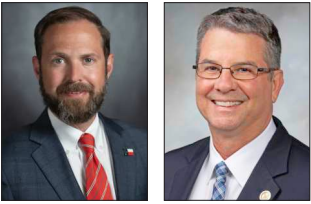
The Texas Legislature will convene for its 2023 session in just a few weeks, and lawmakers expect another busy 140 days that should include movement on a handful of issues important to rural Texans, including continued broadband access and school safety.
The 88th legislative session is scheduled to begin Jan. 10. Per the state constitution, lawmakers meet in odd-numbered years with one primary mandate: crafting a balanced budget for the next biennium. However, other matters will compete for attention following November elections that saw Republicans maintain control of state government.
“We have a budget surplus of $28 billion the last time I checked,” state Rep. Dustin Burrows, RLubbock, said. “We can’t spend it all, and that’s a good thing. We have some constraints in place, but I see an opportunity to make a significant investment in lowering property taxes and a significant investment in infrastructure, including transportation.” In addition to the budget surplus, the state has approximately $19 billion in the so-called rainy-day fund. The additional money gives lawmakers additional flexibility in putting
Burrows has represented District 83 since 2015 and played a key role in legislation crafted in 2019 that provided property tax relief. He said legislators have another opportunity to provide additional relief in this session.
“What I anticipate is part of the surplus being invested in buying down property tax liability,” he said. “There are a couple of ways we can do that. We need to remember it is the people’s money.”
State Sen. Charles Perry, R-Lubbock, agreed that property tax relief has been a hot topic, but he said it is difficult to deliver actual relief to taxpayers.
“We spent $5 billion in the last session to buy down the rate, but with appraisals and growth, we didn’t get the relief we had hoped it would provide,” he said. “One thing we know that gives relief is the homestead, and by increasing that, that’s one way. The homestead is the most politically smart way to deliver real relief to individual homeowners.”
Likewise, Perry said the state must address infrastructure issues, including the power grid that was the source of controversy following a winter storm that led to a massive power outage in February 2021. Legislators addressed the grid during their 2021 session, but some suggest more could have been done.
“We need to jump back on the path to fix the grid, and we have a long way to go,” he said. “The grid affects everyone. This session for me is about infrastructure, infrastructure and infrastructure.”
Perry said he plans to file a bill to address the state’s power grid and one to address water usage. He said leaky pipes across the state cost Texas to lose some 150 billion of gallons of water each year. He wants to leverage state dollars and incentivize conservation.
For Burrows, school safety continues to remain a priority, particularly in the aftermath of a mass shooting at a Uvalde elementary school last May. Burrows served as the chairman of the House Committee that investigated the tragedy.
“We will continue to look at school safety,” he said, “and the state will continue to make an investment in schools in terms of trying to make sure they have better safeguards in place. That is a huge priority for me and for my colleagues.”
The 2021 session also saw lawmakers move to make statewide broadband access a priority. Both Burrows and Perry expect that commitment to continue in 2023.
“Rural Texas broadband is critical in today’s world or Texas won’t be able to compete on a global level,” Perry said. “This is a huge rural initiative with long-term impact.”
“We need to make sure we are investing in our rural health care infrastructure and rural connectivity in terms of broadband access,” Burrows said. “We learned some things from Covid-19 that should be helpful to rural Texas. We need to continue finding ways to expand telehealth and telemedicine so that every one has access. That’s very important.”
Burrows credited Gov. Greg Abbott for his leadership throughout the pandemic, which helped the state’s economy retain its vitality, something he expects to continue in the short and long term.
“We are going to have this great re-shoring of manufacturing coming back to the United States,” he said. “We saw supply chain disruptions and we found our national security was not okay relying on other countries to produce chips and pharmaceuticals. We’re going to see those come back over, and we want to see investment in those opportunities as they come to Texas and rural Texas. We want Texas to compete for those – especially this side of Texas.”
Finally, Perry expects to see progress on the higher education funding front. While there have been regular conversations about the Permanent University Fund (PUF) benefiting only the Texas and Texas A&M Systems, West Texas lawmakers want to see something similar for the Texas
“We are going to have a significant research program for non-PUF schools when we leave here,” Perry said. “It is politically charged, but we will leave here with research higher education looking different and better.”
The 2023 legislative session is scheduled to end
May 29.
- Log in or Subscribe to post comments.
