

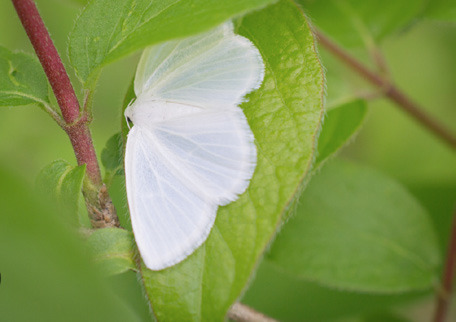
Gardeners get excited
when the first butterflies make visits. But soon after these small, white or creamy-colored butterflies leave the garden, there are small holes in our spring crops. They flit around seeking a Brassica on which they can lay their eggs.
Favorite spring crops are in the Brassicaceae family, formerly the Cruciferae family. The Brassicaceae family is the cabbage family that includes arugula, red and green head cabbages, Napa cabbages, Asian greens, bok choy, kale, collards, broccoli, cauliflower, radishes, turnips, mustard and kohlrabi.
Brassicas are all related and are all susceptible to the same pests. Several butterflies and moths feed on Brassicas as host plants. One of the most common butterfly that feeds on Brassicas is the Cabbage White; the most common moth that feeds on Brassicas is the Diamondback moth.
At first glance it is tricky to distinguish a moth from a butterfly since they are both winged and both members of the Order Lepidoptera. However, they are quite different. Most moths are nocturnal, while butterflies have a diurnal habit, being active during the day.
Both seek Brassicas on which to lay their eggs. As eggs hatch the ravenous larva seek tender foliage to devour. Holes will appear and enlarge and eventually if undeterred, will consume leaf blades, leaving only the tough midribs and eventually skeletonize the entire plant.
Know that these pests will find your Brassicas. Here are some battle strategies.
Row covers. Young plants can be protected with row covers that are spread before seedlings emerge. Keeping plants covered with the thin fabric prevents the adults laying eggs on the foliage. The adults are clever, however, so the entire growing area must be secured with no entry.
Companionplanting. Mixing strongly scented flowers or herbs like marigolds or basil may deter the adults from infesting the preferred host crop.
Trap crops. Some varieties of kale is preferred over others. For instance, Red Russian kale seems to attract pests, while Lacinto or Dinosaur kale growing right next to it is unharmed.
Be vigilant. Keeping close watch can be the best prevention. Daily inspection on the undersides of leaves can detect egg masses. A keen eye can detect small pin openings and when turning leaves over will find tiny worms. Both of these insect stages can be easily taken care of with just a paper towel smashing them.
Ellen Peffley Harp, a retired professor of horticulture at Texas Tech University, writes about gardening for several Texas newspapers.
- Log in or Subscribe to post comments.
