

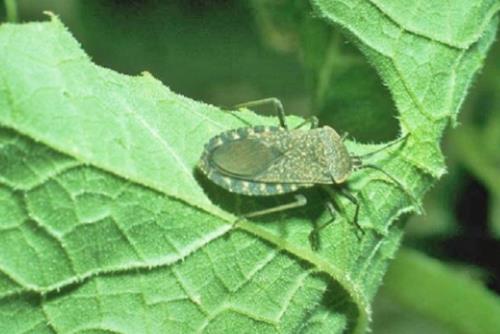
By mid-July squash is really growing, which makes it time to look for dreadful squash bugs. Squash bugs multiply quickly, and
The first sign of an infestation of squash bugs might be a leaf that suddenly wilts. Give a long, concentrated look at the base of the stems to see if there is movement—the adult squash bug is stealthy and tends to hide as it feeds on the undersides of stems of leaves. These bugs move about at the base of the stems; this is where you will find adults.
Inspect tops and bottoms of every leaf and every stem frequently. The telltale signs of an infestation are perfectly arranged clusters of eggs, tiny bronze-colored shiny spheres. Adult females usually lay dozens of eggs in a cluster. Most often eggs are on the undersides of leaves, occasionally on tops of the leaves and along the stems. Eggs will be laid in the interveinal portion of a leaf blade, giving nymphs hatching from the eggs a source of sugar on which to feed. Infestations are easiest to eradicate at the egg stage: flip clusters into a jar filled with water or cut off the portion of infested leaves. Crush the eggs and immediately discard.
If eggs are allowed to mature, within a week or two scores of nymphs will emerge from the hatched eggs. Nymphs are light gray with black legs; they are highly mobile, moving around quickly as they head toward the base of the stems. They start to feed immediately. Nymphs mature to the adult stage in four to six weeks.
Nymphs and adults inject a toxin at the same time they are sucking sugars out of the leaves. The feeding area begins to yellow and leaves wilt because nutrient flow to the leaves is restricted. Leaves will dry, then turn black and brittle. Squash bugs feed on plants but will also feed on the fruit.
How squash bugs know there are squash plants around is a mystery. Insects are drawn to the unique volatile organic compounds (VOCs) emitted by tops and roots of plants. Olfactory organs of humans are far less sensitive than insects but ruffle leaves of a squash and smell the characteristic odor that is released—these are the VOCs, a footprint to which a squash bug will be attracted.
- Log in or Subscribe to post comments.
