

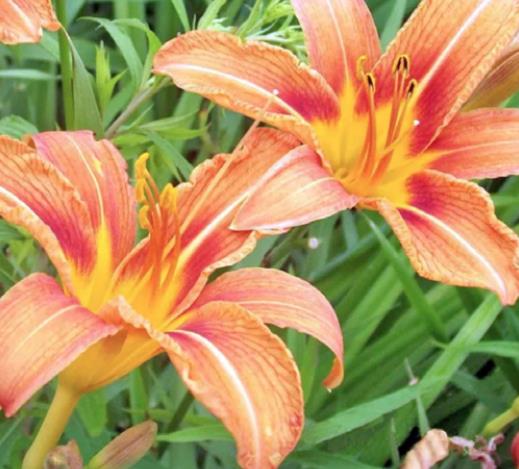
If the daylilies in the garden have had fewer blooms and not are not as robust as in the past, it is probably time to separate them. Daylilies will spread and become crowded over time. September is a good month to divide clumps of daylilies. To keep daylilies flowering, thin the clumps need to be thinned. End of September is ideal for dividing the clumps as there still is time for root systems to become established before winter.
The daylily is a perennial, flowering herbaceous plant, but while it is called a lily, it is not a true lily (family Liliaceae), rather it is in the family Hemerocallidaceae. It is called a daylily because of its lily-shaped, trumpet flower and because individual daylily flowers last one day.
The daylily is one of the many species in the genus Hemerocallis. The generic name Hemerocallis is a derivative of the Greek words for day and beauty, and so is a descriptive name, for a that lasts for only one day, opening when the sun rises and withering as the sun sets. Subsequent flowers on the same flower stalk open the next day.
Daylilies have a clumping growth habit and are best in the landscape in borders and when massed. As a monocot, the leaves are linear, dark green, smooth margins; leaves grow to a length of 1 to 2 feet depending upon variety and are thin, ½ inch to 1 inch wide. They are herbaceous perennials and will die back following a freeze.
Daylilies are an excellent choice for xeriphytic landscapes as they can survive with little water. Their fleshy roots become almost rhizomatous. There are no serious pests or diseases.
Divide clumps in the fall, giving the newly divided clump time to recover and establish a root system before a freeze. They are easy to divide following this strategy:
Dig clumps with a garden fork. Place the fork under the clump, gently push the fork up to lift the numerous fleshy roots still attached to the crown of the plant. Knock off as much soil as possible. Spread clumps on concrete, douse with water to remove residual soil. Gently tease apart the entangled roots of the clump.
Cut tops back into a single fan of leaves. New plants can be started with just one root. Spread roots into a prepared hole and backfill with soil.
- Log in or Subscribe to post comments.
