

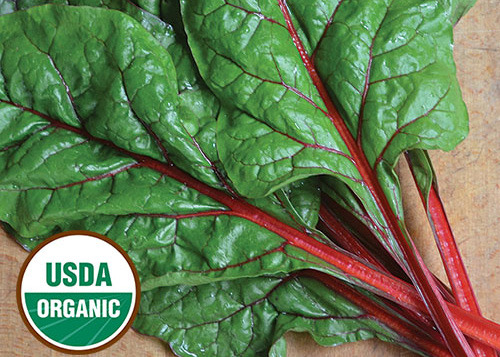
Swiss chard is one of the few greens crops that are classed as cool season and can survive summer months as a warm season crop. Chard is a sister to the garden beet. Both are in the Chenopodiaceae family and share the scientific name Beta vulgaris, although chard has the added variety, Beta vulgaris var. cicla.
The above-ground portion of chard and beets is very similar. The leafy greens of chard are quite a bit larger than those of beet. The difference between chard and beets is that only the leaves of chard are the edible portion, while both the tops and roots of beets are edible. The most usual consumed portion of beets are the swollen roots, but the tops are also edible.
The tops of chard emerge from a rosette; the large leaves are dark green, crinkly, with pronounced, crunchy midribs. The pronounced midribs are a main feature and qualify chard for use in an ornamental garden and as a striking decorative planting in a container.
Seed catalogs have Swiss chard in their inventory of vegetables. Gardeners can plant several varieties to achieve drama in the flowerbed.
Varieties: An old standard is ‘Fordhook Giant’. It has heavy crinkled, dark green leaves with broad, thick white midribs. Leaves reach two feet in height.
Another old standard is ‘Lucullus’. It, too, has broad, thick, white or pale green midribs. Leaves are dark green and crumpled. It grows well in high temperatures.
‘Rhubarb’, as can be discerned from the variety name, has crinkly, dark green leaves with deep, crimson red, slightly flat midribs. Leaves reach two feet in height. The red midribs of ‘Rhubarb’ Swiss chard juxtapose nicely with ‘Fordhook’ and ‘Lucellus’ in an ornamental garden.
Some of the newer varieties have midribs of other colors. ‘Bright Lights’ was introduced in the late 1990’s and it is wildly successful. It is carried by most seed companies under various names; ‘Bright Lights’ was the first to be introduced with plants that have white, yellow, gold, orange, pink, red or striped midribs; ‘Rainbow’, midribs of several colors; ‘Neon Lights’, which, as the name indicates, has midribs with more intense coloration.
Seed can be sown before the last freeze up through early summer but growth will be slower in the warmer months. Plant in full sun for the deepest colored leaves and midribs.
Ellen Peffley Harp, a retired professor of horticulture at Texas Tech University, writes about gardening for several Texas newspapers.
- Log in or Subscribe to post comments.
