To judge by the prevalence of hats and boots in last Saturday night’s audience in Lubbock, along with the whoops and cheers when TV character Beth Dutton delivered one of her signature zingers in a brief screen clip, the locals were there to hear filmmaker Taylor Sheridan talk about two things. “Yellowstone” and the Four Sixes Ranch. And maybe not in that exact priority.
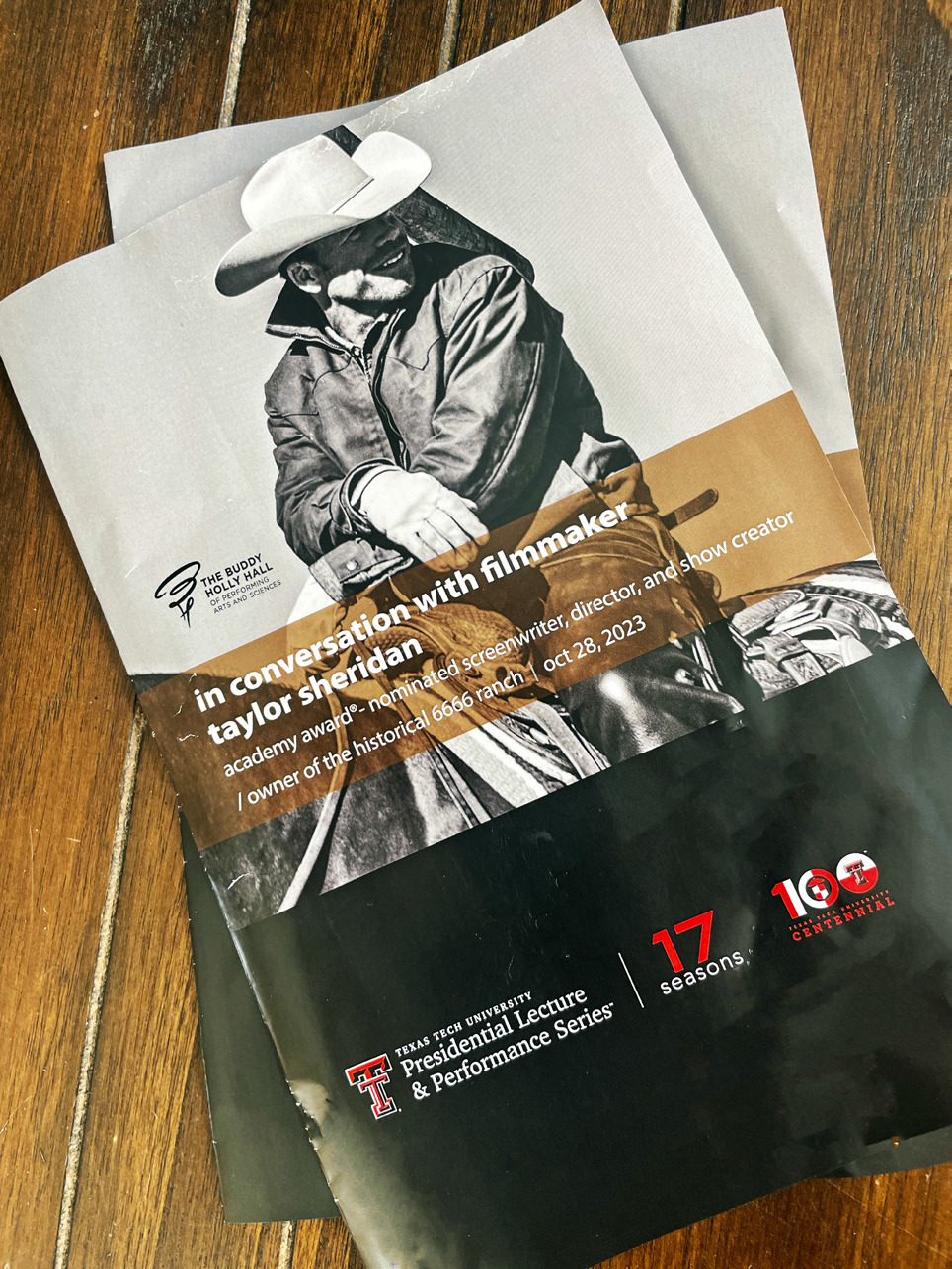
Sheridan’s appearance debuted the 17th season of the Presidential Lecture & Performance Series at Texas Tech University, which is celebrating its centennial in 2023. While the popular event series typically brings a range of writers, artists, public figures, scientists and thought leaders to the Tech campus, according to event administrator Dóri Bosnyák, this was the first time it had been slated for Lubbock’s 2,297-seat Buddy Holly Hall.
“For the Centennial year, we wanted a more recognized figure,” Bosnyák explained regarding the invitation for Sheridan to open the season. “But then it also came down to someone who could properly help us celebrate what it means to be a Texan.”
Sheridan—rancher, artist, filmmaker—checked all the boxes. In conversation with Tech’s director of Centennial coordination Blayne Beal, he ranged widely across observations about Hollywood, beef cattle, actors, music—and what it means to him to have lost the most meaningful place of his early life but gained one of the most storied ranches in the West.
Roots in West Texas ranching. “Ranching informed my life,” Sheridan explained. Born in 1970, he grew up in tiny Cranfills Gap, Texas (near Waco), on a family farm and ranch operation. “I never knew a neighbor, not one,” he said. While he expected he might be headed for a law enforcement career, the loss of the ranch after his parents’ divorce struck him hard and likely informed the reverence with which he regards land today. He also watched a slew of old Westerns on TV while recuperating from an illness in seventh grade—a formative experience in his role as a storyteller.
College didn’t stick, but TV acting did. “The only school in Texas I haven’t flunked out of was Tech,” he said with a grin. His break into the business was an advertising spot for Montgomery Ward in Chicago. Fifteen years later, with a regular spot on the FX network biker-gang series “Sons of Anarchy,” he grew disenchanted telling others’ stories, and quit to write his own.
Making “ Ye llowstone.”
Finding the right home for his “Yellowstone” script took a while. Even after Sheridan’s success with the Academy Award– nominated “Sicario” (2015) and “Hell or High Water” (2016), the fragmentation of network TV and the downturn in movie audiences made Sheridan’s vision for “Yellowstone” a risk, and a costly one.
Everybody passed on it until Paramount Pictures gave it a chance, Sheridan explained. The writer got his way, with on-location filming in Montana (and later in Texas), a cast led by Kevin Costner, and the right horses for the job. “If no one knows how to ride, or how to film cowboying, it won’t work,” said Sheridan, who cited Clint Eastwood as well as the “Lonesome Dove” miniseries as top influences on his style of Western.
Lots of Westerns fall short of Sheridan’s ideal, he said, if writers don’t get the details right. “You need to make it for the experts,” he advised, ensuring that working cowboys and cattle raisers recognize the nuances of their own lives right down to saddle and rope.
When film is done right, though, “at its highest level it can entertain, educate, enlighten,” he said. “The holy grail of three things.”
For Tech students in the audience—for whom Sheridan had also presented a master class in screenwriting during his visit—his observations distilled into one nugget of advice: “Every writer in Hollywood sits around wondering what the audience wants to see. You make the movie you would pay to go see.”
The filmmaker on characters. Each segment of Beal’s interview with Sheridan was preceded by brief big-screen vignette on the subtopic.
“How do you develop such nuanced characters?” the interviewer wanted to know following a montage of well-loved actors, including Sam Elliott, Helen Mirren and Harrison Ford, Sylvester Stallone, the aforementioned Kelly Reilly as Beth, and fellow Texan Barry Corbin, who with his wife was among the evening’s audience.
Sheridan, one booted ankle propped casually over a jeans-clad knee, cited Beth Dutton as an example. “Fear marked her from an early age,” he said, “and she’s determined to never be a victim again. That thing you always wish you’d thought to say when someone’s been rude to you in the drive-through, after you drive off? Beth says it.”
And when you stumble on a character you know is going to resonate, he said, you double down. Fans in the crowd appreciated that.
What comes first, character or plot? Beal asked.
“I don’t have a plot,” Sheridan shot back. “It’s all character. There is no plot.”
He proceeded to tell how he managed to sign both Helen Mirren and Harrison Ford (“Han Solo and the Queen. On a ranch” is how a 2022 Atlantic article put it) as the perfect matches for characters in “Yellowstone: 1923.” Vintage wines and a private jet figured in—along with the aid of Sheridan’s wife, Nic.
Place as character— and what a place. Sheridan nonetheless appreciates that many of his West Texas followers want to know what it’s like to own, live on, and film at the historic 6666 Ranch, which is headquartered in Guthrie, an hour and a half due east of Lubbock.
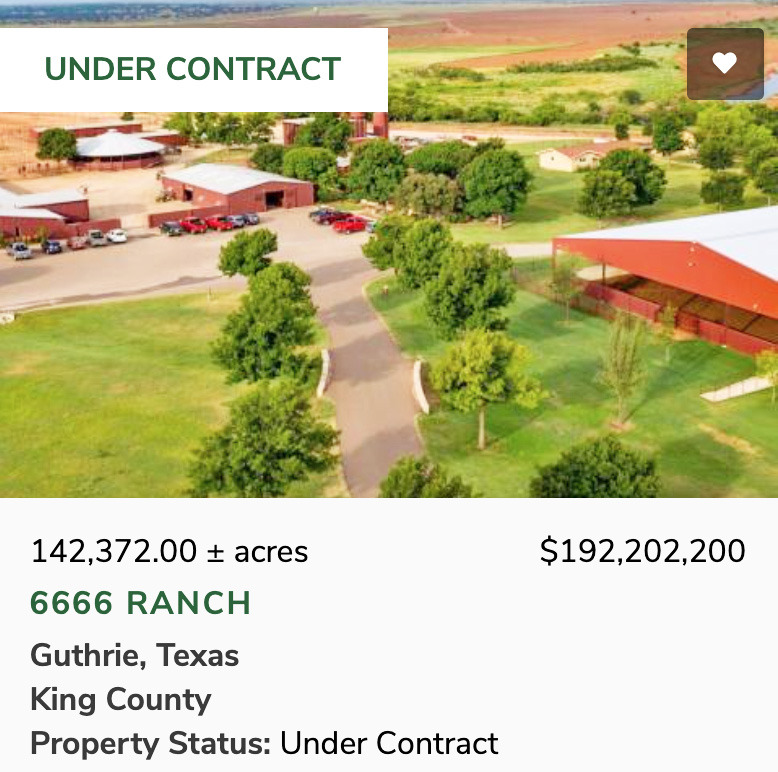
The segment’s opener featured aerials of horse herds and cattle on the storied King County spread. It’s a familiar sight to many, as pastures, horse barns, the headquarters house, and even the airstrip and hangar are readily visible off Texas Highway 114, and readily recognizable in “Yellowstone”’s Texas scenes.
“The location—the land‚ is typically the main character,” claims Sheridan.
How Sheridan signed this particular character for his series is the stuff of modern legend.
“When you come from this part of Texas,” Sheridan reminded listeners, you know the Four Sixes.
But watching TV few years ago after his own series had started to gain traction, Sheridan came across a segment on “The most famous ranch in America—the ‘Yellowstone’”— and it struck him that respect for the authentic places of the West was wanting.
“I wanted to write something about a real ranch. I knew (the late) Doc Blodgett and (6666 manager) Joe Leathers . . . . I wanted to showcase this way of life.”
A real estate agent arranged a meeting between Sheridan and Leathers. The ranch manager understandably had questions, conditions and concerns about how the ranch would be affected and portrayed.
After some back-andforth Sheridan got to the bottom line. “Listen, Joe, if you don’t want this project,” he said, “I’ll just go next door and make the Pitchfork the most famous ranch in America.”
“Miss Anne” Marion, great-granddaughter of 6666 founder Samuel Burk Burnett and by then the matriarch of the operation, called Sheridan that Christmas Eve. Why did he want to film there?
He had to convince her. The story would just be about an old rancher and a young cowboy coming there and learning the code, he said.
Would there be any violence in the footage? Marion asked. No, ma’am, he assured her.
Would there be any sex? “Well, one cowboy is sleeping with a vet tech, but don’t tell me that’s not happening already. And,” he added—“I would like to masturbate one stallion.”
She paused. “Can we choose the stallion?”
In a life-imitates-art twist, Marion died only a few weeks later—leaving the fate of the ranch in the balance with concerns about legacy similar to the fictional John Dutton’s. Milt Bradford, Sheridan’s “Yellowstone” advisor and the real estate agent handling the sale of the three 6666 divisions, per Marion’s will, thought Sheridan might be the right buyer who would maintain the ranch’s integrity We think you’re the one, said Bradford.
How much? asked Sheridan.
$350 million.
Well—I’m about $330 million short, Sheridan told him.
Sheridan was well aware that this ranch was a singular property, with its 277,000 acres still maintained much as it appeared “when Burk Burnett got there,” kept free of mesquite and salt cedar. He went to his studio backers.
“We’ve got this chance,” Sheridan argued. “By the time Yellowstone airs, the ranch won’t be there. We need to put together a deal.”
Paramount came up with the cash, and Sheridan worked out terms for writing new shows as part of the package. “‘Mayor of Kingstown,’ ‘Kings of Tulsa’ — those came out of that deal,” said Sheridan. “I was extremely wealthy for 21 days.”
But as he told his wife, “I think I’m supposed to do this.”
He sat their 13-yearold son down to tell him how big the responsibility would likely be, for them all and for their legacy. “You want to be a doctor, a painter, whatever you want to do, you do it, but you’re going to do it in Guthrie.”
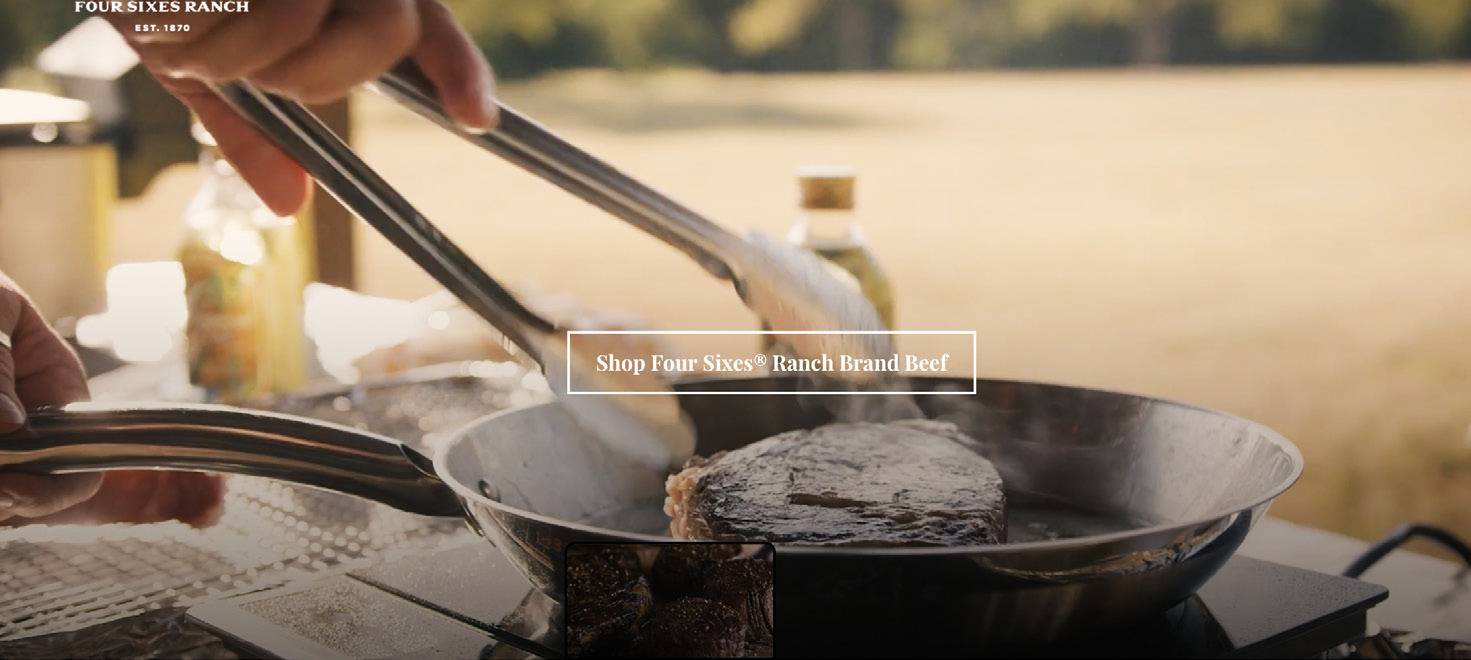
Among the accomplishments he’s most proud of since closing the 6666 deal in January 2022, Sheridan said, the management of the beef cattle operation ranks right up there. The challenge is the usual cow-calf operation, he and Leathers agreed. They would start going direct to the consumer with their beef—controlling genetics, feeding, all the way to packing, despite the hiatus of 16 months to ramp up. In 2023, said Sheridan, “I started showing up with Four Sixes beef in a cooler.” They quickly found customers and began turning a profit. “And now more people can know where their food comes from —it’s very fulfilling.”
Today Sheridan spends time in Guthrie as well as at his Bosque Ranch in Weatherford, which he had bought before the 6666, and which turns out to have been Marion’s own planned Granbury division of the Sixes.
And when he’s on location, he works closely with the ranch manager to schedule day-to-dayactivity. “When we are at the Sixes, I’m trying to show it off, to show those cowboys at work,” he said.
Asked how he felt his legacy will be defined, Sheridan mused: “The best thing we can hope for is that in about 100 years people talk about how this storied ranch is still run the way it used to be—I think I’ll be remembered more for the 6666 than a few movies.”
Music for the movies.
In a setting like the Buddy Holly Hall, it’s natural Beal would ask the filmmaker, “What about movie songs and soundtrack?”
Many fans know that “Yellowstone” has proved a launch pad for musicians— with seven originals from the show hitting #1 on country charts. Lubbock’s own Flatland Cavalry, a band formed at Tech, was featured in Season 5.
“The sound is half the movie,” said Sheridan. “The score is important because it tells viewers it’s okay to feel what they’re feeling.” And he wanted to use numbers people hadn’t already heard—even after casting country superstars Faith Hill and Tim McGraw in “Yellowstone: 1883.”
“I want the moment to be new, just like the song is new,” Sheridan said.
For “Yellowstone”’s haunting opening theme, Sheridan engaged no less a composing talent than Bryan Tyler of “Rambo” and “Fast and Furious” fame.
Sheridan clearly relished telling this one.
“The studio balked at bringing in a symphony for the score,” he said, but one day when Tyler was set to work with the London Philharmonic on ‘X-Men,’ that movie’s shooting was running overtime and the director hadn’t arrived. Union contracts meant that in the meantime, a full orchestra was cooling its jets at Abbey Road.
Could I email you the sheet music, Sheridan asked, and could you go get 88 copies made?
“Disney spent a lot of money recording my score,” he said.
Cultivating craft. For novice screenwriters among the audience, Sheridan advised “you must absolutely write the best you can” and submit to festivals, calls, competitions everywhere and don’t worry so much about just “getting in a room” with an agent.
Regarding stage plays, while Sheridan said he’s never worked in that medium, he nonetheless had respect for its challenges. “On stage,” he said, “you have to tell me everything that you can’t show me” with the camera.
Writing for an audience is a demanding occupation, and Sheridan noted that ironically, the recent writers’ strike yielded him valuable time space out all those projects he’s on the hook for.
Eager fans, naturally, want to know what’s next—and when. Sheridan hedged a bit when Beal tossed out his closing pitch: “Give us an update on the shows.”
“I knew how this thing ended before I wrote the first episode,” he said— even while his followers await a sign from Paramount on the next installment of “Yellowstone,” and what’s in store for the “6666” spinoff. (In a June 2023 interview with The Hollywood Reporter, Sheridan said that development might take a while, the actors’ strike notwithstanding: “6666,” he said, “needs a unique level of special care because this is a real place with real families working here . . . You have to respect the lineage. I’ve told [the studio] to be patient.”) In his West Texas–gritty though not-quite-gravelly voice, eyes shadowed deep under the felt brim of his dove-colored cowboy hat, Sheridan assured his listeners, “I’ll keep telling stories as long as there are people enjoying them. As long as you keep enjoying them, I’ll keep telling them, and when you don’t, I’ll ride off into the sunset.”
- Log in or Subscribe to post comments.