
Texas has a rich and singular history connected to the U.S. Civil War, commemorated by plaques such as the one explaining the role of Lubbock namesake Colonel T. S. Lubbock in the war, to one denoting the war’s last battle, Palmito Ranch, near Brownsville, to the Juneteenth marker erected in Galveston in 2014.
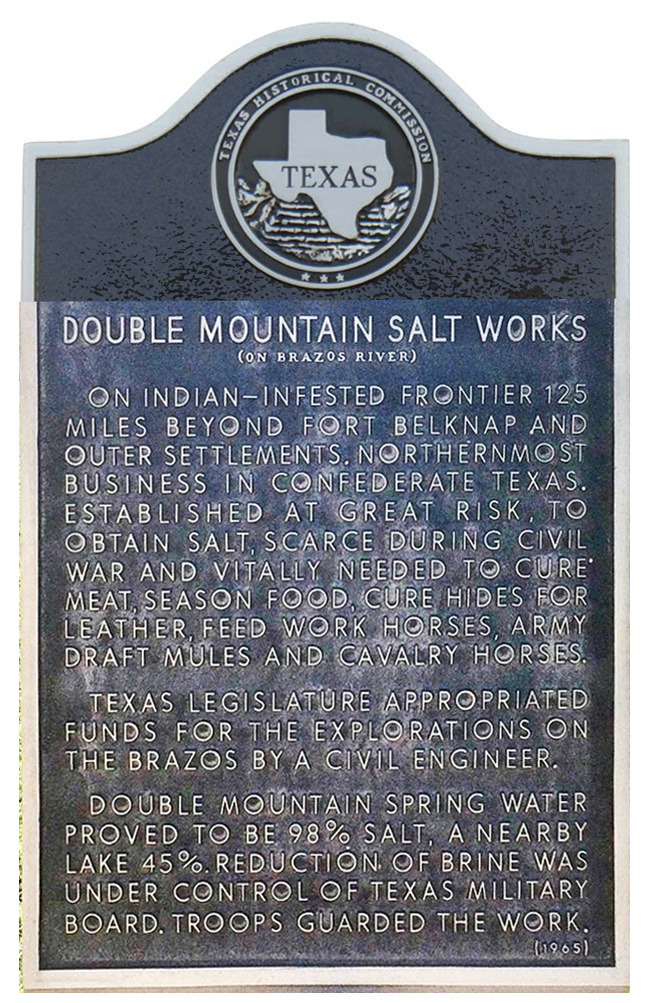
But few markers are as far from the war’s main action as one in Kent County, Texas, denoting the Double Mountain Salt Works on the Brazos River. It was the northernmost business in Confederate Texas, according to the marker text. “Established at great risk, to obtain salt, scarce during Civil War and vitally needed to cure meat, season food, cure hides for leather, feed work horses, army draft mules and cavalry horses.”
The text, crafted more than half a century ago in less culturally sensitive times, became the subject of a Texas Historical Commission (THC) review this spring when a challenge was posed to the accuracy of its opening description: “On Indian-infested frontier 125 miles beyond Fort Belknap and outer settlements.”
At its April 28 quarterly meeting, the THC approved new wording, which has been shared with the Kent County Historical Commission.
The newly researched marker text leads with, “On Indian-controlled land . . .”
The process of revision “can include different steps,” said THC historical marker program coordinator Bob Brinkman, “where if not agreed, they can approve.” Texas Administrative Code states, “If the requestor, or the County Historical Commission, or the county judge are not satisfied with the staff recommendation, they may choose to file an objection to the Commission’s History Programs Committee.”
KCHC chair Dana Brinkman of Jayton (no relation) said the local group has not yet taken action on the exact language, so as of January 2023 the old marker still remains in place.
The marker is located on the northwest corner of the Kent County Courthouse grounds, at the southeast corner of N. Main St. (SH 70) and E. 4th St. in Jayton.
One interesting opportunity posed by the revision is to do further research into the actual location of the salt works, and the source of other facts cited in the text, said Bob Brinkman.
“From 1961 to ’65 a committee on the Civil War Centennial worked with the THC,” he explained. “They had their own research; THC doesn’t have the files.” His department will continue to investigate at the Texas State Library and Archives and other sources. He’s keen to know, he said, who appointees to the Kent County Historical Commission were in 1965, at the time of this marker’s dedication. Where, also, might newspaper archives from that year reside? And even farther back, where in state of Texas papers might the civil engineer’s report from the 1860s be located?
The answers might point to an additional marker opportunity for the county (which has only five total, at present) nearer the actual salt works site.
The replacement for the existing salt works marker at the courthouse will be paid for by the state. Similar marker review requests can result in replacement markers as funds are available. The going rate for markers these days ranges from $1,175 to $1,675, post not included, and has been subject to increases and production schedules of the manufacturer.
Bob Brinkman is excited at what new investigations might turn up. “If we are going to take the time to tweak the opening sentence, it would be great to research further facts,” he said. “It would be nice to find that and make that connection in the text. The hope is that finding history will help them spin off some other areas of research.”
Detailed information on particular Texas historical markers may be located by searching https://atlas. thc.state.tx.us; general information is at www.thc. texas.gov/markers.
RIPE FOR REVISION “Infested”in the text of a 1965 marker displayed on the grounds of the Kent County courthouse caught the eye of one reader, who requested a review for accuracy by the Texas Historical Commission. | THE TEXAS SPUR
ALLUSIONS IN ALUMINUM In addition to the culturally objectionable phrase that’s to be revised on thisTexas historical marker are tantalizing hints: “Texas Legislature appropriated funds for the explorations on the Brazos by a civil engineer. Double Mountain spring water proved to be 98% salt, a nearby lake 45%. Reduction of brine was under control ofTexas Military Board. Troops guarded the work.”| THE TEXAS SPUR
- Log in or Subscribe to post comments.
