

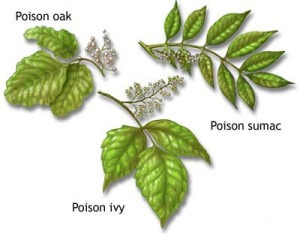
Autumn is a great time to hike in West Texas. As hikers hit the trails, watch out for common but poisonous plants that may or may not be found in our wilds. Some heads up on these plants might help. Poison ivy, poison oak and poison sumac each exude the sticky sap urushiol, the culprit to which people react.
Poison ivy causes the allergic reaction of redness, swollen itchy areas of the skin. Poison ivy can be found in all states of the continental United States except Alaska and Hawaii. It is identified by its trifoliate leaves — each leaf has three leaflets. In the West, poison ivy is a shrub, but in other parts of the U.S. is a vine. Its leaves are serrated, which makes it look much like Virginia Creeper.
Poison oak is similar to poison ivy, in that its leaves are also trifoliate but its leaves are smoothly lobed, not the jagged serrated leaves of poison ivy. Tops of leaves facing the sun have tiny hairs. Reaction is formation of bumpy, oozey blisters.
Poison sumac is the least likely to be encountered on a hike in West Texas. This woody shrub grows in swampy areas. Unlike the trifoliate leaves of poison ivy and oak, each leaf of poison sumac has 7 to 13 leaflets.
Two poisonous members of the Apiaceae, the carrot or parsley family, should be avoided. Both are found in our region.
Wild parsnip looks much like the edible parsnip when it flowers. It has coarse serrated leaves on stiff, grooved flower stalks. Stalks can reach a height of 5 feet. Like edible parsnips, wild parsnips have flowers that form umbels but unlike edible parsnips, leaves, stems, flowers touching skin can cause a rash. This is a wild plant found on roadsides and pastures.
Poison hemlock is also in the carrot family. Its flowers actually look much like Queen Anne’s Lace. Leaves look much like parsley but mature plants have purple blotched stems and rigid seed. Its mature size can be short, no more than 8 inches in height or quite tall and rank, up to 7 feet. It is poisonous to humans and other animals. Do not touch the plant as the oil is absorbed through the skin.
Some information from webmd.com Ellen Peffley Harp, a retired professor of horticulture at Texas Tech University, writes about gardening for several Texas newspapers.
- Log in or Subscribe to post comments.
