
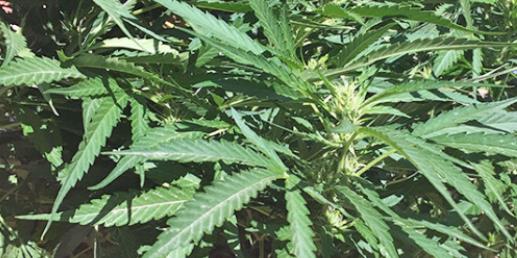
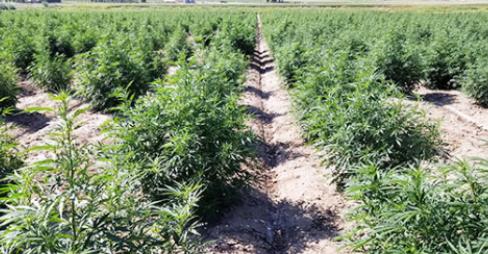
Hemp as a crop has been in the news lately. Since I have been asked questions about growing hemp plants in the garden, today’s column gives some botany about the crop.
Any information in this column is not to be taken as an endorsement of growing hemp or its relatives in the home garden. Any legal, agricultural or production questions should be directed to the Texas A&M AgriLife Extension Service, www.agrilifeextension.tamu. edu/hemp/ or the state of Texas Agriculture Commission, www.texasagriculture. gov/RegulatoryPrograms/Hemp.
Hemp (Cannabis sativa) is a member of the Cannabaceae family that also includes marijuana (Cannabis sativa), hops (Humulus) and hackberries (Celtis). The distinction between hemp and marijuana is the level of the secondary compound THC (tetrahydrocannabinol) a compound that produces psychoactive effects in humans. Varieties of the Cannabis sativa cultivated as hemp has only small amounts of THC relative to that grown for the production of marijuana or hashish.
The name “hemp” is used to define Cannabis sativa that contains 0.3 percent or less THC content by dry weight (healthline. com).
The appeal of growing hemp for some is its use in a rotation strategy because it is in the Cannabaceae family, which is infrequently grown. But its use for such a purpose is negligible, explained in the following paragraph.
Hemp is a warm season annual with an optimum temperature range of 70° to 80°F. Plants have a strong central axis, with side branches. Height can vary from less than a foot to 15 feet, depending upon the conditions in which is it grown: most varieties of hemp are photoperiod sensitive, flowering when days shorten and nights lengthen. The optimum growing season for warm season crops in West Texas is in the summer with long days and short nights. When hemp is grown in natural daylight under long days and short night the result is a very short flowering plant that ceases to grow early in the summer.
Common pests are aphids, spider mites, thrips and whiteflies.
Hemp plants are dioecious; that is, they have either male or female flowers on one plant but not both male and female. Another common dioecious crop plant is spinach.
Seed purchased for production will have roughly half male and half female plants. it is the female plant that produces the flowers.
Seed sources of hemp sold in Texas follow:
• highgradehempseed.com/hemp-seeds-for-sale-in-texas
• texashempsource.us/certified-hemp-seeds-for-sale
• texashempcultivators.com
• texashempsource.us
Ellen Peffley Harp, a retired professor of horticulture at Texas Tech University, writes about gardening for several Texas newspapers.
- Log in or Subscribe to post comments.
