
Few resources are as crucial to our everyday lives as the water we drink (and cook, shower, wash dishes, and brush our teeth with).
Well into the 21st century, in our country at least, we’ve become quite accustomed to turning on the faucet and filling a cup with clean, clear, potable (that is, drinkable) H20. (That’s what White River Water Management District (WRWMD) general manager Shane Jones says his own wife expects—and she’s the first to call if nothing comes out!)
It’s hard to fathom for us that many of the U.S.’s municipal water and sewer systems were constructed as far back as the 1800s. Even in Texas back then, East Dallas was considered the most luxurious place to live in Dallas County—when 90 percent of its houses had running water by 1889!
Piped, treated water was later arriving in our parts of the state. Many supply pipelines in our region date as far back as the 1940s, and although we’ve gotten by with ingenuity and hard work so far, most of our communities’ water systems are feeling the strain of constant patch-ups.
In Spur, which draws its household and commercial water supply from the White River reservoir and from regional wells, Jones says that the original pipelines from the plant were put in in 1960, while the current well field was tapped in 1999. City lines and other equipment are even older. Jayton, which like Spur experienced numerous line ruptures during February’s severe freeze, draws its water from local wells.
In both of these cities, as well as nearby towns of Dickens, McAdoo, Turkey, Quitaque, Matador, and White River Lake itself, the recent storm brought home the painful realities of what citizens do, and don’t, understand about our water systems—and what to do to fix the problems.
The Texas Spur talked with Jones to get some clarification that might be helpful to those listening in at their city council meetings, or discussing matters with their elected officials or candidates.
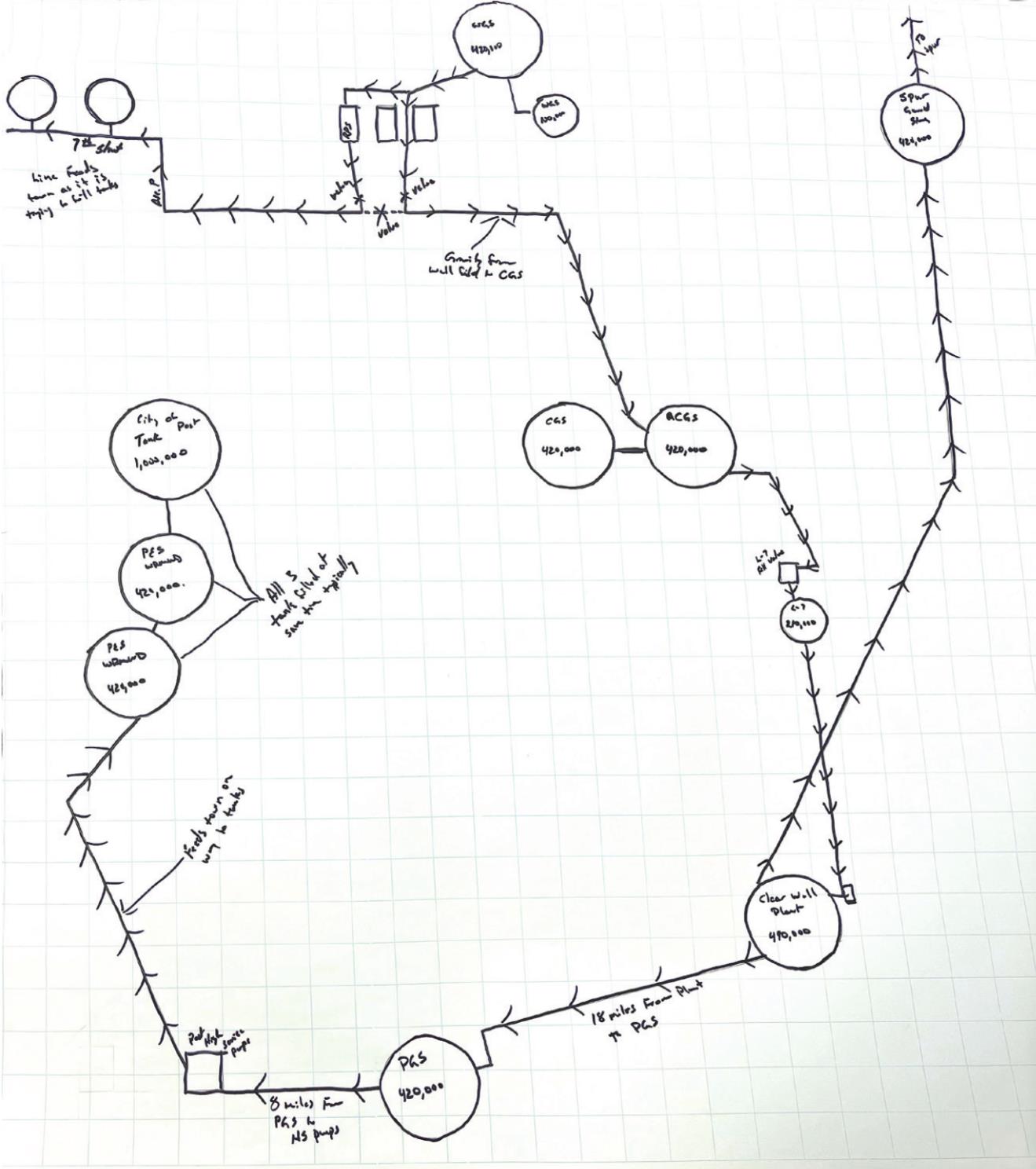
Part of his helpful response is based on a chart he had drawn recently for the benefit of the WRWMD board, and which one of Spur’s representatives on the board, Woodie McArthur, used in reporting to the Spur city council in February.
What was most enlightening to me was the circuitous course our city water must take to reach our taps in town. From WRMWD’s storage facility it’s 27 miles as the crow flies to reach Post; there are 25 miles of pipeline to Crosbyton and then 9 more to Ralls; and 13 to Spur. While the White River reservoir has been offline for the past six months during the final phases of a multi-year plant improvement, storage tanks in the system have been filled from wells that increase the distance of flow up and out even farther.
For perspective on how much water it takes to get things going, from the water treatment plan to the ground storage tank halfway between the lake and Post—18 miles —over a million gallons are required just to fill the line.
That helps provide a bit of perspective on the loss the City of Spur reported during the recent system outage, of 1.3 million gallons.
Further, it’s useful to know that the City of Spur alone used 5.6 million gallons in a typical 31-day month, December of 2020; the city’s average water usage per day that month was 180,667 gallons.
Where I’m going with this is—leaking pipes are not just a headache, but a sore expense to the water authority, cities, and customers alike. Yet the cost of systematic repairs is even greater, and many municipalities across the region, state and nation are competing for federal dollars that will help repair the aging infrastructure.
WRMWD is hoping to complete its contracted plant work by August 1, funded by a $6.2 million project funded via USDA grants and loans. That lake water source will come back online at that point—and, according to Jones, is in no danger of running out.
The City of Spur is just beginning work on a substantially smaller but no less important project involving sewer equipment as well as supply lines, funded by a Texas Community Development Block Grant. Competition among cities large and small is fierce for these grants, but Spur is right in there with the help of the South Plains Association of Governments, and a contracted grant-writing consultant, to regularly make pitches for its share.
If you’d like to make your ideas known in Spur, talk with Mayor Louise Jones or your precinct’s alderperson, or with the city’s Spur representatives on the WRWMD board, Donnie Arnold, Steve Elliott and Woodie McArthur.
And if you’d like to know more specifics about the quality of our city’s drinking water— which has consistently measured up to a high standard, said Shane Jones—those Water Quality Reports are produced annually and available as public record.
- Log in or Subscribe to post comments.
