
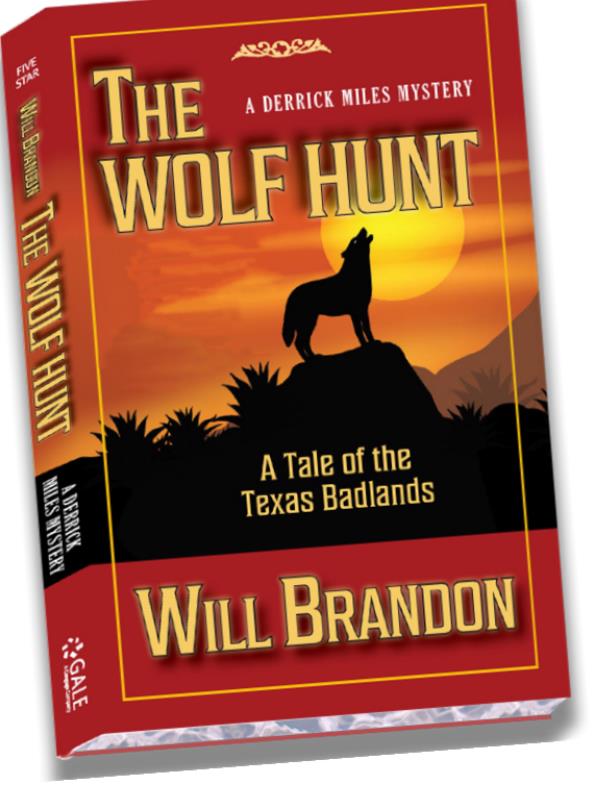
A Derrick Miles Mystery NOW AVAILABLE from Five Star Publishing, a part of Gale, a Cengage Company Excerpted with permission of the publisher
Chapter 4
The Last Wolverton (continued) {In which Miles and Hooper interrogate their visitor from Crosby County.}
NOT SO FAST. THERE’S ANOTHER IMPORTANT BIT OF evidence here—embodied not in the words themselves, but in the gaps between them.” Miles allowed Wolverton to examine the letter for a few seconds before directing his attention to one particular word. “What can you discern there?”
Wolverton leaned closer for a second, then jumped upon it first. “Why, the name ‘Croton’ is cut right in half,” he cried, pleased with himself. “And the letter shapes all look different from the other words.”
“Precisely. It was doubtless lifted from another document—one in which two parts of the word occur.”
“And a capital letter, to boot,” I added. “Well, Captain, what do you say to that?” said Wolverton. “Where does this leave us, besides sitting here debating over details while a prankster—or even a criminal—gets away?”
“I confess that I don’t immediately recognize the source of these two clippings. But it won’t prevent us from scouring the trash bins of the Pickwick Hotel while we ponder on it.” Miles set down his fork, snapped his fingers for the check, and stood swiftly. “Wolverton, let’s see if we can’t get to the bottom of the matter.”
“Wait a second,” said Barlow, who had picked up the letter and was holding it close to his nose and peering through his wire-framed eyeglasses. “I think I know the answer.” He lowered the page slowly, and with a puzzled expression, said, “This part was taken from the name ‘Crosbyton’—in our own locally printed Crosby County News!”
Miles slipped back into his seat again and turned to the Quaker with an expression of genuine admiration. “I believe you have supplied an essential piece of the puzzle, Mr. Barlow. Now we must discover what it all means.”
“Before you all burn more daylight on your sleuthing,” said Wolverton with derision, “it seems high time you kept your promise and gave me a full account of what we are all driving at.”
“Your request is a very reasonable one,” Miles answered. “Mr. Barlow, I think you could not do better than to tell your story as you told it to us.”
Thus encouraged, the country lawyer drew his papers from his pocket and presented the whole case as he had done upon the evening before. Wolverton listened with the deepest attention and with an occasional exclamation of surprise that won out over his skepticism.
“Well, I seem to have come into an inheritance with a vengeance,” said he when the long narrative was finished. “Of course, I’ve heard the dire wolf story ever since I was in knee britches, but I never thought of taking it seriously before. But as to my uncle’s death—well, it all seems boiling up in my head, and I can’t get it clear yet. You gents don’t seem quite to have made up your own minds whether it’s a case for a policeman or a clergyman.”
“Indeed,” said Miles.
“And now there’s this strange affair of the letter to me at the hotel. I suppose that fits into its place.”
“It seems to show that someone knows more than we do about what goes on in Dickens County,” said Mr. Barlow.
“And also,” said Miles, “that someone is not ill-disposed towards you, since they warn you of danger.”
“Or it could be some crook’s scam to scare me away. You can’t fool me with that one—I’ve seen a few fake warning signs posted near mine sites.”
“Well, of course, that is possible also. I am very much indebted to you, Mr. Barlow, for introducing me to a problem which presents several interesting alternatives. But the practical point which we now have to decide, Mr. Wolverton, is whether it is or is not advisable for you to travel to the Wolverton ranch house.”
“Why should I not go?”
“There seems to be genuine danger.”
“Do you mean from this family fiend or from human beings?”
“Well, that is what we have to find out.”
“Whichever it is, my mind’s made up. There’s no devil in Dickens and no man on earth either one who can prevent me from going to the home of my own people, and you can take that to the bank.” His dark brows knitted and his face flushed to a dusky red as he spoke. It was evident that the fiery temper of the Wolvertons was not extinct in this, their last representative.
“As you wish, of course,” said Miles.
Wolverton stood and pulled a dollar from his pocket, which he laid on the table to pay his bill before Miles could even reach for his own wallet. “Time’s wasting, if you ask me. It’s almost three now, and if I’m going to catch a westbound train anytime soon, I’d better go see if I can find that missing boot.”
With that the hotheaded young man was out the door, leaving the three of us scrambling to pay up and collect our hats and coats. By the time we stepped out of the White Elephant onto the plank sidewalk, Wolverton had more than a block’s lead on us.
“Shall I flag down a cab and catch up with him?” I asked Miles. “Or run on and stop him?”
“Neither,” Miles answered. “It’s a fine day for a walk. Let our young heir release some of the steam he’s been building up.”
It took some effort to match Wolverton’s determined pace, which our trio did, keeping some twenty yards behind. As our charge turned onto Main Street a block ahead of us and the streetcar momentarily blocked our view, we lost track of him for a time, and then found him again. Miles called my attention quickly to a hansom cab, carrying a man inside, which was proceeding down the street just behind Wolverton, the driver moving slowly in order to match his speed to the pedestrian’s step and following only a few feet behind him.
“What do you make of this, Hooper? Come quick! Let’s have a good look at the occupant—Mr. Barlow, forgive us.”
The two of us broke into a run, leaving the Quaker behind, and raced to catch up with the cab. We were almost upon him, closing the distance between us and Wolverton, when the vehicle slowed to a halt. At that instant I was aware of a bushy black beard and a pair of piercing eyes turned upon us through the cab’s side window. Instantly the trapdoor at the top flew up, and something was screamed to the driver, who clicked the reins and flew madly off up Main. Miles looked eagerly around for another, but no empty one was in sight. Then he dashed in wild pursuit on foot amid the stream of the traffic, but the carriage’s start was too great, and already it was out of sight.
“There now!” said Miles bitterly as he returned, panting and white with vexation from the tide of buggies and buckboards, to the corner where I stood waiting for Mr. Barlow.
“Was ever such bad luck and such bad management, too? Hooper, Hooper, if you are an honest man you will record this episode also and set it against my successes!”
“Who was the man?”
“I have not an inkling.”
“A spy?”
“Well, it was evident from what we have heard that Wolverton has been very closely shadowed by someone since he has been in town. How else could it be known so quickly that it was the Pickwick Hotel which he had chosen? If they had followed him the first night I argued that they would follow him also the next day. You may have observed that I twice strolled over to the window while Mr. Barlow was reading his legend.”
“Yes, I remember.”
“I was looking out for loiterers in the street, but I saw none. We are dealing with a clever man, Hooper. This matter cuts very deep, and though I have not finally made up my mind whether it is a benevolent or a malevolent agency which is in touch with us, I am conscious always of power and design. When our friend left I at once followed him in the hopes of spotting his invisible attendant. So wily was the man that he had not trusted himself upon foot, but availed himself of a cab so that he could loiter behind or dash past his mark and so escape his notice. His method had the additional advantage that if Wolverton had chosen to take a cab he was all ready to follow them. It has, however, one obvious disadvantage.”
“It puts him in the power of the driver.” “Exactly.”
“Exactly.”
“What a pity we did not get the number!”
“My dear Hooper, clumsy as I have been, you surely do not seriously imagine that I neglected to get the number? Number 304 is our man. But that is no use to us for the moment.”
“I fail to see how you could have done more.”
“On observing the cab I should have instantly turned and walked in the other direction. I should then at my leisure have hired a second cab and followed the first at a respectful distance, or, better still, have driven to the Pickwick Hotel and waited there. When our unknown had followed Wolverton to his lodgings we should have had the opportunity of playing his own game upon himself and seeing where he made for. As it is, by an indiscreet eagerness, which was taken advantage of with extraordinary quickness and energy by our opponent, we have betrayed ourselves and lost our man.” As we waited, Mr. Barlow at last caught up with us.
“There is no object in our following them,” said Miles, straightening his cravat and turning to acknowledge Barlow’s presence. “The shadow has departed and will not return. We must see what further cards we have in our hands and play them with decision. Could you swear to that man’s face within the cab, Hooper?”
“I could swear only to the beard.”
“And I could wager it was a false one. A clever man upon so delicate an errand has no use for a beard save to conceal his features. Let’s step in here, gentlemen, before we return to the Pickwick.” We found ourselves in the Western Union telegraph’s main office, where Miles was warmly greeted by the manager.
“Ah, Mr. Schneider, I see you have not forgotten the little case in which I had the good fortune to help you?” said Miles.
“No, sir, indeed I have not. You saved my good name, and perhaps my life.”
“My dear Fritz, you exaggerate. Now, I have some recollection that you had among your errand boys a lad named Cartwright, who showed some ability during the investigation.”
“Yes, sir, he is still with us.”
“Could you summon him, if he happens to be on duty?—Thank you! And perhaps you’d be so kind as to change this two-dollar note for five-cent pieces.” As Miles penciled in a brief telegram and handed it to Mr. Schneider, a boy looking to be in his mid-teens, dressed neatly and with a bright, keen face, arrived from somewhere in the back office. He stood now gazing with great reverence at the famous detective.
“Let me have the city directory,” said Miles. He opened the booklet to a certain page and, thanking the manager, turned to the boy. “Now, Cartwright, there are the names of a dozen hotels here, all in the immediate neighborhood of the Union Depot. Do you see?”
“Yes, sir.”
“You are to visit each of these in turn.”
“Yes, sir.”
“You will begin in each case by giving the outside porter one nickel. Here are twelve coins.”
“Yes, sir.”
“You will tell him that you want to see the wastepaper of this morning. You will say that an important message has been lost and that you are looking for it. You understand?”
“Yes, sir.” “But what you are really looking for is the front page of the Gazette
“But what you are really looking for is the front page of the Gazette with some small holes cut in it. Here is a copy of the paper; it is this page. You could easily recognize it, could you not?”
“Yes, sir.”
“In each case the outside porter will send for the hall porter, to whom also you will give a nickel. Here are a dozen more. You will then learn in possibly ten cases out of the twelve that the waste of this morning has already been burned or removed. In the two other cases you will be shown a heap of paper and you will look for this page among it. The odds are enormously against your finding it, so do not be discouraged. There are sixteen nickels left over in case of emergencies. Let me have a report by wire at Houston Street before evening.” He sent the lad on his way and returned his attention to us. “And now it only remains for us to find out the identity of the cabman, No. 304, and then we will return to the Pickwick and reunite with Mr. Wolverton.”
Mr. Barlow expressed relief at this plan, and our bedraggled, dusty party turned at last onto Eighteenth Street for the last few blocks’ walk to the hotel.
There, before we could even ring for Wolverton, to my surprise the cabman Miles was seeking was already waiting, seated uneasily in the foyer, livery cap in hand.
“I got a message from the head office that a gent at this hotel had inquired for No. 304,” said he. “I’ve driven my cab this seven years and never a word of complaint. I came here straight from the cab yard to ask you to your face what you had against me.”
“I have nothing in the world against you, my good man,” said Miles. “On the contrary, I’m impressed with your prompt response to my telegram. And I have a silver dollar for you if you will give me a clear answer to my questions.”
“Well, in that case,” said the cabman with a grin, “what was it you wanted to ask, sir?”
“First of all your name and address, in case I want you again.”
“John Spiller, 24 Crump Street, over by the Fort Worth & Denver shops. My cab is out of Mason’s Livery, near Union Station. It’s just three blocks from here, which is why I came in person.” Miles made a note of it.
“Now, Spiller, tell me all about the fare who came and watched the White Elephant Saloon at two o’clock this afternoon and afterwards followed a particular gentleman down Main Street.” The man looked surprised and a little embarrassed.
“Why, there’s no good my telling you things, for you seem to know as much as I do already,” said he. “I ain’t in the custom of breaking confidences. The truth is that the man told me that he was a detective and that I was to say nothing about him to anyone.”
“My good fellow, this is a very serious business, and you may find yourself in a pretty bad position if you try to hide anything from me. You say that your fare told you he was a detective?”
“That’s right, sir.”
“Excellent! Tell me where you picked him up and all that occurred.”
“He hailed me at half past nine beside the streetcar line across from the Southern Hotel. He said that he was a detective, and he offered me two bucks if I would do exactly what he wanted all day and ask no questions. Two dollars—a week’s wages for me, sir! I was glad enough to agree. First we drove down to the Pickwick Hotel and waited there until two gentlemen came out and hailed a hackney from the street. We followed their cab a little behind until it pulled up at the White Elephant and the two men got out.”
“At what time?” said Miles.
“Right at one o’clock. We watched the men enter the restaurant, then my fare instructed me to wait within view of the door. An hour and a half later I was having a time of it, keeping awake in the box, when all of a sudden one of the men stepped out and started west on Main at a fast clip. The detective signaled me to keep up with him. We continued straight ahead until—”
“I know,” said Miles.
“Until we got three-quarters down Main. Then my fare threw up the trap, and he shouted that I should drive right away to the Union Depot as hard as I could go. I whipped up the mare and we were there in under five minutes. Then he paid up his two bucks and a tip to boot, and away he went into the station. Only just as he was leaving he turned around and looked up at me and he said: ‘It might interest you to know that you have been driving a detective of great renown.’”
“Did he say anything more?”
“He gave his name.”
Miles cast a swift glance of triumph at me. “Oh, he gave his name, did he? That was imprudent. And what was the name that he mentioned?”
“He told me,” said the cabman, “that I had been driving Captain Derrick Miles.”
Never have I seen my friend more completely taken aback than by the cabman’s reply. For an instant he sat in silent amazement, as Mr. Barlow looked on in confusion. Then he burst into a hearty laugh.
“A touch, Hooper—an undeniable touch!” said he. “I feel a foil as quick and supple as my own. He has hit home upon me very prettily! So his name was Derrick Miles, was it?”
“Yes, sir, that was the gentleman’s name.”
“I see. And you saw no more of him?”
“Not after he went into the station.”
“And how would you describe Mr. Derrick Miles?” The cabman scratched his head.
“Well, he wasn’t altogether such an easy person to describe. I’d put him at forty years of age, and he was of a middle height, two or three inches shorter than you, sir. He was dressed like a dandy, and he had a black beard, cut square at the end, and a pale face. I don’t know as I could say more than that.”
“Color of his eyes?”
“No, I can’t say that.”
“Nothing more that you can remember?”
“No, sir; not a thing.”
“Well, then, here is your coin. There’s another two bits waiting for you if you can deliver any more information. You’ll find the listing for Derrick Miles, Consulting Detective, in the city directory.”
Spiller raised his eyebrows in surprise. “You fellows work for him?”
“You might say that.”
“Well, it’s been quite a day, then. Good afternoon, sir, and thank you!” John Spiller departed chuckling, and Miles turned to me with a shrug of his shoulders and a rueful smile.
IN THE RUGGED, DESOLATE CROTON BREAKS OF WEST TEXAS a spectral creature with a six-inch pawprint has spooked livestock of late. When British-born cattle baron Basil Wolverton is found dead outside his own ranch gate, cowhands and nesters alike whisper of an ancestral curse, the dire wolf of legend.
Sir Basil’s executor Wesley Barlow knows what he must do: catch the next train for Fort Worth, where consulting detective Derrick Miles and his assistant Dr. Frank Hooper are his best bet to figure out whether there’s been a crime committed . . . or some diabolical force at work.
If the story sounds familiar, it should. Transporting the Sherlock Holmes classic The Hound of the Baskervilles to Dickens County, circa 1891, author Will Brandon reimagines Sir Arthur Conan Doyle’s thrilling tale with a Texas twist on a murderous beast, a fugitive outlaw, greed and grit, affairs of the heart, and a landscape yet untamed. In the popular tradition of serial publication The Texas Spur has obtained exclusive rights to run excerpts of this new novel, timed with its revised April 2021 release in book form.
In the heyday of Charles Goodnight and Quanah Parker—and one of the craftiest stalkers on the frontier—The Wolf Hunt traces Hooper’s solemn pledge to solve the vexing case with which Miles has entrusted him and protect the Wolverton heir in his charge. But will bullets and iron bars bear out against the embodiment of evil? In this high Victorian adventure, the answer is anything but elementary.
- Log in or Subscribe to post comments.
