
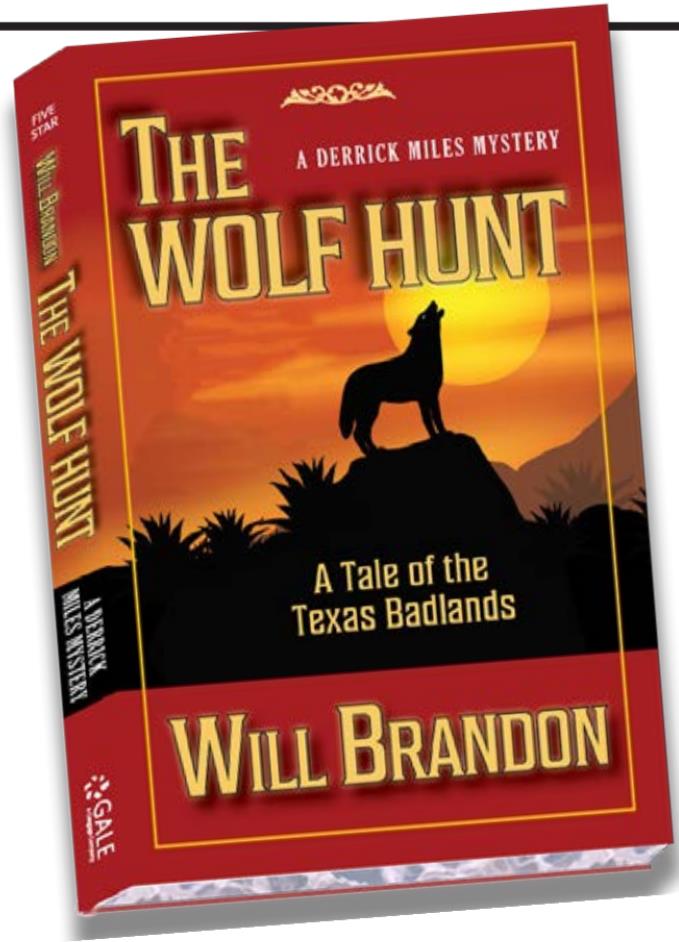
A Derrick Miles Mystery
Published April 2021 • NOW AVAILABLE from FIVE STAR
Five Star Publishing, a part of Gale, a Cengage Company Excerpted with permission of the publisher
Chapter 2
The Curse
{In which Mr. Wesley Barlow of Crosby County, Texas, reveals one clan’s darkest secret.}
I brought with me some doCuments that will help explain,” said Barlow.
“I observed one of them as you entered the room,” said Miles, pointing to the man’s side pocket.
Barlow extracted a much-creased sheet and began to unfold it. “This map is fairly old, as things in Texas go.”
“From 1854, unless it is a very good forgery.”
“How can thee ascertain that information with such precision, sir?”
“You allowed an inch or two of it to protrude as you entered, showing a bit of the map’s distinctive engrossing. You may recall that I’m quite familiar with the maps of our state, having served some months with the army at Fort Griffin during the Indian campaigns of the Red River. This one, unless I’m mistaken, is a later authorized copy of Captain Marcy’s expedition survey of 1854—easy for me to remember, as it is also the year of my birth.”
“I apologize for bringing none more recent; thee will soon understand why this document in particular is relevant.” Mr. Barlow pushed his spectacles up on his nose, drew the map from his side pocket, pushed aside our plates, and unfolded it on the dining table. I brought over the old oil lamp to provide additional illumination.
“Observe, gentlemen,” he said, “in this roughly sketched but quite accurate map, something of the nature of the country that lies between here”—he indicated just off the page to the right, where that map did not extend to embrace our present location in Fort Worth—“and here, at the western edge, in Dickens County. West of here it is primarily broken and rugged land, threaded through by tributaries of the Red, Wichita, and Brazos river systems, remote and difficult to access. Until recently it was Comanche country. Captain Marcy in the 1850s indicated springs, peaks, what few forts that existed, and the wagon road from New Mexico; the advent of the railroad would not occur until more than twenty years after.”
“I well recollect that occasion,” said Miles, “having arrived here in the city by rail not long after the line’s opening.”
I chimed in here, not wishing to interrupt our guest but eager to stake my claim as something of a pioneer as well. “As do I. It was that very train, the Texas and Pacific in July of seventy-six, that introduced me to Derrick Miles, fresh out of the army’s service with the rank of captain.” Miles shot me a glance. “But that, of course, is a story for another day.”
“What is important to note on this copy of Marcy’s map,” our guest said, “is the great void west of where the Brazos forks at about the one hundredth meridian. Marcy indicated this series of rugged peaks, here, but left the country beyond empty. In that space, faintly penciled at the far edge, pray tell me what thee sees.”
Miles leaned closer. “I make out . . . ‘Quaker colony, est. 1879.’”
“That, sir, is where our people settled after a long journey from Indiana. And where we have remained to farm in peace, despite hardships. Know you the meaning of ‘Estacado’?”
“It is Spanish for ‘staked,’ is it not?” Miles offered. “A descriptor applied to the plains by the soldiers under Coronado, who found the escarpment to resemble a palisade.”
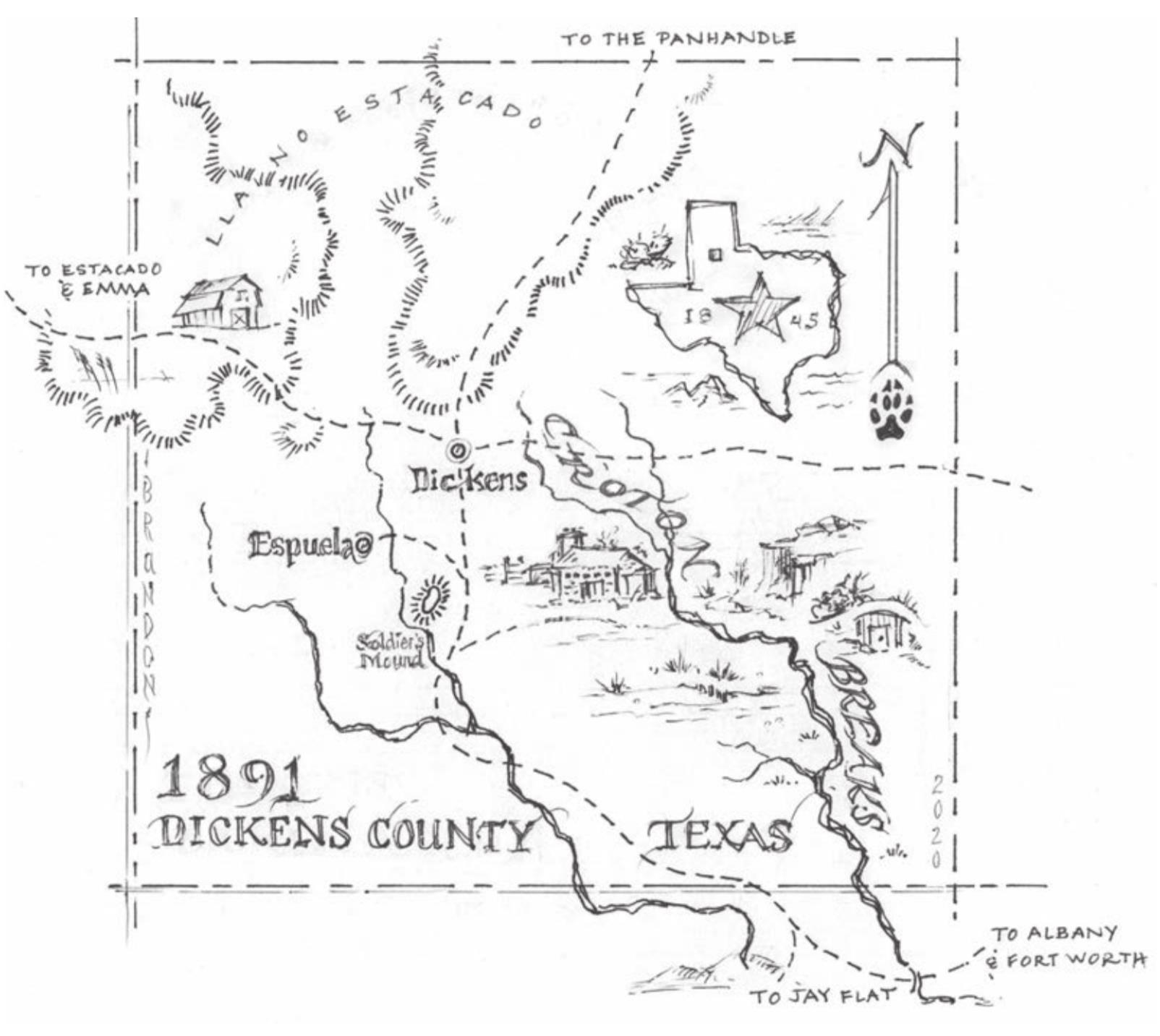
“Thee is correct, though some hold with alternate theories. That Coronado’s scouts marked their way across the trackless plain with sticks, for instance. But that is not our concern at present. Our situation lies just below the caprock escarpment, here in the eastern portion of which, as of seven months ago, has been legally organized as the County of Dickens.” He moved his finger slightly to the right on the map, where I could see further pencil markings around the engraved hachures. “The annotator of this map has drawn in the wandering lines of two creeks. These intermittent streams traverse the vast holdings of the Spur Ranch, carving rugged canyons through a remote portion known as the Croton Breaks.”
“It is a country with which I am somewhat familiar, and I certainly know of the celebrated Spurs,” said Miles.
Mr. Barlow lowered his voice. “The region remains unknown to most, except the cowhands of that ranch, who even themselves report the occasional disappearance of cattle in the jagged breaks, never to be seen again. It is a land of treacherous river bottoms that seem innocuous, only to trap the unwary animal or rider fast in quicksand; and creeks that rise to raging floods after brief rainstorms upstream. The dark recesses of canyons have for centuries hidden Indians; they still harbor venomous rattlesnakes and vicious badgers and hydrophobic polecats and other wild creatures of which I will presently tell thee. The land is subject to searing heat, blistering cold, and northers—like the one we seem to be experiencing tonight—that can come on so suddenly the mercury drops sixty degrees in an hour.”
At our guest’s words I registered the chill that had settled over the room and went to add more coals to the grate. Mr. Barlow continued as I brought the tray over and refilled all our glasses, his with water, ours each with whiskey. The dog lay obediently at his master’s feet, accepting a bread crust slipped to him from the table.
“I must beg your pardon for taking the long way round, gentlemen, for some history is necessary if one is to make a sound judgment, I believe.
“Some years back, when American beef was at a premium and investors from across the Atlantic spied opportunity to control costs by buying up tracts of rangeland being broken up by fence, a certain member of the British nobility acquired a portion of the Spur holdings. Basil Wolverton II—styled Baronet Wolverton of Brent—migrated lock, stock, and barrel to his new ranch in America, bringing with him his young wife and his servants. It was rumored that he hoped to increase his wealth but also to reconcile with his surviving younger brother, who had left the ancestral isle some years before him. In due time the baronet renounced his British citizenship and title and pledged allegiance to his adopted country, where the locals simply took to calling him ‘the Earl’ despite his actual rank.
“That was a decade past. I served as the Earl’s local counsel in some of these property transactions and in due time made the acquaintance of his wife and household, our neighboring counties having much in common in civic life and commerce. Estacado’s small gathering of Friends are always willing to help out our fellow settlers in times of crisis, of which we have shared many.
“I became something of a confidant and even, I dare say, a spiritual adviser to the Earl. He was—I almost said is, although it has been some days since the mysterious tragedy that claimed his life—he was a capable and shrewd man in business matters, though prone to a periodic melancholy that may have figured into his demise.”
“I am sorry to learn of your loss,” I said. “And, one assumes, a loss to your community as well.”
“Indeed, yes. Thee is kind to note it.” The man nearly broke down in tears, and drew out a handkerchief with which to dry his eyes before resuming his saga. Miles remained intently focused as the story seemed to be approaching the crux of its problem.
“Lady Wolverton—herself an angel of beneficence to the cowboys of their ranch and the surrounding area—became ill within a year of their arrival in Texas, a factor that wore on her husband’s mental state increasingly, as her health declined. Olivia Wolverton suffered from a debilitating condition of the nervous system that manifested in increased redness and sensitivity about the face, and partial loss of control in her limbs. Eventually she became confined to a wheelchair, a difficult circumstance on a working ranch, as you can imagine.
“The couple traveled to consult doctors in Austin. Observing a peculiar butterfly-shaped pattern apparent in the lesions on Mrs. Wolverton’s face, the physicians quickly concurred on a diagnosis—”
I could not refrain from interrupting, medicine being my own field of professional training. “Lupus erythematosus, I’m sure you were about to say. The symptom is classic, and the prognosis, I fear, was not hopeful.”
“Lady Wolverton did not survive that long winter, a particularly harsh one throughout Northwest Texas, as you must recall. At least there were no children to grieve. All that season cattle froze, driven en masse against fences, and four-legged predators skulked about, feeding as they might on carcasses. The Earl himself grew thin and wan, and obsessively fearful. He seemed to dwell on a long-ago story from the days of the first Baronet Wolverton, back in Devonshire, and more recently on the account of a curse placed on his Texas lands by the Comanche tribe as they had been lately driven from their ancestral hunting grounds. The fatal occurrence of lupus—‘the wolf ’—only fueled his obsession with the myth. He became convinced of a conspiracy of sorts.”
At this I slid back in my chair once again, fearing the account was about to steer away from the empirical and scientific into the realm of the metaphysical.
“You gentlemen have heard, perhaps, of the dire wolf ?” “An enormous ancient species naturalists consider long extinct,” replied Miles.
“The Indians claimed the dire wolf appears at times of impending tragedy, to stalk, to scare, perhaps to kill,” said Barlow, his tone measured.
“What credence would a man of business, a man of faith, lend to a native folktale?” asked Miles. •
- Log in or Subscribe to post comments.
