
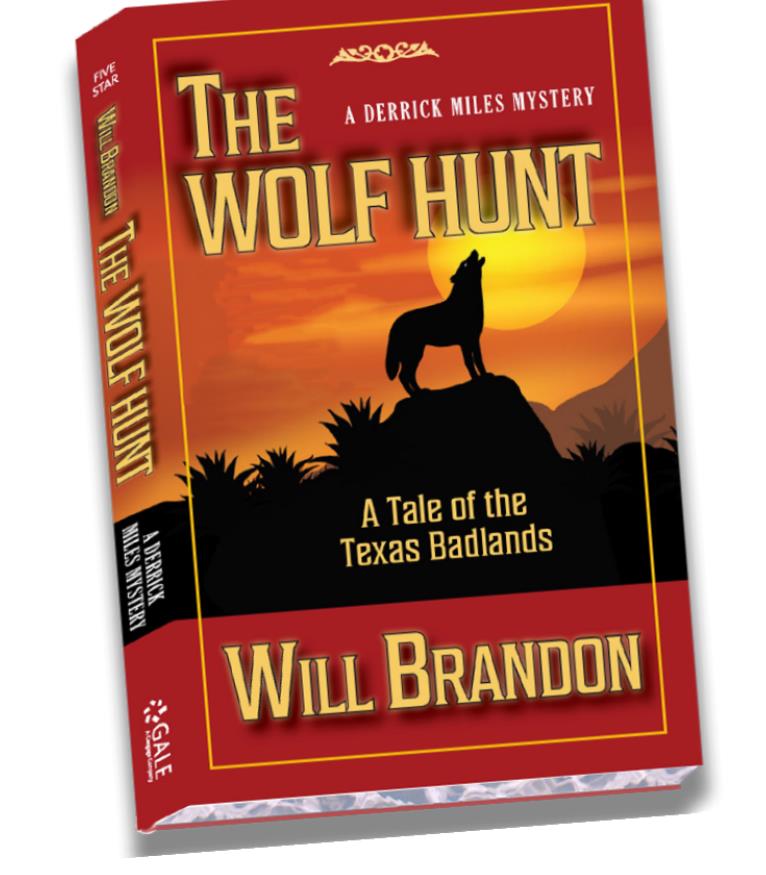
A Derrick Miles Mystery Published April 2021 • NOW AVAILABLE from FIVE STAR
Five Star Publishing, a part of Gale, a Cengage Company Excerpted with permission of the publisher
Chapter 2
The Curse (continued) {In which Mr. Wesley Barlow of Crosby County, Texas, reveals one clan’s darkest secret.}
AS I HAVE SAID, BASIL WOLVERTON WAS KNOWN to fall into occasional fits of choler,” said Barlow. “These seemed aggravated, understandably, by his wife’s failing health and untimely death. He became very careful to lock all doors to the ranch headquarters, whether inside or out, whether his employees were present or not. He never left home unarmed, even to attend church or business in town. He turned distrustful. Eventually he dismissed all his work staff save one married couple—a woman who oversees the house itself, and a ranch manager to look after the much-diminished Wolverton herds.
“But more than that,” Barlow continued, “increasing depredations of cattle have in truth been reported in the region below the caprock, and by numerous citizens. It has been an extremely hot, dry summer we’ve had, you see, and wolves and coyotes have been observed with some frequency as they have been forced to range farther in search of water—and food. The bounty for lobo scalps has been raised to five dollars a head as incentive. Ranchers have set traps and spread poison, but captures of the predators have been few.”
Miles considered this last information. “I see,” he said, peering out the window to the west as though trying to transport his deductive capacity to the distant landscape, “how nature may be lending credence to legend.”
“Yes,” said Barlow. “And now—I am getting to the heart of the matter—the tragedy of the Earl’s death has incited great speculation and concern, extending throughout the county and surrounding settlements. Such news may not have reached your ears here, however—our frontier newspapers being few and sporadic compared to your own daily Gazette.”
“You are correct, sir, that I have not been made aware of it,” said Miles.
“But I bring with me, also, Captain Miles, the Dickens Progress from Friday last that should lay out the known facts more clearly than I could recite them.”
Mr. Barlow handed the single broadsheet to Miles, who held it to the lamp and, after a moment, read the relevant article aloud.
“DEATH OF DICKENS ‘EARL’ REPORTED THIS MORNING. The sudden death last night of Basil Wolverton II, whose name had been mentioned as a possible candidate for county judge in the recent election, having given up a peerage in his native Britain and taken the oath of loyalty to this country, has cast a gloom over the region. Though the Earl, as he was familiarly known, had resided at the Wolverton ranch house for little more than a decade, his upstanding character and business acumen had won the admiration and respect of the citizens. The Earl, as is reputed, inherited his fortune from mining ventures in England, and later made large sums himself in the Texas cattle industry and in railroad investments.
“It was widely understood that charitable assistance to many needy organizations and individuals, credited only as anonymous gifts, originated in actuality with Basil Wolverton. Additionally, as Wolverton and his late wife had no children, it was his openly expressed desire that the community should, within his own lifetime, profit by his good fortune, and many causes will miss the benefit of his philanthropy. Generous donations to causes such as the war widows’ benevolent society and the Espuela School have been frequently chronicled in these columns.
“The Earl had also recently offered up his assistance in organizing a hunt with the objective of ridding our region of the pest which preys upon livestock and threatens the traveler. Wolverton had pledged the sum to cover the services of a guide and related expenses. Plans for a fall hunt were halted when ranchers learned of Wolverton’s sudden and tragic demise.”
Miles folded the paper to expose the next column of type more fully to the light and read on.
“SHERIFF DISPELS RUMORS. The circumstances connected with Wolverton’s death cannot be said to have been entirely cleared up by this morning’s investigation, but at present there is no reason to suspect foul play, or to imagine that death could be from any but natural causes.
“The Earl was a widower, and a man who may be said to have been in some ways of an eccentric habit of mind. Neighbors, including Mr. Wesley Barlow, friend of the deceased from nearby Estacado, and the ranch manager and his wife, have said that of late the Earl was not in the best of health, and that frequent episodes of shortness of breath, changes in skin color, and acute attacks of nervous depression may have indicated some affliction of the heart.
“According to ranch manager Antonío López and his wife, Felicia, the housekeeper, the Earl was in the habit every evening before dark of riding out to the edge of the canyon to survey the land on his ranch below the caprock. This custom was also attested to by a neighbor, Mr. Rufus Griswall, and his daughter.
“Yesterday evening, October eighth, on a brisk but still night following a day of gray and drizzle, the Earl had declared his intention of starting the following day for Fort Worth, and asked López to be ready to drive him in the buggy to the train station in Albany. At twilight he went out as usual for his nocturnal ride along the fence line, in the course of which he was in the habit of dismounting and smoking a cigar. By nine-thirty p.m. his horse, a large bay, returned without its rider. López, hearing the horse outside and finding the hall door still open, became alarmed, and, lighting a lantern, went in search of his boss. López traced the horse’s prints down the trail to a gate leading out onto the breaks above the canyon floor. There were indications that the Earl had dismounted and stood for some little time there. The body was discovered close by, on the other side of the open gate.
“López, unable to move the body alone, said that without further delay he rode at a gallop back to the house to inform his wife, who raised an alarm by means of the large dinner bell mounted on the porch post of the house. Several ranch hands, roused from the nearby Spur, arrived, along with the aforementioned Mr. Griswall. Together the men took the wagon and retrieved the body. One of the hands was then sent posthaste to Estacado to fetch Mr. Barlow, counsel and friend to the Earl.
“One Webster, a horse trader, was riding along the Mackenzie road a quarter mile away at the time, but he appears by his own confession to have been the worse for drink. He declares that he heard strange cries but is unable to identify whether they were human or animal, or to state from what direction they came.
“No signs of violence were to be discovered upon the Earl’s person, nor had the rifle he customarily carried been discharged, and though the sheriff’s evidence noted an almost incredible facial distortion, it was explained that that is a symptom which is not unusual in cases of dyspnea and death from cardiac exhaustion. This explanation was supported by the post-mortem examination at the doctor’s office in Crosbyton, which showed long-standing organic disease, and the coroner determined the death to be from natural causes.”
Miles cleared his throat.
“Burial to be private; a memorial service will be scheduled for some future date, following attempts to locate relatives.
“It is hoped that any living heir to the Wolverton estate should settle at the ranch and continue the good work which has been so sadly interrupted.
“It is understood that the next of kin is the son of Basil Wolverton’s late younger brother, Nigel. The young man when last heard of was in Arizona Territory, where he has been sought to inform him of his loss.”
Miles drew out a long breath and took another sip of his Jameson’s.
“That,” said Mr. Barlow, “is the full public account of the death of Basil Wolverton.”
“I must thank you for coming so far, over such treacherous territory, to bring this case to my attention,” said Miles. “And I thank you as well for your systematic approach to describing it. This article, you say, contains all the public facts known within the first hours of the event?”
“’Tis a lucky circumstance that the weekly paper comes out on Friday afternoons. The editor happened to have been one of those summoned soonest to the scene and rushed his issue into print. I obtained a copy from him right off the press, judging it to be of use in my mission.”
“Indeed. Then tell us anything you know that was not reported in the paper.” He leaned back and templed his fingertips in a judicial mien. Most of Miles’s visage was obscured in shadow, however, and I could not readily gauge his reactions.
“In doing so,” said Mr. Barlow, who had begun to show signs of some strong emotion, “I am telling thee of observations I have not confided to anyone. Such reticence runs counter to my upbringing in Quaker plain speech. But my reasons for withholding such information from the coroner and the newspaper are several. One is that a man of faith shrinks from appearing to endorse a popular superstition. And further, I wanted to do nothing that might hamper the fortunes of my neighboring county or cause harm to a friend’s reputation. But I will be frank in the expectation that thee will preserve my confidences.”
“I assure you that your trust is well placed,” said Miles. “Go on.”
“Dickens County is sparsely inhabited and served by no railroad nor means of communication other than a few haphazard telegraph stations. Those who live there must rely on one another, and on services from their neighboring county. For this reason I saw a good deal of Basil Wolverton. With the exception of Judge John McQuarrie of the Bar M Ranch; Mr. Rufus Griswall, the dowser and geologist, and his daughter; and the farmer Hagins, who has recently arrived to establish a cotton gin, along with Mr. Hank Smith and his wife of the Blanco Canyon Rock House in my own county, there are few other people outside of our own settlement within a day’s ride in any direction, whose interests have aligned with my own.
“I have said the Earl was a private man, but the chance of his land deal brought us together, and shared concern for civic life kept us so. He subscribed by mail to news from throughout the United States as well as from Britain, and many a stimulating evening we spent together discussing world events and local affairs alike.
“Over the course of this long, hot summer it became increasingly plain to me that the Earl’s nervous system was strained to the breaking point. He had taken exceedingly to heart this fable which I have related to thee—so much so that, although he would ride over the grounds near to his ranch headquarters by day, nothing would induce him to go down into the breaks, day or night. He allowed his herds to dwindle almost to nothing, instead diverting his investments into the railroads. He often relied upon me to disburse his charitable distributions, to account for their successful transfer and also to mask their source.
“Incredible as it may appear to thee, Captain Miles, the Earl was honestly convinced that a dreadful fate overhung his land. Others in his close company can attest to this impression as well. The idea of some ghastly presence constantly haunted him, and on more than one occasion he had asked me whether I had on my journeys spied any strange creature or come upon larger-than-usual animal tracks.
“I can well remember driving up to the Wolverton headquarters one September evening in my buckboard, at the late hour when the setting sun casts long shadows over the valleys. He chanced to be at the door of his house. I had descended from my perch and was standing in front of him, when I saw his eyes fix themselves over my shoulder and stare past me with an expression of the most dreadful horror. I whisked round and had just time to catch a glimpse of something which I took to be a large calf passing at the head of the path. So excited and alarmed was he that I was compelled to go down to the spot where the animal had been and look around for it. It was gone, however, and the incident appeared to make an extreme impression upon his mind. I stayed with him all that night, and it was on that occasion, to explain the emotion which he had shown, that he confided to my keeping that narrative which I have shared with you just now. I mention this small episode because it assumes some importance in view of the tragedy which followed, but I was convinced at the time that the matter was entirely trivial and that his excitement had no justification.
“It was on my advice, afterward, that the Earl was preparing to travel to Fort Worth and thence down to Austin for his health. It grieves me to consider that my friend would have traveled in peace, perhaps, in the very train car I occupied coming here, had events not taken such a turn!” Mr. Barlow paused for a moment to regain his composure, then continued.
“His heart was, I knew, affected, and the constant anxiety in which he lived, however chimerical the cause of it might be, was evidently having a serious effect upon his state of mind. I myself had suggested that a sojourn at Barton Springs might do him enormous good, and that a few months among the distractions of the capital city would send him back a new man. Mr. Griswall, a mutual friend who was much concerned at his state of health, was of the same opinion. Then at the last instant came this terrible catastrophe.”
I nodded, indicating my sympathy with the unfortunate Wolverton’s plight but also the wisdom of Mr. Barlow’s prescription. Miles remained impassive as Barlow continued his testimony.
“On the night of the Earl’s death López the ranch manager, who made the discovery, sent a man out to the colony at Estacado to fetch me, as I have said, and I returned that very night with him to the Wolverton ranch. The county had experienced a little rain, the first in more than three months. The Earl’s body, splashed with mud, had been removed to the ranch house, where it was laid on a plank table in a spare bedroom. I was shocked to note its condition, the limbs as gruesomely splayed as they might have been in a very moment of terror, the facial features contorted in apparent fear. I grieved for the horror and pain my friend must have experienced in his final moments. The body, López said, was already stiffened when he had come upon it.”
Miles interjected, “How many hours, do you surmise, elapsed between the time of the event, and the time of López’s discovery?”
“I cannot say for my own account, and López could not be sure either, though he was certain that the Earl left on his ride at twilight, about five-thirty in the evening, and it was after ten when the riderless horse arrived at the house; it took López another fifteen minutes to follow the trail.”
“Certainly sufficient time for rigor mortis to have set in,” I noted. “Stiffening begins with the eyelids, neck, and jaw, as early as two hours after death. As for the appearance of the facial features you describe, Mr. Barlow, it would have taken a severe shock indeed for such an expression to have resisted the immediate relaxation of muscle tissue that typically precedes stiffening. It must have—” I registered the sobering effect of my clinical words upon Mr. Barlow, and retreated in embarrassment.
“Do continue, Mr. Barlow,” urged Miles, and our guest snapped back to the difficult task he had come to fulfill.
“After saying a brief prayer for the departed I asked López if he might accompany me down to the site where the Earl had breathed his last. I felt it my duty as Wolverton’s attorney and executor of his estate to witness all evidence for myself.
“We rode along the fence to the gate, carrying cedar-knot torches to light our way and taking care to disturb the damp earth no further than necessary. Once I reached the gate, however, it was obvious to me that the frenzied activity of men and horses had already obliviated prints of feet and hooves that might have lent clarity to events. The site, regrettably, had been quite compromised from an evidentiary standpoint. I berated the ill fortune that I had not been on hand sooner—or even to have accompanied the Earl that night and perhaps forestalled his death!
“I resigned myself to returning at daylight, which I did alone after remaining the evening at the Wolverton house. At that point, with the benefit of shadows cast by the early light, I made a most startling discovery.”
Miles leaned forward, and I set aside my self-absorption and paid close attention.
“Signs on the ground indicated that events were quite as López and the ranch hands described: the Earl had indeed dismounted at the gate, stood for a while smoking his cigar, as indicated by traces of fallen ash and a few still-observable prints of his boots. Additionally, there were no spent bullets about, nor sign of any struggle. But the Earl’s footprints, I now saw as the damp mud had hardened like ceramic molds, altered their character from the time that he passed the ranch gate, and that he appeared from thence onward to have been walking upon his toes.” “Curious,” Miles added.
“Yes,” said Barlow. “And in this region and just beyond, there were deep footprints.”
“Footprints?”
“Footprints.”
“A man’s or a woman’s?”
Mr. Barlow looked strangely at us for an instant, and his voice sank almost to a whisper as he answered. “Captain Miles, they appeared to have been the footprints of a gigantic . . . wolf!”
TO BE CONTINUED IN THE TEXAS SPUR
LIKE WHAT YOU’RE READING? Stick with us as The Wolf Hunt offers a few more parts in newsprint. Maybe we could entice you to order your own copy now from the publisher, or your favorite online or bricks-and-mortar bookstore. Or simply check it out at your local library!
Find us on Facebook—www.facebook.com/FiveStarCengage
Visit our website—www.gale.cengage.com/fivestar
Leave your feedback on Facebook
@AuthorWillBrandon Contact Five Star Publishing at FiveStar@cengage.com
CONTINUED from The Texas Spur, May 20, 2021. The publisher of The Wolf Hunt has supported a promotion reminiscent of 19th-century popular novels—that is, serialization as “parts” in periodicals. The first installment ran April 22, and we hope we may continue to whet your appetite a bit longer.
IN THE RUGGED, DESOLATE CROTON BREAKS OF WEST TEXAS a spectral creature with a six-inch pawprint has spooked livestock of late. When British-born cattle baron Basil Wolverton is found dead outside his own ranch gate, cowhands and nesters alike whisper of an ancestral curse, the dire wolf of legend.
Sir Basil’s executor Wesley Barlow knows what he must do: catch the next train for Fort Worth, where consulting detective Derrick Miles and his assistant Dr. Frank Hooper are his best bet to figure out whether there’s been a crime committed . . . or some diabolical force at work.
If the story sounds familiar, it should. Transporting the Sherlock Holmes classic The Hound of the Baskervilles to Dickens County, circa 1891, author Will Brandon reimagines Sir Arthur Conan Doyle’s thrilling tale with a Texas twist on a murderous beast, a fugitive outlaw, greed and grit, affairs of the heart, and a landscape yet untamed. In the popular tradition of serial publication The Texas Spur has obtained exclusive rights to run excerpts of this new novel, timed with its revised April 2021 release in book form.
In the heyday of Charles Goodnight and Quanah Parker—and one of the craftiest stalkers on the frontier—The Wolf Hunt traces Hooper’s solemn pledge to solve the vexing case with which Miles has entrusted him and protect the Wolverton heir in his charge. But will bullets and iron bars bear out against the embodiment of evil? In this high Victorian adventure, the answer is anything but elementary.
- Log in or Subscribe to post comments.
