
David Pafford of Spur and his son Caleb continue their eastward travel around the world. “If you would like to see more photos and hear the ‘long version’ of our story,” wrote Pafford, “please visit the website www.farther-beyond.com/ circumnavigation. I hope you will join us each week to hear the latest report.”
I had not done much research on Georgia before we left.
Other travelers I met during this trip often provided the best information. I met an older Georgian couple walking the city in Prague. I told them I was going to Georgia in a few weeks and asked for tips. They asked what I had planned, and I mentioned Batumi and Tbilisi. “I have no tolerance for heat,” said Mrs. Georgian. “It is too hot there in July. You should go to Svaneti.” Since I, too, enjoy cool weather, I decided to research Svaneti. It turns out all the amazing mountain pictures you see from Georgia are from Svaneti. I didn’t even know what Svaneti was when I left North America. It ended up being the centerpiece of our time in Georgia.
We made Mestia our base camp for exploring Georgia’s Upper Svaneti region over the next several days. We visited the Svan ethnographic museum first to learn more about the Svan people responsible for the striking medieval towers prevalent in the area. We quickly moved on to the Mikhail Khergiani House Musuem,whichhasatower that you can climb. In the process, we learned about Mikhail Khergiani, a Georgian world-class mountain climber; the museum was in his childhood home. Khergiani still holds several speed records for climbing specific mountains. He won seven world championships in this category during the 1960s. He fell to his death while climbing in the Dolomites in 1969.
We saved the tower climb for the end. The first couple of levels of the tower had wooden stairs, but the upper levels were accessed by wooden ladders that did not feel like they were made for people my size. As I got to the top of one, I noticed that the tops of the vertical segments had broken off at some point and other pieces had been nailed onto the sides. I squeezed through the tiny holes in the upper levels of floor and peeked out the hole cut in the roof. It was magnificent, and worth every bit of the climb, and the small fee.
I did learn something about Georgian negotiating skills here. On the Internet, I had read that the fee for this museum was only 3 Georgian lari (about a dollar), but this was not posted anywhere onsite. I asked the fellow who seemed like a sort of self-proclaimed museum tender how much it cost. “Ten lari, but boy free.” The ten-lari fee also got us a long explanation in Georgian about all of Khergiani’s exploits, with an occasional English phrase thrown in here and there. A Jordanian fellow staying at our guest house in Mestia had joined us for the walk to the museum. Apparently, my 10 lari not only covered Caleb, but Sanad, too! He wasn’t asked to pay anything. I hadn’t considered the difference between three lari and ten worth arguing about. My parsimonious Jordanian friend, on the other hand, was a much sharper negotiator and apparently was able to see the museum on my 10 lari.
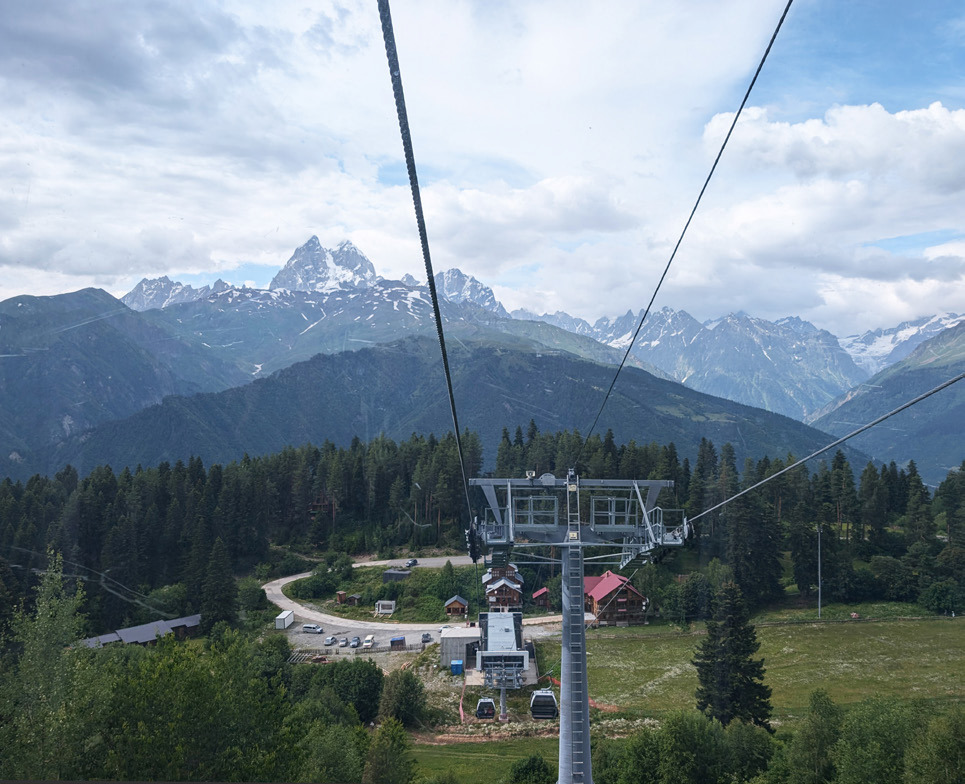
We headed back to the room and rested for a bit before heading out on our final activity for the day. About half a mile up the hill from our guest house sat a pair of ski lifts. For 25 lari, you can catch a ride up to a restaurant and eventually to the top of the nearest mountain ridge, which promised to offer even more spectacular views of the Caucasus mountains that form the Georgian border with Russia. A sign said that the lift ceased operation at 5:00, and it was already after 3:30. We were told the lift only took ten minutes or so to reach the top, so Caleb and I decided to head on up. I read that sometimes they didn’t run the upper lift, leaving you to ascend the rest of the mountain—so I was sure to ask if they were both operational. I was assured they were both running, so up we went.
As we approached the top of the first lift, the second one looked stationary. We hiked a couple hundred meters over to the second boarding point, and sure enough, it was stopped. Another couple was there waiting. I asked them how long it had been stopped. “Only about five minutes,” they cheerfully replied. After waiting half an hour and seeing the clock near 4:30, they decided to head back down. A Georgian in another small tourist group asked the technicians how progress was coming, and was told it was about ready to start back up, and that they would keep it running a bit late so we’d have time to spend at the top. We heard some creaks, groans, and beeps a few times, and finally at about 4:30 the second lift was back underway. We hopped on to make our ascent. Three times on the way up, the lift stopped for several minutes. Once we finally arrived at the top, the lone employee there hollered at us and yelled something that obviously meant it was closing time and we were not being allowed out of the car and should just go right back down.
I used my translator to ask at the bottom of the second lift if we could get a voucher for riding the lift another day, and just got yelled at by a technician who couldn’t be bothered to use the translator back. I don’t know what he yelled, but it was obvious that it was closed, I wasn’t getting another ticket, and it wasn’t his fault that it was closed or broken. So, tough luck! Georgia had been part of the Soviet Union for a long time. Nothing feels more Soviet than old, brokendown equipment and paying full price for something that doesn’t work and having no recourse.
Ushguli is a complex of four villages which remained off-road and isolated until only about five years ago. Even now, most visitors there do a four-day trek. You can either carry your own tent, or stay each night in guest houses along the way. My son Andrew would have loved to hike this trail through the Caucasus high country, but it would have been a four-day complaint trail with Caleb. Now that you can reach the villages by road, I decided to take a marshrutka up on Monday, spend the night at one of the guest houses, then come back to Mestia the following day.
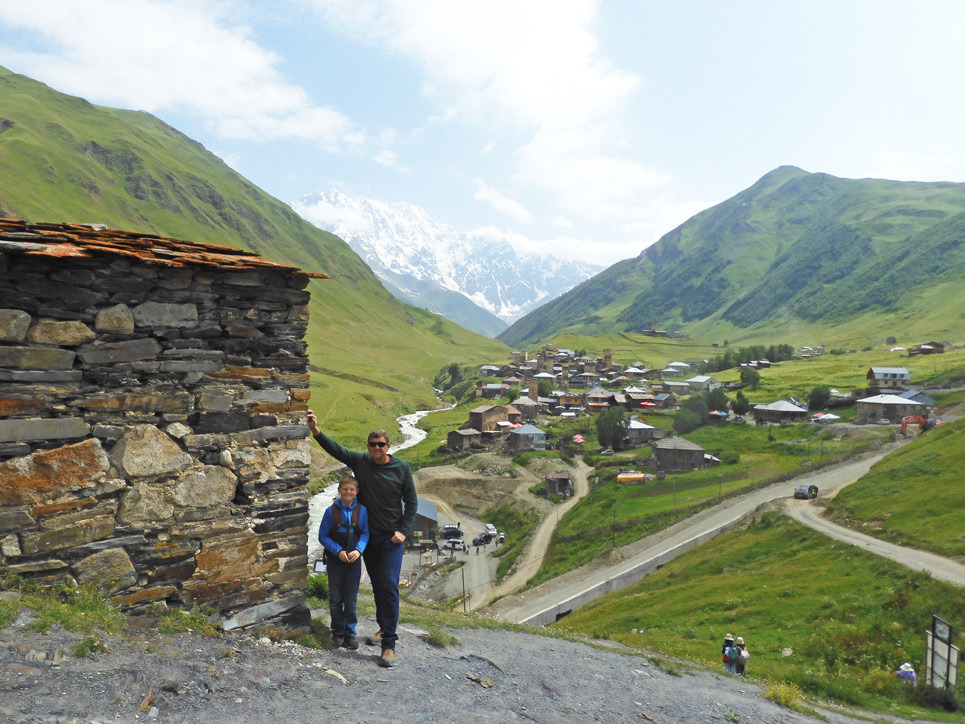
Although the distance is only 46km, it takes about an hour and a half for the marshrutka to get you there. It is a picturesque drive. We saw a medieval chapel high on a mountain, and some Svan towers here and there. The biggest collection of Svan towers was in the group of four villages, which run only about 2 kilometers from the first to the fourth. Ushguli is in the peculiar state of being ripped from medieval times straight into the 21st century. The high mountain setting and the medieval stone buildings and Svan towers are like nothing I have ever seen from a distance. As you get closer, it becomes apparent that every building in that is not falling down has been converted to a guest house. Cows still walk the streets, all of which are unpaved other than the new highway. At the same time, neon signs advertise rooms with free Wi-Fi. The arrival of the road in the last few years has rapidly accelerated Ushguli’s jump toward modernity. It would be interesting to see what the place looks like in ten more years. I suspect there will be high-rises and commercial resorts.
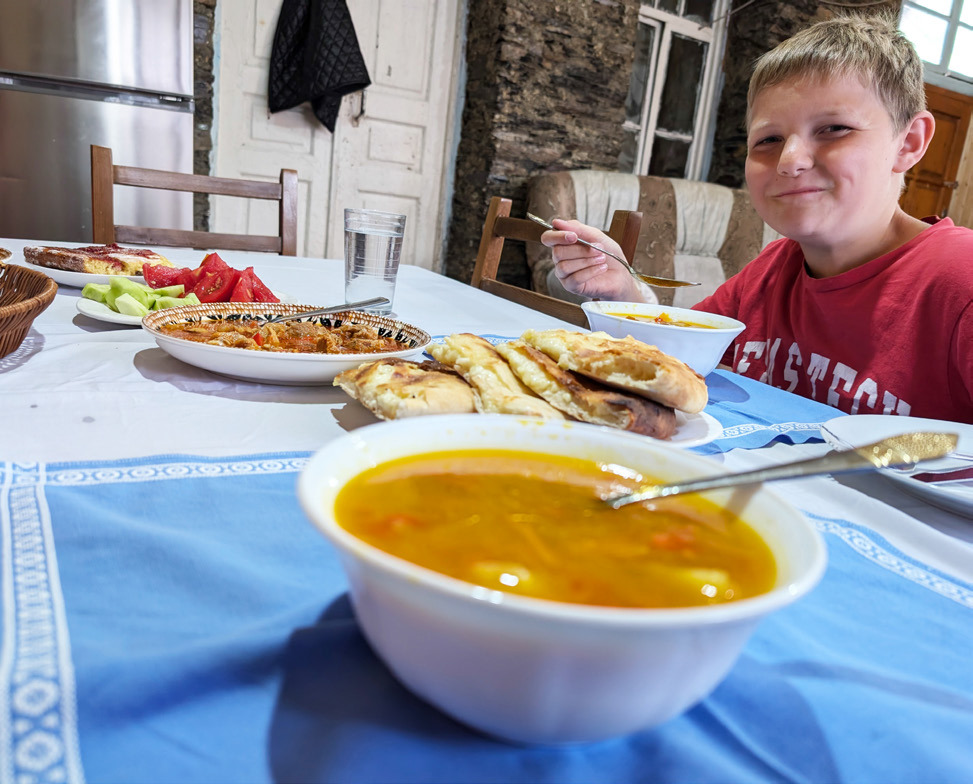
Our guest house was extremely rustic. It was clean, but the walls were made of unpainted particle board. It was sturdily put together with raw 2x12s. Our facility was in the farthest, least developed village. We did not have climate controls or Wi-Fi, which would have seemed out of place in Ushguli anyhow. Our host spoke no English and seemed to have difficulty reading Georgian. She was kind and provided us a delicious meal with huge portions for both supper and breakfast. It seemed from the advertisement as if meals were included in the price of the room. This turned out to be too good to be true. The room was only 55 lari (about $20), but the meals turned out to be another 80 lari! Those were some of the most expensive meals we ate the entire time we were in Georgia. Caveat emptor! In Georgia, you had better know what is included before you consume it, and negotiate the prices beforehand. Fortunately, this was by no means ruinous by American standards.
Caleb and I walked among the Svan towers in all four villages. We climbed to Queen Tamar’s winter residence. Sadly all that remains of this is a single tower, as the Soviets dismantled the rest of the buildings to use the rocks to fence farm plots. We walked to medieval churches and monasteries. We sat on a hill chatting with the trekkers as we gazed at Shkhara, the highest mountain in Georgia, high upon the Georgia-Russian frontier. We sat in awe of the glaciers others had recently hiked. It was a truly amazing experience, all the more for me as I had not even known of Svaneti when we left North America.
