David Pafford of Spur and his son Caleb continue their travels last week, spending July 15–18 in a country that bridges the boundary of Eastern Europe and West Asia. “If you would like to see more photos and hear the ‘long version’ of our story,” wrote Pafford, “please visit the website www.farther-beyond.com/ circumnavigation. I hope you will join us each week to hear the latest report.”
Like Georgia, Azerbaijan is a former Soviet Republic— a place that would have been difficult if not impossible for me to visit earlier in my lifetime.
It is another country in the Caucasus that wants to be part of Europe, but has much in common with Asia; a place along the old land trade routes between Europe and the Far East. Much of Azerbaijan looks geographically like it could be part of the American Southwest. Riding across the country to visit the 18th-century Sheki kahn summer palace, I felt as though we might have been driving along Interstate 40 someplace in Arizona or New Mexico.
Azerbaijan is oil and gas rich, like Texas. Vast stretches are dotted with pump jacks as in the Permian Basin. Stretches of the interior had been leveled and canal-irrigated at some point, but that enterprise had apparently been deemed not economically viable as most of the dry, salty land had been abandoned to salt brush like parts of the Southern San Joaquin Valley along Interstate 5. Dry ridges crop up here and there, looking like California’s coast range, or a desert hogback somewhere near Mojave, minus only the Joshua Trees.
Like Georgia, Azerbaijan has some fascination with pseudo-sci-fi postmodern architecture. There are a lot of strangely shaped buildings, though at least some of them – like the flame towers – do at least seem to have some reason for looking the way they do. Baku’s flame towers are shaped like tongues of fire. They display a light show every night that rotates between fiery images reminiscent of the energy industry that powers the country’s economy and patriotic images of a soldier waving the Azerbaijan flag, or the flag simply fluttering in the breeze.
Azerbaijan does have its Caucasus high country, but it is either drier than Georgia’s mountains, or we did not see its highest, greenest parts. Unlike Georgia, however, Azerbaijanis seem to have embraced tourism. The scenery may be a little less picturesque, but there are some interesting historical sites and it is nice to feel as if people want you in the country for something other than to squeeze a few lari or manat out of you.
We met more than one local interested in sharing the history and identity of their country. Those we met were all quite patriotic. The country is run by what is essentially a family dictatorship, established by Heydar Aliyev and continued by his son, the current president of Azerbaijan. I never met one Azerbaijani who had anything negative to say about him. Unlike the feeling you get in Turkey that perhaps there is not a single person in the country who believes Erdogan has any redeeming qualities, the Azerbaijanis we met seemed to put Heydar Aliyev on a pedestal, often referring to him as “the father of our country.” His son seems to be just a few steps behind.
In semi-Soviet fashion, you see Aliyev family propaganda everywhere. Although there are not Mao– style building sized murals to the late leader, there are highway billboards all over the country with Aliyev’s official portrait superimposed over the national flag. Several of the museums and historical sites we visited featured placards and explanatory signs infused with praise to Heydar Aliyev or the Aliyev family for valuing, sponsoring, or somehow making possible the carpet museum, the restoration of a historical site, or the preservation of some critical component of Azerbaijani heritage. The most interesting part of all of this to me was that it was harmonious. It didn’t feel as though there was some massive state campaign to convince people to love someone they found objectionable.
Another interesting Soviet-era holdover not as evident in Georgia was the presence of state-manufactured cars. The Soviet Union of course created state-manufactured cars during its tenure, which ended in 1991. Apparently some of these cars were built after the collapse of the Soviet Union. You see these cars still running now and then in Georgia and in the city of Baku, but once you venture out into the countryside, a considerable number are these cookiecutter, non-air-conditioned old cars. Some have been converted to have AC, and many are in remarkably good condition. They are apparently inexpensive and easy to work on. Soviet military equipment in World War II had the reputation of being inexpensive and mass-produced, but not of the highest quality. These cars must not have been complete junk, or there wouldn’t be so many of them still on the road.
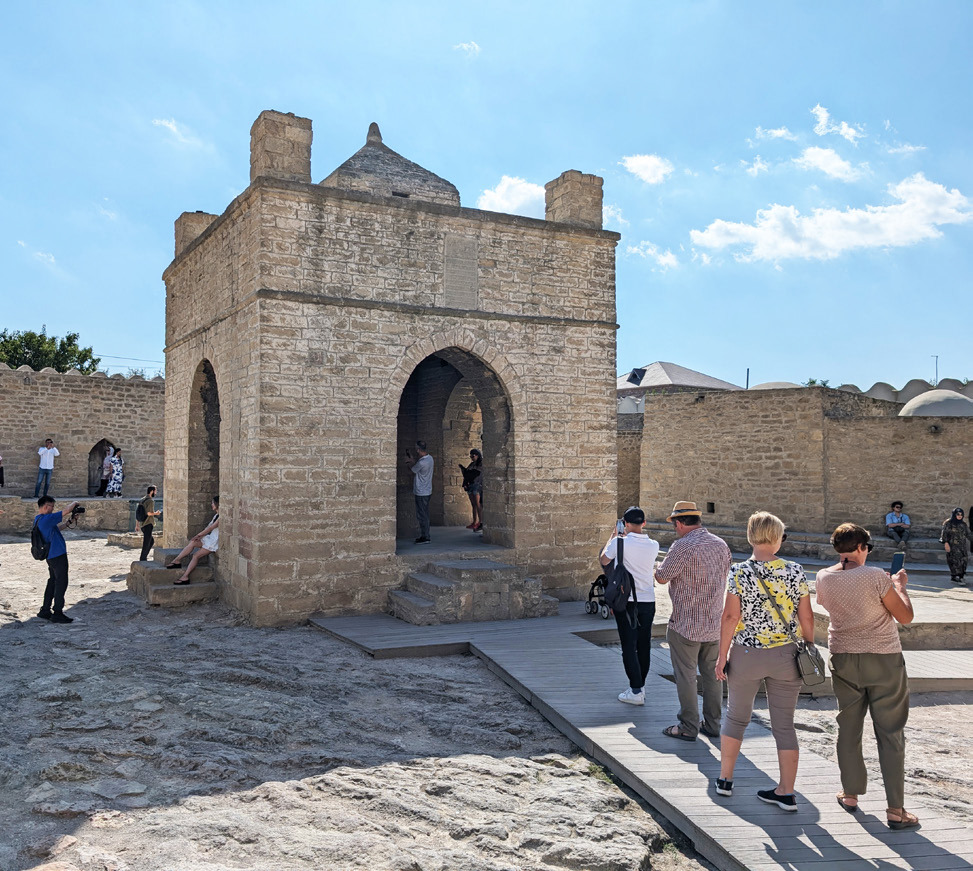
Caleb and I arrived in Baku on Monday morning. We elected to visit a couple of local sites before dinner. We decided on the fire worship sites north of town. We took the city bus over an hour to the Atashgah Zoroastrian Fire Temple. The source of Azerbaijan’s oil and gas wealth also generates surface gas emissions that, once ignited, can cause an eternal flame effect. Ancient peoples may not have understood the natural explanation of this phenomenon, but they understood it was a special and unique place. It became a holy site for Zoroastrian worshipers prevalent in this area before its Islamic conquest. The temple is relatively small, and there are only a few placards around describing pieces of the structure itself and a little bit about Zoroastrianism. Interestingly, the descriptions of Zoroastrianism at the two sites we visited this day differed significantly.
There are recorded mentions of Zoroastrians, Hindus, and Sikhs coming to worship fire on this Caspian Sea peninsula as far back as 1,000 years ago. The original temple seems to have been destroyed by Muslims, who also ran the Zoroastrians and Indian religious practitioners off to India. Indian merchants remained active in trade in this region, however, and pilgrims from the religions mentioned above made treks here to visit this eternal flame and the one at Yanar Dag. Much of the present temple complex seems to have been constructed in the 17th and 18th centuries. The eternal flame went out in 1969, due to either oil and gas extraction or an earthquake, depending on who you ask. The fire in the temple is now fueled by piped-in gas. It was kind of a cool site, and an inspiration to read a bit more about Zoroastrianism. Even I, as a pokey visitor, did not need more than an hour to feel like I had thoroughly seen it.
We then caught a twenty- minute ride to Yanar Dag, another site that was somehow ignited long ago and burns continuously due to gas emissions. It really is just the side of a mountain with a little vertical spot of about 15-20 square feet that looks like the dirt is on fire. Well, there is a fire, it just doesn’t consume anything. There is an amphitheater where you can sit and watch it burn, with a few buildings containing some explanatory placards behind. It is on the Baku tourist trail, so a lot of people come see it. That evening, we grabbed a couple of shawarmas and hit the sack with plans to visit the museums and historical parts of town on Tuesday.
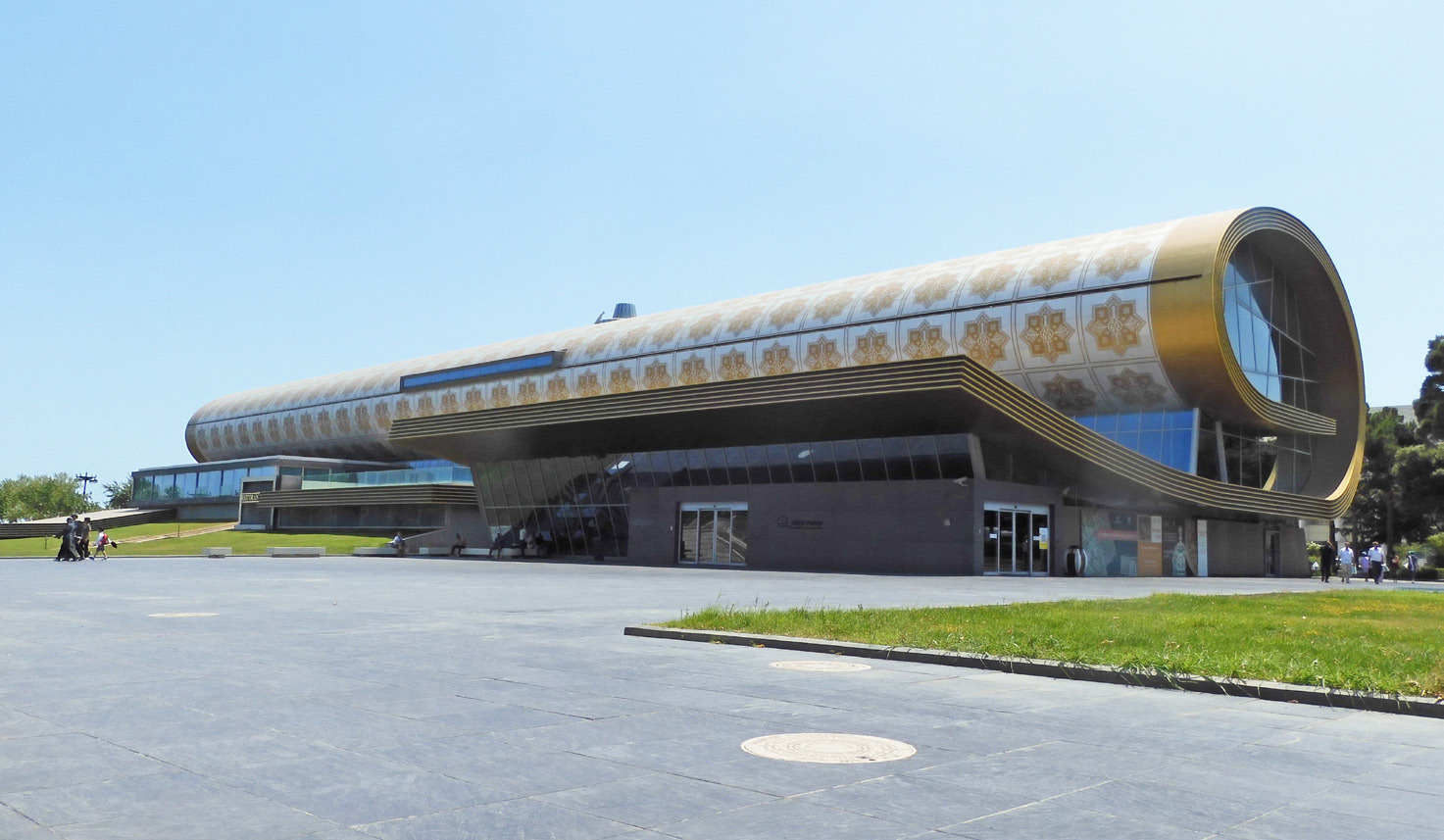
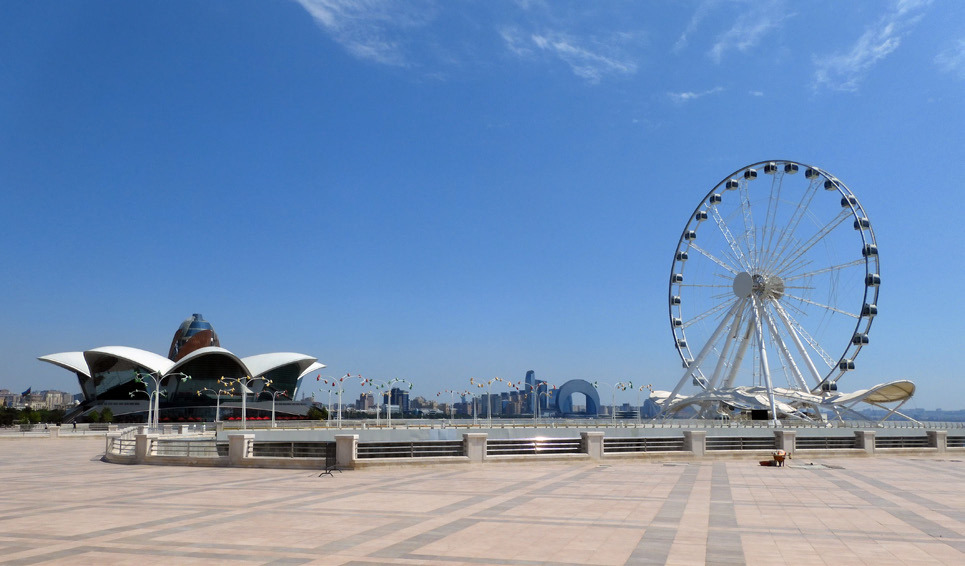
The city has an impressive seafront promenade and a beautiful skyline with modern buildings, a crescent-shaped hotel and a “Baku Eye” modeled obviously after the one in London. We enjoyed our complimentary breakfast overlooking the Caspian Sea, then walked over to theCarpetMuseum—which is actually shaped like a carpet. As you might imagine, the museum is dedicated to explaining the art and process of creating the carpets that come from this area. They are an important part of Azerbaijan’s heritage. It was in interesting place to spend an hour, and the building is pretty cool. Interestingly, pro-Aliyev commentary is infused throughout the literature explaining about the carpets. Heydar Aliyev had apparently been primarily responsible for the creation of the museum.
We later visited the Palace of the Shirvanshahs, old town Baku, and the Maiden Tower. These areas are all obviously old and historical, although many of the exact details of their histories have been lost over time. Baku was an important location due to its position on this peninsula jutting into the Caspian Sea, but it was not a capital until the Shirvanshahs moved their palace here following an earthquake during the 15th century. Shirvanshahs were the rulers of a region called Shirvan here from the 9th to the 16th centuries, when they were conquered by the Safavid Empire. Exact dates are only known only for events like the Safavid conquest that are mentioned in external sources.
There are really no artifacts left in the Palace of the Shirvanshahs. Mostly, you visit to see the building itself and learn about the medieval state of Shirvan and its rulers and people. Several 19th-century cultural artifacts here and there in the building seem anachronistic considering the age of the building. It is an impressive palace, though. It creates a bit of a problem for interpreters. How do you explain the history of an obviously historical building that you don’t know the history of? This presented a problem at the Maiden Tower as well.
Baku’s old town is a commercialized tourist mecca full of shops and restaurants surrounded by a wellpreserved city wall. It is a fun place to visit, and we ate a nice supper there after we were finished visiting, though we did not buy any kitsch. I had dolma (meatfilled grape leaves) for supper; it was very good. Caleb had some form of kebab, which he also liked. We walked the area en route to the Maiden Tower, paid our fee and climbed.
No one really knows the purpose of the Maiden Tower. The 12th-century tower, about 100 feet high, offers pretty views of the city and surrounding areas from the observation platform on top. It could have been defensive, or it could have been some kind of temple. Stairs spiraling up the perimeter walls guide you up about nine floors, offering resting points that have been converted into a museum of sorts, chronicling the basic history of Baku and Shirvan. Like the palace, though, the tower has few artifacts predating the 19th century. The two upper floors feature holographic displays depicting items believed to have been connected to medieval Shirvan, and lamenting their extraction to museums around the world. Almost none of the holographic images were functioning, so we could not even see the images of the “stolen” artifacts. I was left with a sense that if they couldn’t even keep their displays lighted, perhaps the more valuable objects were better left under the protection of the British Museum, the Louvre or the Metropolitan Museum after all.
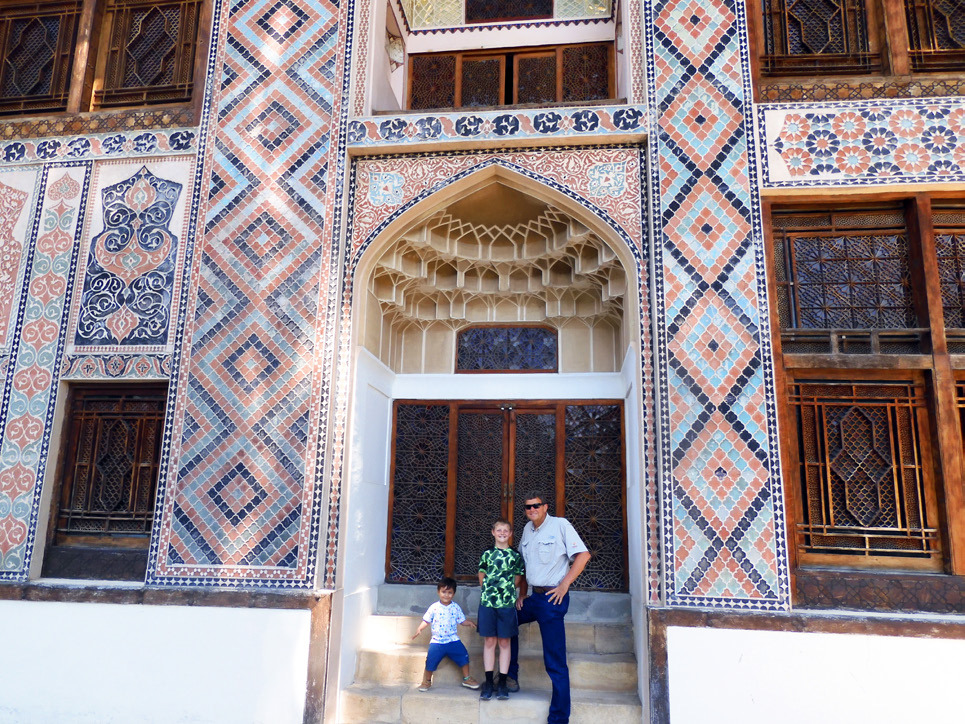
On our last day in Azerbaijan, we took a guided tour to Sheki. We don’t normally take guided tours, but I wanted to see the Sheki Khan palace, and it was a five-hour drive. The buses that went that direction would never have gotten there and back the same day, and we only had one day. Guided tours did offer day trips there. We traversed a lot of territory that, as earlier, resembled the American Southwest.
The Sheki Khan palace was a beautiful 18th-century building with ducting technology to keep it cool, and hand-assembled stained-glass windows. Everything was assembled with pegs—no nails. You cannot take pictures inside, which is unfortunate, since the stained glass is brilliant when caught by the sun, but does not even look colored from the outside. As with the Palace of the Shirvanshahs, there are relatively few ancient artifacts. Most of the good things were lost or plundered long ago. It is not an extremely large building, so it does not take a very long time to see. That was good, because we had a couple of other stops to visit on this trip and a long drive back to Baku.
After the Palace of the Shirvanshahs, we visited the Sheki caravanserai, where traders on the old silk and spice road would stop to ply their wares as they came through town. The rectangular two-story structure was arranged to allow traders to set up shop on the ground level or rest in apartments above. There was a basement level for storage of goods, feed, and that sort of thing. A caravan coming through town was not an everyday occurrence, thus there was a dedicated space in the square for dancing girls, partying and carousing. I learned also that excess livestock was also stored here. Traders bought was was effectively horse and camel insurance. Then, if they arrived with a sick, lame, or dead animal, they could trade it out as they passed. The insurance peddlers then could attempt to nurse the afflicted animal back to health and trade it off to subsequent caravans. I had no idea such an arrangement existed, and found this both amusing and practical.
Before leaving town, we stopped for an outdoor lunch. This took longer than it should have, which put us a bit behind schedule. Our meal was tasty, though. Caleb ordered a brazed lamb dish, and I ordered a stewed lamb dish. When our plates arrived, they had identical lamb shanks lying in buttery garlic and coriander sauce. I had a lamb soup as well, which as far as I could tell had one small bite of lamb in it. All of these tasted good, though, and we enjoyed visiting with our fellow tourists.
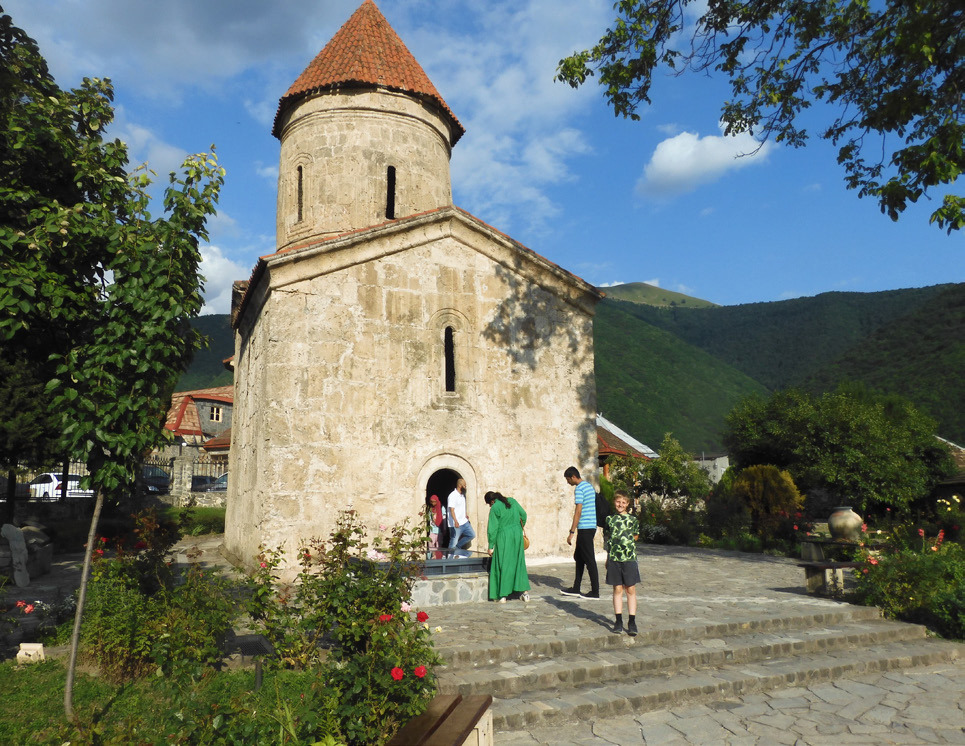
We had one last stop scheduled—an Albanian church. This area was called Albania, although it has no relation to the modern nation of Albania, which sits across the Adriatic Sea from Italy. According to legend, Christianity was spread to this area by Bartholomew, who was martyred near Baku in the 70s A.D. I am not an expert on Christianity’s spread to this area, but this sounds a little bit dubious to me. It is certain, though, that there were churches here in the fourth century. The conquest of Islam a few centuries later impeded the continued existence of these congregations, but the buildings remained.
Our driver intended to take us to an off-the-beatenpath Albanian church, but got lost trying to find it. We could hear him speaking to the guide and several people on the phone in excited Azeri—our little Mercedes diesel van scrambling up rock paths all the while. After driving about an hour into the mountains away from Sheki, we seemed to reverse course. No explanation was ever made about this, and both driver and guide pretended we were just going to the intended church all along. But about an hour later, we rolled back into Sheki, and stopped at an Albanian church right there in town, not 10 minutes from where we had eaten lunch!
There are several Albanian churches in the area. They are all ancient, and they seem to all look similar, so this one was as good as any. It just cost us a couple of hours of travel time. This site had been used as a place of worship for a long time. Excavations had been made revealing stone walls from before the time of Christ, and a Norwegian researcher had carbon-dated cultic objects he claims were from 3,000 B.C. The current building, though, was built in the 11th or 12th century and functioned most recently as a Georgian Orthodox church. It was probably used as a Chalcedon Church or an Armenian or Albanian Apostolic Church in its more distant past. There are several artifacts on display, not just from the Christian history of the building, but also cultural items unearthed in the Norwegian research. Caleb was most impressed by the glass-covered holes through which you could peer to see human remains in the crypt.
We stayed only about 15 minutes at the church. The building was tiny, and this was enough. Searching for it, however, had put us a couple of hours behind. We had been scheduled to arrive back in Baku by 10 p.m. Our driver made up some time coming back toward town, but it was after midnight before Caleb and I rolled into our hotel room to pack things up and prepare for our relatively early flight to Dubai the next morning. Other than having a bit of a short-sleep night, everything worked out fine. We saved an hour of sleep time by ordering a Bolt to the airport in the morning rather than waiting on the public bus. I considered this money well spent. By midday Thursday, we walked off another comfortable Azerbaijan Airline flight and into Dubai.