
David Pafford of Spur and his son Caleb continue their eastbound circumnavigation after bidding good-bye to wife and sister. “If you would like to see more photos and hear the ‘long version’ of our story,” wrote Pafford, “please visit the website www.farther-beyond.com/ circumnavigation. I hope you will join us each week to hear the latest report.”
Our introduction to Romania started in Budapest. In an attempt to gain a new experience and save on overnight accommodation, I booked a sleeper car on a train scheduled to leave Budapest, Hungary at 3:10 p.m., and arrive in Bucharest, Romania, at 8:35 the following morning. We passed on hiring an entirely private compartment, opting instead for an air-conditioned four-person billet in which the seats folded into a lower set of bunks, with a permanent overhead bunk. In its communist era, the Romanian government operated the railroads. When the government was toppled in 1989, the state railway was broken up into a passenger rail company, a rail freight company, and a separate company managing the infrastructure such a tracks, stations, bridges and that sort of thing. So, the company providing us this service was essentially the Soviet-bloc era Romanian national rail system, with an additional 35 years to age—and the experience was about like trying to eat cheese that had “aged” 35 years.
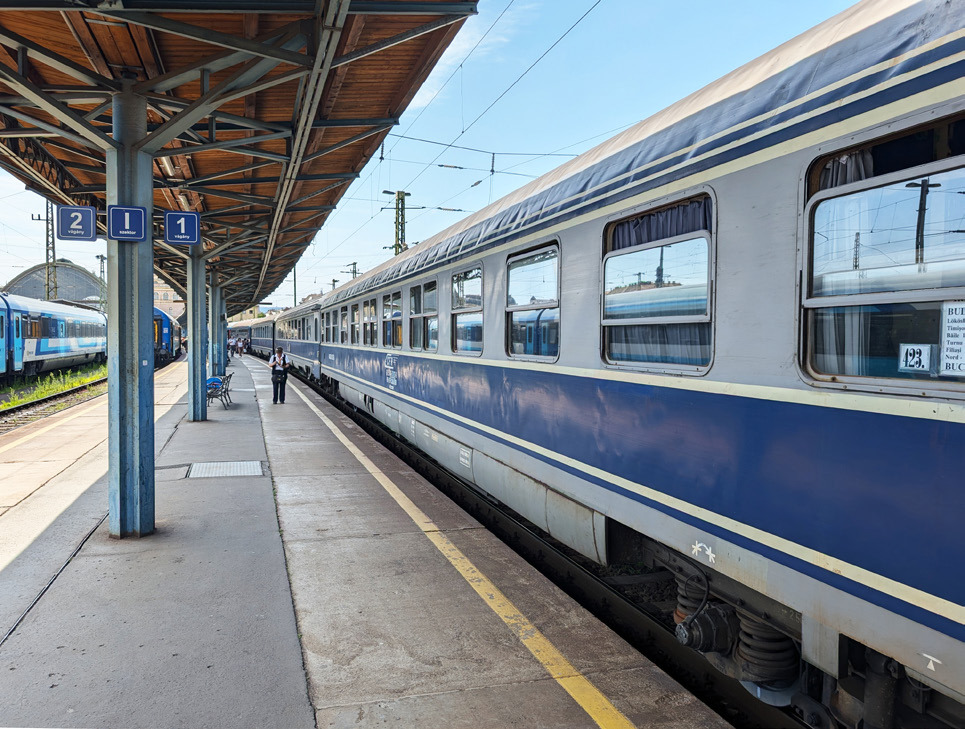
The Budapest train station seemed like a vestige from the Soviet era. It actually looked pretty cool, as if it were from some ’50s or ’60s spy movie. With communist (in)efficiency, the station was set up so that you had to read a giant board to figure out which platform your train would leave from, then scurry over to it before the train left. Only in this case, some of the platforms – like ours – were about a half a kilometer from the board. I suppose the electronic board was not from 1989. We made it to our train in time, but none of the cars were labeled. We found a conductor taking a smoke break and had him help us identify our coach.
The train itself also looked like it could serve in a period piece, except that the tops and sides of the cars wererustedandtherewasdiesel oroilrunningoutofpanels and down the sides of most cars. The steps to enter the car were big grates recessed into the side of the car itself, so that it was about like a six-foot vertical ladder to get in – impossible to surmount with bags. I helped a couple of ladies heft bags in, and did the same for Caleb, before raising my own bag over my head and chucking it inside the car to climb in. It was the middle of the afternoon, and the train was stopped on a humid 33C day (in the low 90s F). The inside of the train was uncomfortably hot. Perspiration ran down my shirt and back. I could feel a cool surface on a mechanism that I supposed was the air conditioner, but it certainly wasn’t blowing anything out. Perhaps once the train began moving, the air conditioning would kick in as is sometimes the case in older vehicles. I decided to wait in the breeze out on the platform until the train was ready to leave. This provided some relief.
Once the train started down the tracks I went back into the car and met a young Swiss couple with whom we would share our compartment. They were sitting on the shaded side, so Caleb and I scrunched over toward the middle of the bench, out of the direct sunlight from the window. The air conditioning system at times oozed a bit of air. It kicked off altogether for long stretches. Since our car was designated an A/Cequipped accommodation, most of the windows had been sealed shut. In a stroke of luck, I discovered that one of the windows in our compartment had not been effectively sealed. I asked the Swiss couple of they minded if I tried opening the window. They initially agreed, and a blissful whoosh of fresh air – and admittedly quite a bit of noise–enteredoursweltering cube. I considered the noise a welcome tradeoff for the air flow, but after a few minutes the waifish little Swiss fellow said the air pressure was hurting hisears,andbeggedmeto shut the window. I reluctantly did so, but then went out to standinthehallwayalongthe opposite side of the car where I found another unsealed window.
Standing in the hall next to a window would not be practical for an entire sixteenhour train ride, so I decided to explore the rest of the train. This is when I discovered that there was also no available food or potable water. I had suspected this, and packed plenty of food and a liter of water apiece. One of the three air-conditioned cars hadonlyseats.TheACworked comparatively well in that car. Behind it, the second-class cars had only seats and open windows. It was substantially more comfortable with the airflow,soIeventuallypacked a few of my things and sat in that area until we reached passport control.
Hungary, Romania and Bulgaria have all signed onto the Schengen agreement. Signatories are supposed to have no border controls. When you pass from France to Belgium, for example, you may not even notice the sign, as they are less prominent than signs identifying the borders between U.S. states. Apparently, the Balkan states aren’t completely comfortable with this arrangement yet, as we underwent border inspections crossing into every new country after Hungary. I went back to our car to reduce the number of things that might have to be explained if I was in the wrong seat, or Caleb were by himself. I stayed there for a bit, munching on my food, visiting with neighbors, and trying to keep Calebfromoverwhelmingour compartment mates. Once they heard there was better air a couple of cars back, the Swiss couple decided to hang out back there for a bit. I stayed, because I knew there was passport control on both sidesoftheRomanianborder. The Swiss folks were gone for a surprisingly long time. I thought perhaps they had gotten off the train to try to buy food or water at the Hungarian checkpointandmaybe not made it on when we left. Whathadhappenedtothem? They had been locked back in “steerage.” At a certain time, the conductor locks the sleeper car for the privacy of those who have reserved this more expensive ticket. After a brief scolding, they had been allowed back. The unfortunate consequence of this was that none of us could any longer access any of the other cars, either.
Not too long after 8:00 p.m., our Swiss companions madeouttheirbeds.Theyhad beenassignedbothofthebottom bunks. This left no seats in our compartment. Caleb andIwererelegatedtoourupper bunks. You can imagine whatthetemperaturewaslike in the upper foot of the car, with sealed windows and no air conditioning. I stood out in the hall, hanging my head out the one open window like a dog in a pickup truck. I could not do this forever, though,andtherewasnowno other car where I could seek asylum. Eventually I gave up and crawled up into the stale, sultry, five-and-a-half-foot bunk near the metal train roof. I did sweat all night, but surprisingly, I also slept some. I woke up with that clammy, pasty feeling of several layers of perspiration dried on top of one another. The Swiss couple did not get up until about eight o’clock. I can seldom sleep past six in the best of circumstances. Early in the morning, I crawled quietly down and walked to the bathroom, to give myself a non-potable sponge bath. It felt at least somewhat refreshing.
I looked outside. Beautiful farms rolled by at about 70kph.HungaryandRomania both have a lot of sunflower fields out in their flatter lands. We passed the occasional center-pivot irrigation system. I saw some corn. There was more beardless wheat – the onlykindIeversawinEurope. I thought to myself, “You got some sleep. You are on a tour of the world, what do you have to complain about?” A warm feeling – a good one this time – overtook me as I thought about the blessing and freedom I had to do what I was doing. I was blessed that Caleb was with me. I was doing something I had always wanted to do, and this was just a funny part of the experience. It hadn’t ruined anything, other than perhaps advancing my laundry schedule one day. I am still glad we rode that train rather than just hopping on another FlixBus. If I had it to do over again, though, I think I would savethemoneyandjustbuya second-class ticket on the car with opening windows.
In keeping with the pattern, theRomanianstatetrain rolled into Bucharest about two and a half hours late, for no apparent reason. All this did was restrict our sightseeing by a couple of hours in Bucharest.
