“You’re from the Carolinas. Nobody from around here says ‘Post’ that way.”
(Editor’s note: I’d heard him pronounce the name of the neighboring Texas town they’d just left as ‘peaust,’ a dead giveaway to the high-tide accent of certain portions of the Eastern Seaboard.)
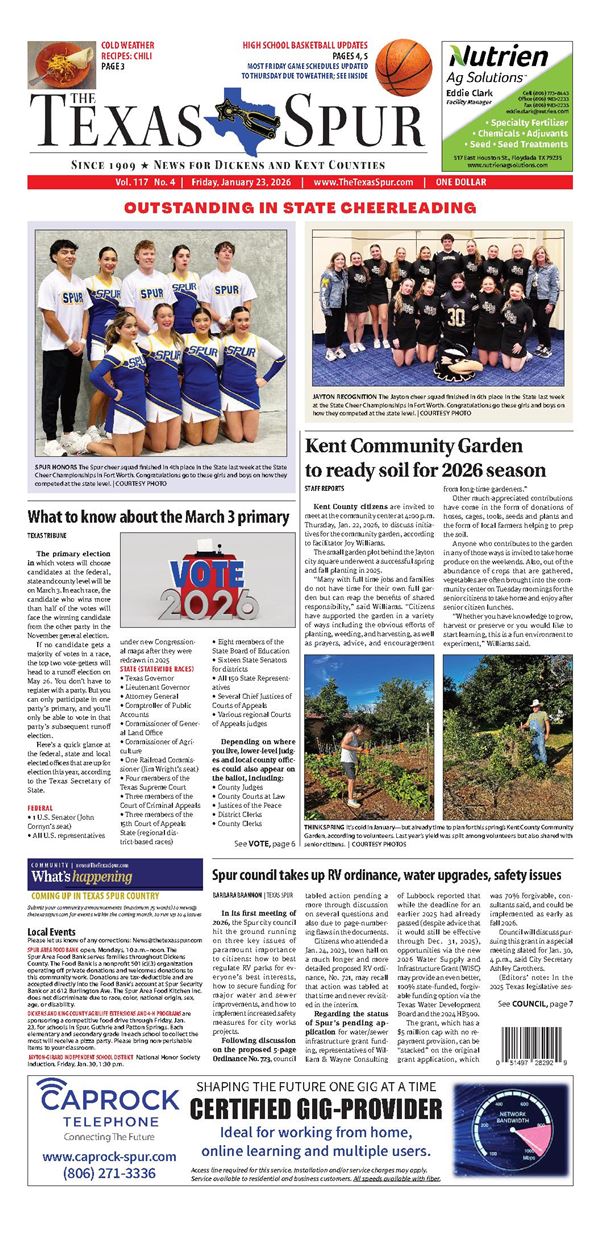
Saturday morning, rainy, not quite a gullywasher and the lights were on in the offices of The Texas Spur newspaper. Of course we stopped and I went in.
That’s how I met Barbara Brannon. Post, Barbara told me, was built by C.W. Post, of Post Cereals, to be a utopian village. Since I chase squirrels: his daughter, Marjorie Merriweather Post built Mar-a-Lago and bequeathed it to become a national monument, but maintenance costs forced Mar-a-Lago back into private hands.
Barbara gave me a copy of a book she’d written, “The Ferries of North Carolina,” because, Barbara explained, there’s not much demand in Spur, Texas for a book on North Carolina Ferries.
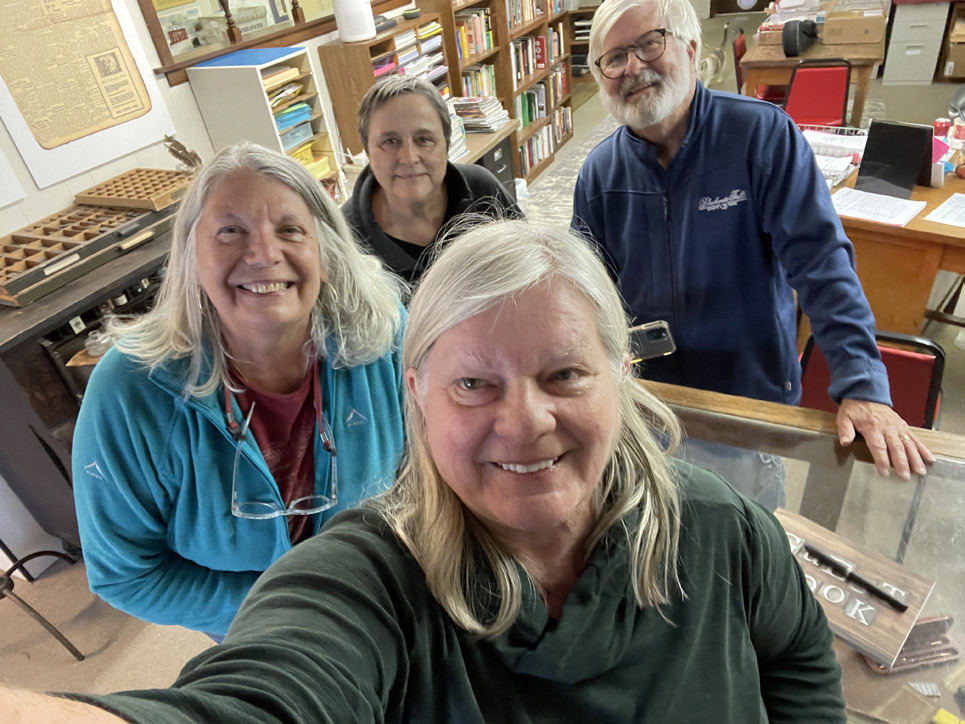
After great salads at the Turnaround Cafe, named for the turnaround at the end of the railroad spur, I went back to The Texas Spur. This time Sharon went in with me and we talked with Barbara, editor and co-publisher, and Kay Ellington, publisher, for two hours of stories. They are now the drivers of four other nearby small-town weeklies.
While Kay worked at The Wilmington Star-News, Barbara had taught at UNC Wilmington. One of her students was Jason Mott, whose novel “Hell of a Book” won the 2021 National Book Award for best fiction.
Sharon and I went to a Celia Rivenbark book signing. Celia had been one of their Wilmington neighbors. Barbara didn’t know of Ivy Hayes. We didn’t know of Minnie Evans. My mother grew up in Burgaw. Barbara’s sister lived just outside Burgaw. Of the several musical instruments in a back room of the newspaper office is a reed organ Barbara’s great-grandmother had played as organist at Airlie Chapel.
The former darkroom had penciled notes on the bare wall, suspected to be formulas for exposure times and image sizes. The “new” bathroom, like the old, was up three steps so there’d be room for the essentials between the commode and the sewer line. The soap was in 14-oz, Go-Jo soap bottles, befitting a bathroom for people who published and distributed newspapers.
Next door is Spur’s Palace Theater, a historical landmark which opened in 1929. The Palace had a showing of “Urban Cowboy” for the 1980 movie’s 40th anniversary. Aaron Latham, screenwriter for “Urban Cowboy,” was from Spur. John Travolta (Bud) introduced himself to Debra Winger (Sissy) “I’m from Spur.”
Bob Phillips was a Dallas TV news reporter who, in 1972, reached out to, and was mentored by, North Carolina’s Charles Kuralt. Bob started a weekly TV show called “Texas Country Reporter” about stories of Texas. In 2021, “Texas County Reporter” was bought by Texas Monthly. Barbara says it’s the Texas equivalent of Our State magazine. I checked the April issue. It’s pretty close.
When Bob called Barbara about doing a story, Barbara figured it would be about the Palace. No, Bob said, we’re going to do a story on The Texas Spur, 20 years older than the Palace, that started printing in 1909, the year Spur was founded and two years before Spur was incorporated. I don’t know, but I suspect, editorial comment in The Texas Spur contributed to incorporation of the town. That’s what newspapers can do.
Barbara and Kay, each with a background in print media, are attached to, are committed to, are passionate about small-town newspapers. Unlike the partisanship of big media, small-town papers are about neighbors. Town council meetings, successes of the high school drama class and sports teams, the new books in the library.
The split in the Methodist Church filtered down to Spur and Dickens County, but the necessary coverage was written by neighbors, about neighbors and would be read by neighbors so it had to tell the story without spreading the sparks.
A leaking roof on the historic building where The Texas Spur is now located had weakened the floor and the printing machine and the Linotype had fallen through the floor, since rebuilt, but the tools for the linotype are still hanging on the wall in their original places.
The Library of Congress included The Texas Spur in its series “Chronicling America, funded by the National Endowment for the Humanities” (LCCN sn 86089669), and has the Texas Spur’s starting date as “1943?”—the year I was born—and not 1909, its founding date. Past issues of The Texas Spur are online in the collections at UT Austin and Texas Tech in Lubbock. Family genealogists are appreciative, as are Barbara and Kay since they can now do referrals instead of research.
Barbara and Kay, in addition to being publishers, editors, authors, reporters and professors, are, at heart, custodians of the history of small-town newspapers, and champions of small-town papers, the papers that report on the day-to-day of America’s core, the more determinative stories. Postscript: An article in the Texas Spur Feb. 29 issue is about the District One Act Play competition in Spur. Sharon and I had breakfast at the Back Door Cafe in Roosevelt, Texas. The server taught art and drama. Last year their drama went to states as part of the Texas UIL (University Interscholastic League) competition. The Roosevelt entry was based on Jessica Swale’s “Blue Stockings” about women’s suffrage and their fight to be recognized by academia.
The UIL winners list goes back to 1926. I wonder if Aaron Latham performed in the UIL One Act Play competition.