
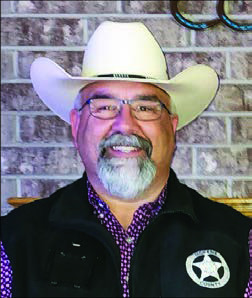
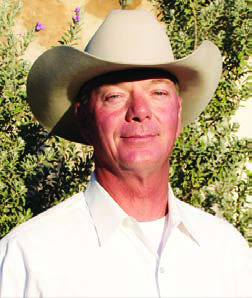
Dickens County voters and residents—and the general public—had their final chance to meet both candidates in the primary runoff for county sheriff last Thursday night.
But it turned out a candidate forum—singular— again.
Due to a last-minute, out-of-town work responsibility regarding a case on which Deputy Jay Allen is working with Texas Rangers, Allen told The Texas Spur on Tuesday night, it was unlikely he would be back in Spur in time for the 6 p.m. event. (Texas Spur readers were informed via social media on Wednesday after attempts to negotiate a rescheduled date did not work out.)
Allen provided a statement to be read aloud at the beginning of the forum (it is printed at the end of this story).
Afterward, as with the February 15 forum to which all three candidates were invited, Jerry Schmidt had the floor to himself.
Schmidt introduction.
In his brief self-introduction, Schmidt noted issues such as the importance of keeping Dickens’ county jail, working with the Jail Commission, working on emergency community standards, and preparing a budget for submission to the county.
In comparing law enforcement records, Schmidt noted, “My ability to do my job has come into question by my opponent, but I am a keep-your-head-down-andget- results kind of guy.” He noted 205 arrests under his watch with DPS, which did not include all assists. “My investigative skills are essential for the job, returning a great deal of valuable property to owners,” he said.
Schmidt said that according to his research, his opponent had 60 total arrests; not statistically broken out. “The most important thing is safety of all of you,” he said; “not all calls end in arrest.”
Moderator Kay Ellington had prepared the audience of some 40 people that questioners would be allowed to submit questions anonymously on paper.
Some audience questions were directed particularly at Schmidt, such as facts regarding his length of earlier service with the Department of Public Safety (“12 years on the road”) the highest rank he achieved, and rank when he left.
Schmidt explained that after an injury that was not a disability case, he was given the choice of a desk job in Austin or a post at a lower rank of corporal back in Spur.
Other audience Q&A.
“Does Spur have a drug problem?” was one of the top issues Allen’s supporters had discussed at his separate May 14 rally in Spur—and it was asked of Schmidt Thursday.
“Drugs are a big problem in our county,” said Schmidt, who said one method of interdiction would be to “wait for some of those people to get on the road,” then use traffic controls to stop them, and using probable cause to search the vehicle. “Vehicle seizure can lead to an investigation and warrant for their property.”
Asked if that practice was being followed in Dickens County, Schmidt responded, “It was when I was a trooper.”
Some of the following are paraphrases, for length and clarity.
Question: How do separate law enforcement agencies work together?
Schmidt: “I would like to see a joint unit. The politics behind the current arrangement — I don’t understand it. As far as DPS and other agencies go, you always work together. The State has a lot of available resources that we don’t have here in the county; we should use them.”
Question: For a while, the city [of Spur] didn’t have a police department, and it cost the city $100,000 for coverage. [Note that there was not an immediate opportunity for fact-checking or clarification of the time frame in question.] Schmidt: “You would think that seems like a lot. As a taxpayer that would concern me.”
“You’d have to charge for your man-hours, but if your deputy’s out patrolling anyway, in DPS we would still stop through the towns and work with them, and the state never once sent a bill for those services. There might be more to it than I understand. It sounds expensive for something they’re already paid to do.”
Question: Talk about Senate Bill 22 and the opportunities that has brought to sheriff’s departments.
Schmidt: “I don’t know what the budget is and don’t have access to the records. I know there’s a lot of money for upgrading equipment and infrastructure. As for training, we definitely need it, and those funds need to be used as wisely as they could. Pulling from the small cities, a city officer working 80-100 hours a week and getting paid $30K a week might want to go elsewhere.”
A comment from the floor noted that the annual budget is available on the county website.
Question: The next group of questions have to do with, what to do about the jail. How would you maintain jail standards?
Schmidt: I would have to follow the commission on jail standards; historic jails are exempt from some requirements. Deputy Romero is up on that and would be useful to keep him on. I would love to keep that building and keep it functioning.”
Question: What specific kinds of training would you advocate for and implement if elected training?
Schmidt: “I would have to see what training deputies have right now: some requirements have to do with drug interdiction, 1st Amendment, 4th Amendment, search & seizure; would have to go through and get everybody up to standards.”
Question: “When you retired from DPS, were there any disciplinary actionds pending?
Schmidt: “No.” Question: If elected, what would you do in our [first] 100 days in office to set the tone for your time in office, and goal-setting and planning?
Schmidt: 1. Find out everyone’s training via TCOL; make sure everyone is up to standards. 2. Focus on drug interdiction and criminal interdiction. 3. Full oneyear goal: “kind of shooting in the dark”but get everybody up to standard and get as many hours on the road as we could.”
A question was posed about Spur having a separate police department, or not.
Schmidt: “That’s between the County Judge and the Mayor, if they want to work together and combine forces; I’ve seen it successul in a lot of other small communities. Then they could possibly hire on another deputy.”
A question was posed about protocols for deputies: What sort of weapons would be issued, and would standard uniforms be required when on duty?
Schmidt: “Yes, standardized uniforms make your county proud. People won’t respond to plainclothes, but you don’t have that problem if you’re in uniform. Weapons would be a long gun, a sidearm. And a taser, and a blunt force weapon—and be trained in their use. Otherwise, what the deputy is proficient in and comfortable with.”
A questioner submitted a question preceded by a perception that, under the current sheriff, there is a reluctance to get involved in civil disputes, welfare checks, stranded motorists, and the like; if elected, what would Schmidt’s protocol be?
Schmidt: “You go if you’re called. That’s what the taxpayers pay you to do; you need to go do your duty. Civil disputes are nasty, I’ve worked them, but you have to go in and separate, that’s part of what your duty is.
Question: Would do welfare checks as needed?
Schmidt: “Yes, definitely.”
Question: Is it okay to campaign on county time in a county vehicle?
Schmidt: “That would be up to the taxpayers who are paying fuel bill and salary to answer.”
Question: “If you were elected?
Schmidt: You’d do that on your own time.
Question: Do you have any idea how many traffic stops and arrests have been made in 2024?
Schmidt: “No; I’ve heard someone pulled the records the other day, but for 2024, zero.”
Question from the moderator: “Besides drugs, what are some of the things that you feel are important?
Schmidt: “Be proactive: go out and be seen; we have people who have little concern for law enforcement because they know about set hours. Let people know that you’re out there. Stop crimes before they happen, not just taking action afterward. You can’t be on duty 24/7, but you can definitely be out during hours of high crimes, starting noon Friday into part of Sunday— statistics show that’s when the crimes have increased.”
Question: How long have you been campaigning for sheriff?
Schmidt (smiling): “Too long.”
Question: How many people have you talked to—what is it you hear over and over that people want to see?
Schmidt: “That their sheriff’s office is out working for them. They don’t
See ELECTION, page 6 see the officers out being productive; they see them in cafes and at the jail, but not out in the community.”
From the floor, Schmidt was asked to follow up about community engagement; he mentioned programs to assist with topics such as firearms training, that get officers out in the community. Coordination of schedules with the school resource officer in Spur could help with coverage; “Patton Springs is just kind of left to dry, but the sheriff’s office could show up at random times and have a presence.”
The Q&A portion of the event wrapped up about 7 p.m., with an opportunity for visiting with candidate and community members.
Election day is Tuesday, May 28, 2024; early voting continues through Friday, May 24.
