
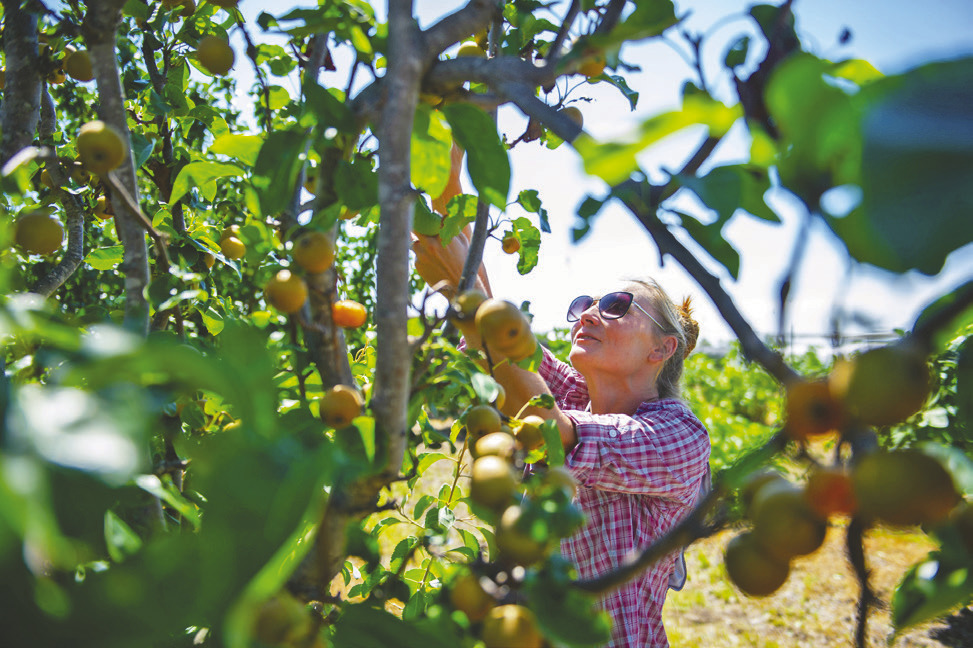
Few things are more satisfying for a gardener than to walk out into their own backyard and pluck a juicy, just-right peach directly from the tree; or a juicy, plump plum; or a crisp, juicy apple or pear. All are possibilities for West Texas gardeners.
Here are some guidelines for choosing trees for our area.
Knowtheplanthardinesszone for your growing area. Surviving low temperatures during the winter is crucial. Plant hardiness zone designations aid in predicting the likelihood of survival. The zones represent average annual lowest winter temperatures at a given location during a particular time period, not necessarily the coldest temperatures it has ever been or will be, but simply the average lowest winter temperature for the location over a specified time. Zones have a 10-degree Fahrenheit band, divided into 5-degree zones 'A' and 'B.'
The USDA hardiness map was updated in 2024. Our West Texas readership area is broad, expanding to the USDA Hardiness zone 8a, 10 to 15° F, in the southern region and 7b, 5 to 10° F, the northern region (planthardiness. ars.usda.gov).
The map website has a 'find your zone by ZIP code' function.
Choose trees that indicates they are hardy to the minimum temperature as indicated by the hardiness zone of your given ZIP code.
Chilling requirement. This is not the same as the hardiness zone. Fruit trees require a certain number of cold hours below 40° F that must be met to break winter dormancy in order for growth to resume in the spring. The longer the chill hours, the slower to come out of dormancy in the spring. This is especially critical for our growing area since we often experience late spring freezes. Trees that have broken dormancy will have put out flowers early in the spring, which can then be killed with a late freeze. Choose a tree with a long chill requirement.
Size. Choose a tree size to fit your space. Height of trees at maturity is genetically programmed: standards grow to heights of 30 feet; semi-dwarf, 15 feet; dwarf 6 to 15 feet. Large areas can accommodate standards, while dwarfs fit better in smaller gardens with limited space. Consider height at harvest time; gardeners will need a ladder to pick fruit from standards.
Next week’s column will have further discussion on choosing fruit trees.
Ellen Peffley Harp, a retired professor of horticulture at Texas Tech University, writes about gardening for several Texas newspapers.
