
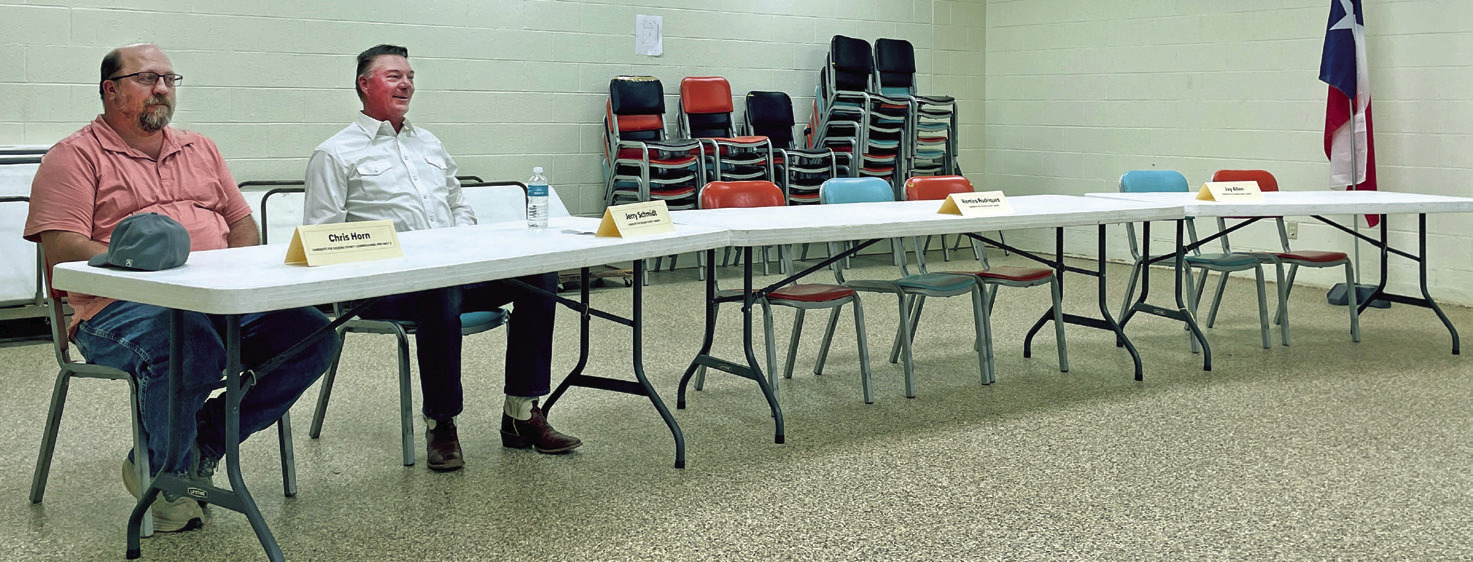
At last Thursday evening’s Meet the Candidates forum in Spur, the answers were interesting and informative, on a wide range of topics. From both of the participants.
While all candidates for county public office were invited—whether in contested or unopposed spots on the ballot—only two attended, at Dickens County’s only event this primary election cycle to provide face-to-face dialogue among candidates and voters.
The event was organized and moderated by The Texas Spur—as has become the tradition in every local election since 2018—with publisher Kay Ellington serving as moderator.
Refreshments, logistics, and introduction were provided by the Spur Area Chamber of Commerce.
For County Commission Precinct 3, to succeed retiring commissioner Charlie Morris, Chris Horn appeared well equipped to take on responsibilities that have moved far beyond road and bridge maintenance these days, to complex business and budget management, a wide range of security matters, and more.
“I’m a hometown boy who’s come back home” in 2012, said Horn in his introduction. He has two sons—graduates of Spur High School—one now in the Air Force and one who works for the solar farm.
We’ll have more on Horn’s background in next week’s Texas Spur.
Horn said that he’s still learning about jobs of county commission. “If I do come away with the win in the primary, he said, “I plan to attend all commission meetings, to get a better handle on business matters.”
Members of the audience, which numbered about 30, submitted questions anonymously via moderator Kay Ellington but also posed follow-ups from the floor. Horn was asked a variety pf questions about how he would maintain and improve Dickens County. The following excerpts are paraphrases and have been edited for space.
Q: How would you handle support for the City when called on?
A: Unless I’m overstepping in what a commissioner can do, I will provide aid with heavy machinery work (such as was done with the teardown of Spur VFD site). County machinery has always been available as far as I can see.
Q: How would you manage large-scale business and industry that draws a lot of county resources?
A: A new industry in a small county can be tricky; it does bring in new revenue, and you’re not necessarily going to stop new businesses from coming in or would want to, but you’ve got to look first at, is this going to benefit Dickens County? Job opportunity is the biggest thing. If a new business brings in availability for revenue and jobs, that’s a win for the county. . . . As far as tax base coming in, that money will need to be looked at and sent to the areas where it’s needed first.
Q: When the Dickens County Commission was involved in negotiations with Argo and then Galaxy, a certain number of jobs must be in Dickens
County. Is this a good precedent?
A: Yes. Any tax abatement should be contingent on jobs.
Horn weighed in on other questions graciously and patiently.
Moving to the main concern for the audience, the office of County Sheriff has drawn three filers as incumbent Terry Braly has declined to seek reelection after 12 years in that office.
Jerry Schmidt, the only candidate to participate, introduced his background with modesty and gentle humor, saying that he moved to Spur with his family following earlier military service and “was stuck here.” After deciding to attend Texas State Trooper school, he covered Motley and Childress counties for DPS. He was deployed in 2017 and injured overseas and “had to take a break for a while.” But after healing, Schmidt said, he “decided to throw his hat in the ring” for sheriff.
Audience members had a variety of pointed questions, though several did not hide their disappointment at not being able to hear from the other two candidates as well. (Candidate Ramiro Rodriquez, who along with candidate Jay Allen is currently employed as a deputy in the Dickens SO, had called The Texas Spur earlier in the day to say he was on court duty in Lubbock and unsure whether he would make it back in time for the event, and Ellington and introducer Matt McArthur of the Spur Area Chamber of Commerce shared this
See CANDIDATES, page 5 information with the audience.)
Again, the responses below have been paraphrased and shortened. Q: How would you improve sheriff’s office?
Schmidt: Definitely be proactive; actively patrol instead of just sitting and waiting for a call to come in. Eighty percent of the crimes aren’t solved after they happen. I would actively seek out criminal element with traffic stops and discover problems.
Q: How would your previous law enforcement experience set you apart?
A: Training. Texas Highway Patrol has some of the best training available, and I took advantage every time I could. I have gone to to Langley and elsewhere for training schools.
Q:Howwouldyoupursue additional funding?
A: Chase those grants. There are grants for drug interdiction, K-9 programs, training grants, and the like. I have contacts among grant writers and Lubbock that I would consult.
Q: You’ve mentioned the Constitutional Sheriff concept before. What does that mean?
A: Constitutional law is what you’re guaranteed by U.S. law; three-letter agencies come down and they enforce that across the country. (Schmidt discussed this in a bit more technical detail, with examples.)
Q: What about community engagement? How involved would you be?
A: Citizens appreciate seeing a police or sheriff’s report — people want to know where crime is happening.
Q: Would you provide
a report?
A: Yes, definitely. When you have the trust of the community, they call you, they help solve the crimes — you can’t have eyes everywhere. They can be your best allies in law enforcement.
Q: What should be the cooperative roles of city police and county sheriff?
A: I think they should work hand in hand. On days off, scheduling, authorizing with the county like the sheriff has; I think it should be a coorindated effort as partners.
Q:Whatdoyouthinkis the biggest challenge facing the Dickens County SO?
A: I’m trying to put this in good words. Just a lack of motivation, working with other agencies. I talk to troopers . . . there’s not a lot of cooperation there. I would definitely coordinate with other sheriffs.
Q: How do you see the SO engaging with the school districts?
A: I would definitely cooperate. Spur is lucky enough to have a school security officer; Patton does not. Get to know the kids, be a positive role model, so they will look up to law enforcement.
Q: Have you thought
about an auxiliary?
A: Yes, under posse comitatus rule, you could do that.
Schmidt went on to address questions about community involvement; what he saw as the breakdown of duties of a sheriff (“You are the administrator and supervisor; but you have to do everything from chasing cows off the road to criminal interdiction”). The sheriff is off the road more, Schmidt said, but “once you get your ducks in a row, you still have time to do enforcement activities, meeting with the community.”
In small rural counties, Schmidt said, “using your manpower wisely” is important; the deupty’s job is “to be on the road—but what deputies make right now isn’t enough when you have people who don’t know what they will encounter on the road at any day. If we want people to risk their lives, we’ve got to pay more than $36K that they could make” in another kind of job.
Q: When the county asks for help from our chief, is it right for the county to pay for the city services every time?
A: The City should pay only if for auxiliary duty, but not if simply called for backup when already out on patrol.
Darla Thomason, as former county treasurer, offered “a statement, then a question,” observing that currently, the sheriff’s office is over budget every year and asking how Schmidt would view budgeting responsibilities as a county elected official. (Thomason explained that each county unit is sent their last year’s budget; they have to make a case for any variance, which has to be approved by court after discussion. Also, the county has a $1,000 spending variance limit.)
“First thing, we have a budget and that’s a set rule; you have to work within it,” said Schmidt, who also added that he might be facing the need to hire all new deputies if the current staff were to resign. Schmidt pointedly commented, “These two men they try hard but their lack of training, or motivation ion from sheriff; they’ve had 12 years that I’ve been here, but there’s no past history of improvement.”
One audience member raised his hand to said that after his dog was recently shot, the sheriff’s office had come out to investigate but he had heard nothing back, and in a follow-up phone call the other deputy had no awareness of the complaint.
Schmidt responded that the staff should routinely have a pre- and postchangeover with a debriefing on log, activities.
Matt McArthur, currently a deputy with the Floyd County Sheriff’s Office, asked a management question: “What are your plans for making Dickens County an attractive location for other officers, with the $250,000 from SB22 (the recently passed legislation providing grants to rural sheriff’s offices)?”
Schmidt said that salary would be the first major use of the money, possibly even enabling the sheriff to recruit from within the county.
Following several other questions from the floor, on matters such as community involvement, school security, drug problems in the community, Schmidt summarized, “Your paid job is to take care of the citizens.”
Attendees who set aside their evening to learn more about their community’s law enforcement—and to press candidates on the issues— couldn’t agree more.
Note that candidates prevailing in the March 5 partisan primary election may still face possible write-in opponents in the November general election. In Dickens County, no candidates filed in a Democratic primary, so there will be no Democrats for those offices on the November ballot. Newly elected officers will be sworn in January 1, 2025.
