
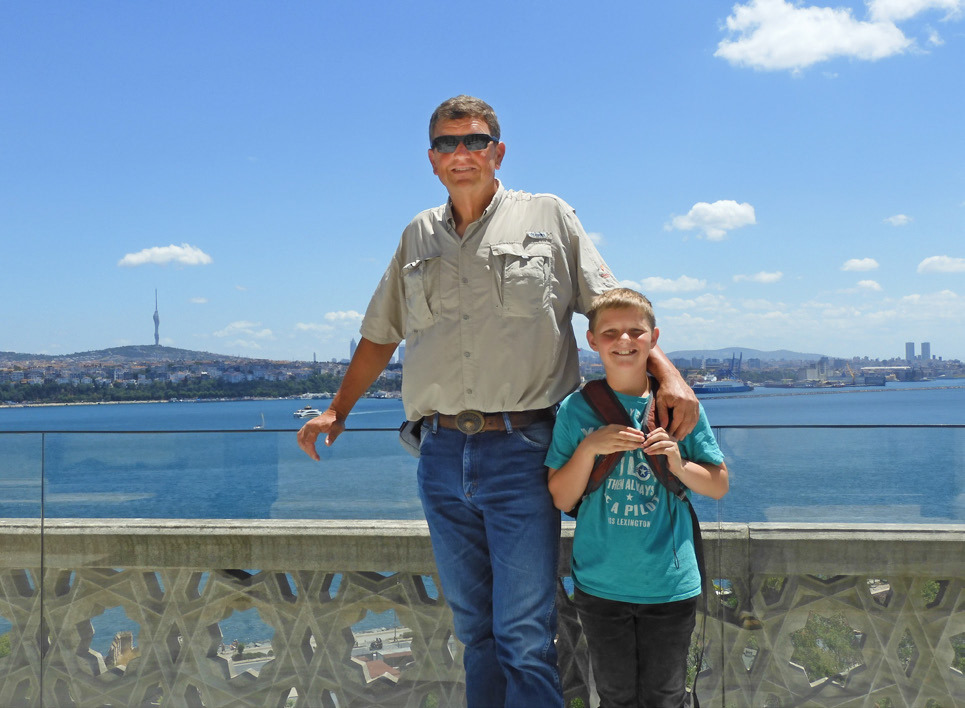
David Pafford of Spur and his son Caleb continue their eastbound circumnavigation, spending the first few days of July in Istanbul and vicinty. “If you would like to see more photos and hear the ‘long version’ of our story,” wrote Pafford, “please visit the website www.farther-beyond.com/ circumnavigation. I hope you will join us each week to hear the latest report.”
From the time man first set eyes upon it, people have always known there was something special about what is now known as Istanbul.
Before it was Istanbul, it was Constantinople. It has also been New Rome and Byzantium. It sits on the crossroads of the old world, at the junction of Europe and Asia, and also at the junction of the Black Sea and the Mediterranean. The old spice roads that connected Europe with the Far East went through here before the Ottoman Empire closed passage, forcing the Italian City States and other European powers to search for sea routes to the Orient, indirectly leading to the discovery of the Western Hemisphere continents.
Because of this pivotal location, it sat at the heart of several empires. We often think of the collapse of Rome as happening in the fifth century when Germanic tribes took the city of Rome. By then, Rome had been divided into an Eastern and Western portion. Historians later referred to this Eastern Roman Empire as the Byzantine Empire, but its citizens always thought of themselves as Romans, even if they spoke Greek and had a more Hellenistic culture. This Eastern Roman Empire lasted nearly another millennium. It wasn’t overrun by the Turks until 1453!
From 1453 until after the first world war, the Ottoman Turks based their empire – an Islamic Caliphate – at Constantinople. The Sultan was in theory the religious and political leader of all the Muslims of the world. This Caliphate survived until it was replaced by the Republic of Turkey in 1924. They controlled vast swaths of land directly, and ruled over much of the rest of the Muslim world through tributary or vassal states like Morocco, Algiers, and Tunis.
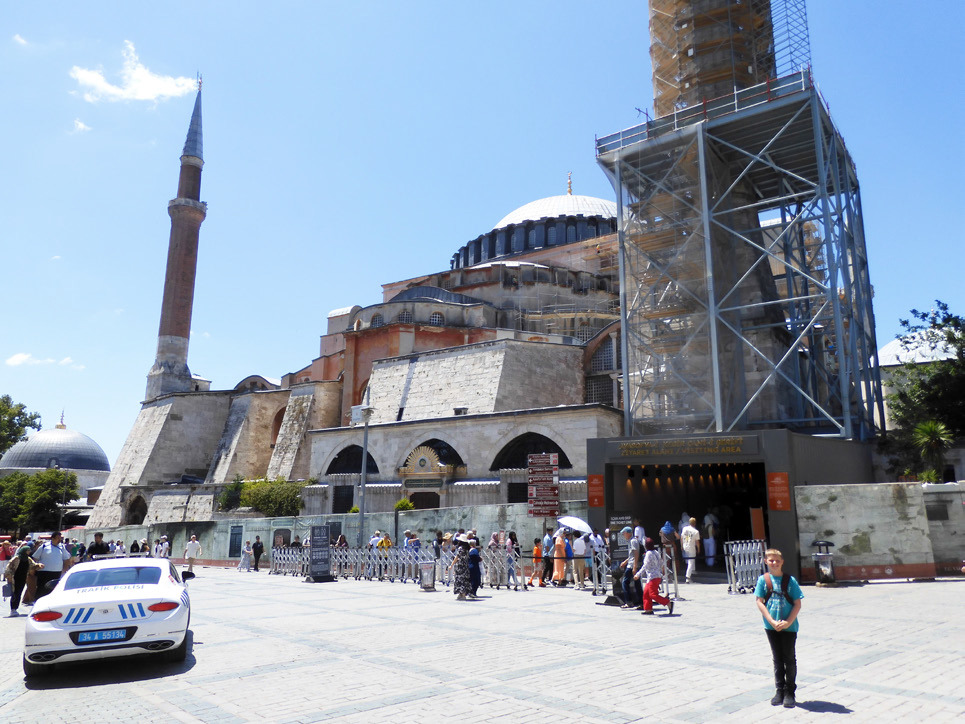
The Ottoman Empire never really placed much value on the historical significance of the political, religious, and cultural artifacts left by their land’s previous rulers or inhabitants. The first thing Sultan Mehmet II did after capturing the city was to make his Muslim prayers in the Hagia Sophia, a massive domed Christian cathedral completed in the year 537. Even now, the Turks have converted nearly every ancient church of any importance into a mosque (even though there are already mosques on nearly every corner in the city), rather than just allowing them to remain as museums. They have scavenged other ancient Roman buildings and fortifications for building materials, allowed newer buildings to be constructed in or on them, and have just generally not valued the importance of the historical sites that predated their domination of the area.
Knowing some of this, I wasn’t sure how much time I really needed to dedicate to Turkey. I knew there were some famous sites in Istanbul I wanted to visit. Ultimately, Turkey far exceeded my expectations. Although it is the fifteenth largest city in the world and a developing country to some extent, navigating the tourist parts of the city was relatively easy. Most of the major attractions are in a compact area easily accessible by public transport. We stayed in Sultanahmet neighborhood. From there, you could walk to the Topkepi Palace, the Blue Mosque or the Hagia Sophia in a few minutes. Anything else was accessible by tram or metro within 15-30 minutes, with rides costing about 17 Turkish lira—amounting to fifty cents.
For the most part, Turkey is inexpensive to visit. The main tourist sites are an exception. For an English language guided tour, we paid $95 each. We really enjoyed the tour. Our visit included the harem, and all of the ancillary museum exhibits the Turkish government has on display here. Topkapi Palace was the Sultan’s residence and center of government from the time Mehmed the Conqueror captured the city until the more modern palace was constructed in the 19th century. It really was a city unto itself. The royal family and harem lived there. The eunuchs and servants lived there. Highranking officials and viziers did business there. The population was over 5,000. The palace was built with a commanding view of the Bosphorus Straits. Not only did the sultan enjoy this view, but the apartments of his favored concubines and even his mother overlooked the city- and seascapes. A huge courtyard leads into a middle courtyard where such business was transacted as collections of royal tributes and payment of royal obligations.
One area of the palace I found interesting was the treasury. There were actually two treasuries. One outer treasury supervised by the grand vizier. From this, imperial obligations were settled and into it taxes and tributes were collected. The sultan’s private treasury, on the other hand, housed precious objects too valuable to be very far out of sight. In late antiquity and the middle ages, Christians placed a high value on religious relics. Many places, for instance, claim to have splinters of the “true cross,” or nails from it. Physical remains of saints were also popular. Hagia Sophia and other Orthodox churches in Constantinople had long histories and held many relics that had been accepted for centuries as authentic. When the Ottoman Turks captured these, the sultan entered them into his treasury, where they remained. Today, the museum has an arm and a skull fragment they claim belonged to John the Baptist. They have Moses’ staff and the sword David used to slay Goliath, they say. They say this, of course, because that’s what the Eastern Romans said. They also have several of Muhammad's beard hairs, a seal of his, and multiple imprinted footprints they claim are his. There are some letters and documents from Muhammad as well as some early followers. Like many other treasuries, this one houses some pretty cool war trophies. We paid extra to see the harem section of the palace. This was moderately interesting, but there is nothing particularly salacious andnothinganymore extravagant than the rest of the palace. I did learn a few interesting tidbits, however. The Ottoman equivalent to the Queen Mother—the sultan’s mom—held a particularly esteemed position at the palace. This is why she commanded one of the best apartments. She was essentially the chief of the harem. Often when the sultan came back from a long military campaign he went first to the harem, but not for the reasons one might assume. His mother knew all of the inside information as well as palace intrigues which she could catch up on before taking care of other matters. This palace grounds themselves are quite large and it took all morning for us to see them. We grabbed a snack and then walked to the nearby Hagia Sophia. For most of its life, Hagia Sophia has been a church. It was built in the 530s and served as a church until 1453 when it was converted to a mosque. From 1935 until 2020 it served as a museum, before being turned back into a mosque. One nice thing about it being a mosque was that for a time, it was free to enter. Wanting to have their cake and eat it too, the Turks now allow Muslims to enter the mosque free of charge, but require anyone else to pay a fairly steep admission for which you are only allowed to access the second floor. Of course, I still shelled out the money to see one of the oldest surviving buildings in the world, and one of the most famous and important churches.
The building itself is massive. It was the largest indoor space in the world when it was constructed. It remained the largest cathedral in the world until the 16th century. Much of the building’s religious artwork had been covered up for Islamic worship services. Aside from the fact that the artwork itself was Christian, Islam contains very strict rules regarding iconography. Islamic artwork always contains geometric and floral patterns, but no clear depictions of people or animals, as they consider this idol worship. Christianity had its own strife over this issue. In the eighth and ninth centuries, Byzantine churches hotly debated the issue and occasionally mobs stormed churches and destroyed Christian artwork. Certainly Muslims defaced some of it, too, and much of it fell victim to the effects of time.
Many old European churches contain frescoes on the ceilings and walls. By far, though, mosaics are my favorite form of Christian artwork. These pieces—usually from late antiquity or the middle ages —are constructed from small pieces of colored stones. Sometimes, they are very obviously mosaics. Other times, the artists craft was so fine that at first the piece looks like a fresco, and only upon closer examination do you notice it was actually a mosaic. Several large sections of these mosaics have survived in Hagia Sophia. Aside from the massive dome and impressive architecture of the ancient building, the mosaics are worth paying to see. As I will share later, there are other churches with more and better mosaics. If you could only visit one church in old Constantinople, though, you would have to go to this sixthcentury colossus.
The Hagia Sophia admission also gets you into a neighboring interpretive museum. There were some nice artifacts in it. The highlight of this museum for us, though, was the engaging audio-visual explanation of the basic history and context of the building. I think Caleb absorbed a lot more of the basic story having seen this museum. It also had excellent air conditioning, which could not be said of the 6th-century Hagia Sophia or the 15thcentury Topkapi Place.
The Blue Mosque is a much later building. It is similar in size to Hagia Sophia, and built to be a sort of rival structure.
As I mentioned earlier, many Roman artifacts have not survived time or the Ottomans. There are a few, however, in the park between Hagia Sophia and the Blue Mosque. When Constantine moved the Roman Imperial capital to Constantinople (which he called “New Rome”), he moved many landmark objects here to make it look like a great capital of antiquity. Bits and pieces of an old chariot racing facility can be seen here. As in Rome, the course proceeded around a pair of imported obelisks. The base of one of these remains, as does the entirety of one that was reconstructed in the 10th century after damage. A giant serpent statue was also present in this square. It apparently still had its head into the 19th century, but now is missing the top. The base and shaft of this monument are still there. Although they are hard to recognize, you can also find some spectator seating.
Last on our first full day in Istanbul, we headed across the Golden Horn to Karakoy for some Iskander, a very popular Turkish meat dish. We rode a ferry back to Sultanahmet, which was part of the city transportation system. It was a big first day, but there was much more to do.
