
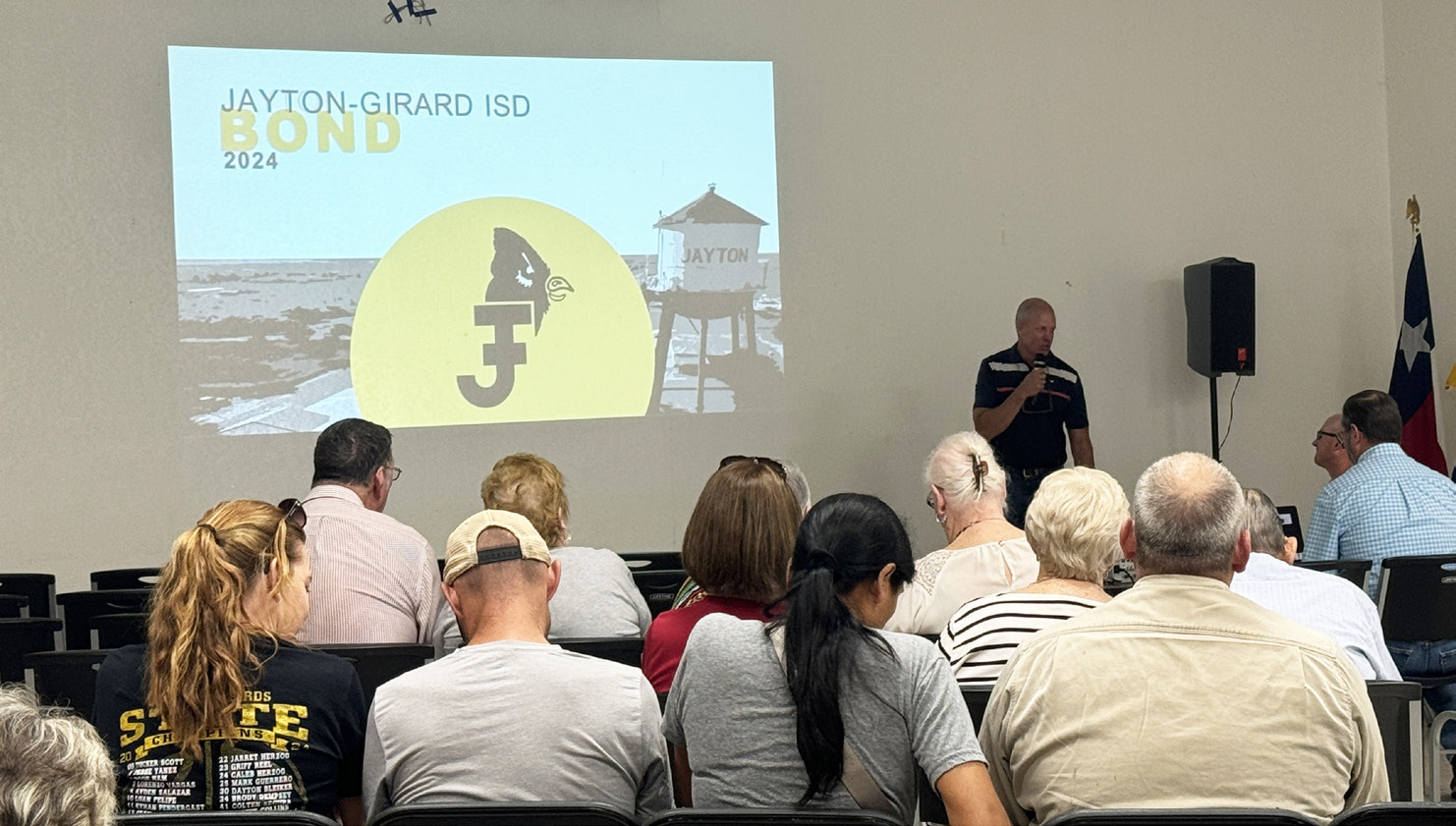
In an open meeting for the Jayton community last Sunday afternoon, school superintendent Scott Bicknell presented information about the Jayton-Girard Independent School District’s proposal to issue $21 million in bonds, and expectations for repayment. Between 50 and 60 people were present. Also present were representatives of Hilltop Securities and MWMA Architects, who have been involved with the proposal.
With the aid of projected slides and a handout, Bicknell gave a clear explanation of why the district was turning to bonds as a way to build improvements, rather than using the cash in the Kent County Permanent School Fund.
“A bond election is repaid by property taxes or other revenue sources — and we will talk about other sources today,” said Bicknell.
Tax rates are not anticipated to increase (despite required ballot language on any bond proposition that indicates it represents a tax increase), he said, though individual bills might of course go up, as it would in any year, if the appraisal of a property increases.
If a district is fortunate enough to still own its school lands—a Texas funding mechanism that dates to 1915—it has likely built up principal in its Permanent School Fund (PSF) as well as annual interest. JGISD is one of only a handful that still retain such funds after more than a hundred years, and the value has continued to build.
In that fund, the principal can be used two ways; the interest can be used to run the school. But the school does not want to deplete the PSF, Bicknell said, as that would result in the interest no longer being generated.
Bicknell indicated, as in the handout, that the district expects to repay the bond through annual payments of $2.1 million from the PSF. The school would continue to use interest But why take on these expensive projects in the first place, and the indebtedness that comes with them? The answer also has to do with Texas’s way of financing schools statewide.
“As a property-wealthy school, we are subject to recapture,” Bicknell said. “Forty-nine percent back in recapture means that of every $100 you pay in school property taxes, $49 goes back to Austin. School boards have no say in this.”
As the small district’s enrollment increases, even by small increments, the recapture percentage decreases, as shown in a tenyear comparison chart on
“In that 9-year span, we’ve had 57 more students enroll,” said Bicknell. The only way to battle recapture is to increase enrollment, he said.
District leaders are hoping that state-of-the-art facilities, and a surplus of available housing, will attract families with schoolage children to relocate to Jayton. With trends in remote working, Bicknell said, this hope is not out of the question. Bicknell also said that he had had inquiries from families from time to time who might be interested in coming to Jayton.
Four separate bond propositions are detailed on one page of the handout and were also published in The Texas Spur Sept. 5. Starting in 2019, Bicknell explained, schools had 6 different ways to break out their propositions, instead of all-or-nothing vote. Now, all propositions work independently of one another.
• Proposition A involves $10 million in bonds for school facilities and the purchase of new school buses and the levy of taxes sufficient to pay the principal of and interest on the bonds.
A new baseball/softball complex would be constructed on a 40-acre (mostly vacant) tract south of the school and already owned by the district, said Bicknell in showing an architect’s rendering that indicates how the sports facilities, teacher housing, and golf driving range might be situated on this land.
• Proposition B involves $9 million in bonds for school teacher housing and the levy of taxes sufficient to pay the principal of and interest on the bonds.
• Proposition C involves $9 million in bonds for school teacher housing and the levy of taxes sufficient to pay the principal of and interest on the bonds.
• Proposition D involves $1 million in bonds for recreational facilities and the levy of taxes sufficient to pay the principal of and interest on the bonds.
This is “a community piece,” said Bicknell, a golf driving range that would also be located on that 40 acres south of town and that would be open for public use.
The presentation itself took about 15 minutes; the second portion, for questions and comments, lasted about 45 more minutes, with a variety of comments from the audience. We’ll cover those in Part 2 of this story, next week.
Two further community meetings are scheduled: Presentation #2: Tuesday, October 8, 2024, 7 p.m. at the Community Center Presentation #3: Tuesday, October 29, 2024, 7 p.m. at the Community Center
