
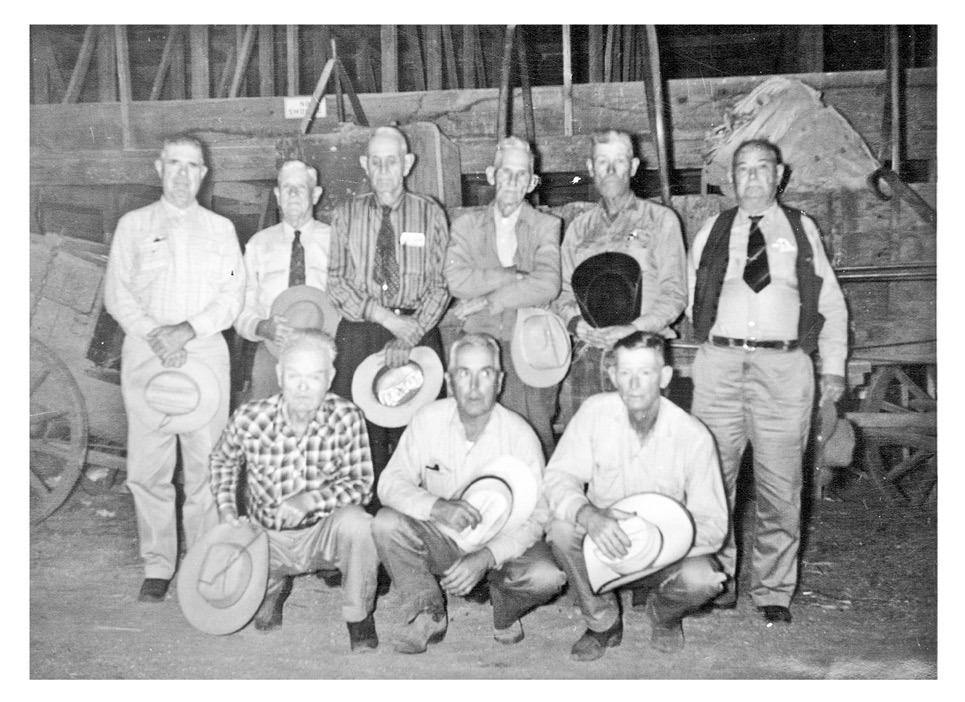
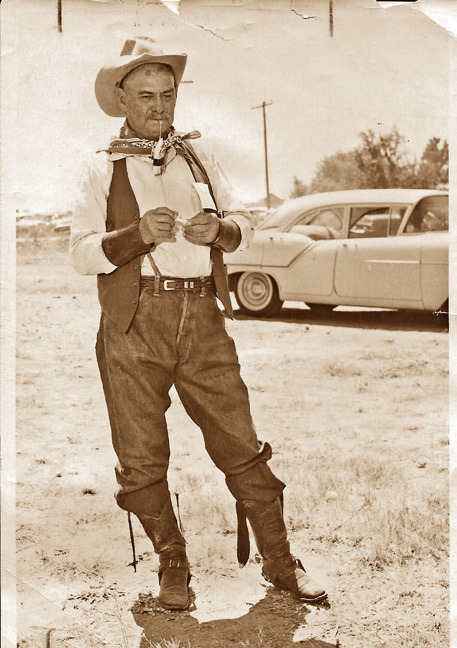
The last working chuck wagon of the Matador Land & Cattle Company pulled into the Lower Division headquarters at Matador in 1958. That event is part of the lore long shared by those who once worked the vast ranch.
“The Matadors,” cowboys like Ed D. Smith, Melvin Dirickson, Virgil and Walker Leonard, Rosie Deaton, Clarence Smauley, and Emmett Gafford, no doubt shared memories that came with 69 years of Scottish ranch ownership and their own experiences.
Forbidden to be in town during the week, once when they were supposed to be working, Ed D. slipped off to do errands. Alas, he was caught by the ranch manager, M. J. Reilly, an circumstance that immediately prompted Smith to remark, “Maurice, what are you doing in town on a workday?”
Yes, he got away with the infraction.
Having too much fun might earn a cowboy an overnight stay at the 1891 jailhouse in Matador. The jail, renowned for its exercise walkway around the two upstairs cells, allowed prisoners to call out to a passerby for a cigarette. Author William Saroyan heard the story from Ben Meador and created a play called “Hello Out There,” which was actually performed in Matador near the jail.
Smith once told the story, without taking any blame, of the time a range chuck wagon with cook tent and stove was set up in Turtle Hole Pasture, where the outfit were working cattle. The stove, too close to the tent, ignited and started a grass fire. With no water available, beating the flames with chaps was not enough to stop burning up the tent, chuck wagon, chuck box, and harness. Only one range wagon ran thereafter, he calmly explained.
When Ed D. threw a shock of feed over the fence on one occasion, he felt the prick of a rattlesnake and heard its rattle. Knowing his wife, Kat, and the kids were prepping for a Saturday night bath, the cowboy drove himself to the hospital, laid down on the couch, and took a nap while waiting for the doctor. His son, Little Ed D., recalled that he missed getting to town for the picture show, but his father survived. With the advent of this son, there were now three Ed D. characters.
Ed D. Smith, Sr., worked for the Matadors in 1893. His son (our subject), was named Earl William, but everyone called him “Little Ed D.” That stuck until his own soncamealong,andhewas known as the second “Little Ed D.” until he became the third Ed D. Smith, Judge of Motley County.
That remaining chuck wagon, which came in from East Pasture in Cottle County to be retired at the lumberyard, was itself such an icon that most of its equipment was gradually taken as souvenirs in fond remembrance. So, it was a wise decision for John V. Stevens to heed the invitation by Albert Mitchell, chairman of the board of the National Cowboy Hall of Fame, to place the Matador Ranch chuckwagon in Oklahoma City, where it would receive excellent care and be displayed as an exhibit for all to enjoy.
The wagon is still on display, as the Motley County Museum learned in 2024 when Dude Barton’s 1940 Schweitzer prize saddle and her documentation of the All Girls Rodeo Association were accepted by curator Michael Grauer of the Western Heritage and Cowboy Hall of Fame.
Along with the 1950s sale of the ranch name and brand to Fred Koch’s Rock Island Company, fourteen other corporations bought portions of the vast holdings, which would be divided up among many aspiring ranch families. The deal was for the land and improvements, so it was necessary to scour the breaks and mesquite thickets for the actual Matador cattle. Former ranch superintendent, John V. Stevens operated the Red Lake Corporation until 1959, when the last of the cattle were shipped.
Collecting the wild Matador cattle that ranged over rugged terrain spawned many more tales to be told and retold by the cowboy survivors at their favorite meeting place, the Motley-Dickens Counties Old Settlers in Roaring Springs, Texas.
