
DAVID PAFFORD |
David Pafford of Spur and his son Caleb continue their travels through Southeast Asia, arriving a few days ago in Malaysia. “If you would like to see more photos and hear the ‘long version’ of our story,” wrote Pafford, “please visit the website www.fartherbeyond. com/circumnavigation. I hope you will join us each week to hear the latest report.”
I was shocked by the beauty and geographic diversity of Malaysia. The country is composed of two major sections: one major landmass on the Malay Peninsula, and another on the island of Borneo, which Malaysia shares with Indonesia and Brunei.
We visited only peninsular Malaysia. Malaysia is an equatorial, tropical country, but it has rock bluffs and towering mountains. In some ways, it reminded me of Costa Rica, in Central America. Malaysia’s rapid elevation changes create multiple climate zones in a relatively small area. Its low latitude and nearness to the sea create a climate unlike the four seasons we see in the middle latitudes. They tend to have a rainy season, and a less rainy season. It is nearly always hot and humid in the lowlands—
how hot and how humid. The highlands are cool enough that rooms don’t need air conditioners. Afternoon highs during our stay in the Cameron Highlands never reached 80 degree Fahrenheit.
Malaysia is a Muslim majority country. It was not an extremely conservative religious environment, however. Nowhere were we asked to modify our dress, and we were asked to remove shoes only when directly entering religious facilities. As in the Emirates, there was a special women-only metro car. I could hear Muslim prayers over speakers at the designated times. One morning as I ran before dawn in Tanah Rata, I heard something faint in the distance that resembled hymns. As I came nearer, it became clear that this was the Muslim morning prayer chant being played over speakers. It was a pretty sound, and I grew to enjoy it.
Another distinct Malaysian characteristic is its diversity of ethnic influences. It is more apparent in the cities, but it is everywhere if you look. There are significant Chinese, Indian and Pakistani influences resulting from migration, commerce and tourism. Most cities have not only a Chinatown, but even an “Indiatown.”
Nearly every place we visited had Pakistani restaurants as well. I found Pakistani food to be delicious. Between that, and the amazingly friendly people we met from Pakistan and their descriptions of the places to visit there, Pakistan has been added to my future travel plans.
Our first major stop in Malaysia was the Cameron Highlands. After a long, winding ascent to Tanah Rata, Caleb and I set out to try the Steamboat, a local specialty. They bring you some kind of base soup—in our case it was either Tom Yam or Chicken Soup—which is heated up in front of you by a burner in the middle of your table. Then, out come numerous other ingredients. We received fish, prawns, tofu, mushrooms, onions, beef, spinach, other greens, scallops, fish, rice noodles, pasta noodles, chicken and a raw egg. You throw any or all of these ingredients into your own soup, as you see fit, and then wait until you think it’s been cooked long enough. If you run out of soup or any other ingredients, out come some more. We had fun with this. As a soup lover, Caleb was in heaven.
Most of the things tourists come to the highlands to see are not accessible via public transportation. Although we don’t like organized tours, we joined one as a de facto taxi in order to efficiently reach all of the area highlights. And really, that’s about all the tour provided—a ride from one place to the next. Several of the places we visited were still merely opportunities to go shopping for tourist kitsch. We did efficiently see what we came to see, though.
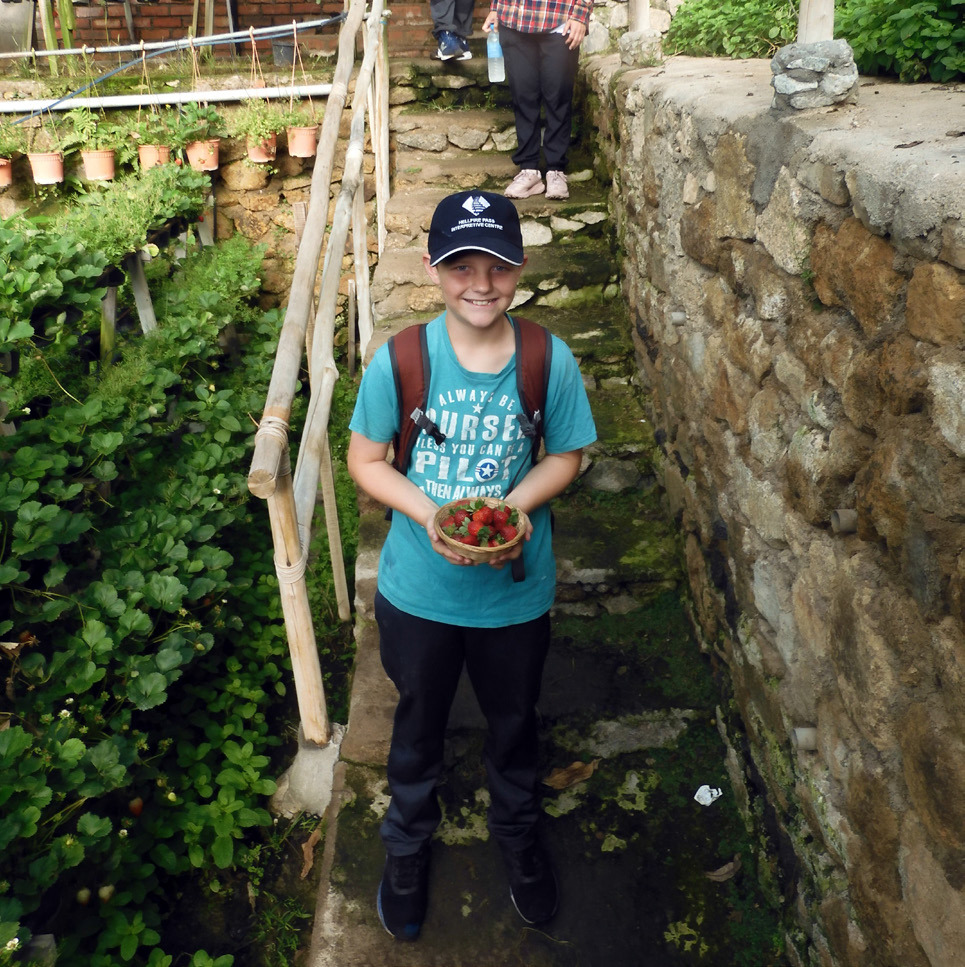
Our first stop was a selfpick strawberry farm. The steep hills were covered with irrigation systems and a large protected area for above-ground potted strawberry plants. Our tour guide made a lot out of this special procedure, making the strawberries sweeter. It was interesting, and we enjoyed visiting with the other tourists while we picked a few—which we paid extra for. I could not tell a noticeable difference between these and any other strawberries. It was a pleasant stop anyway.
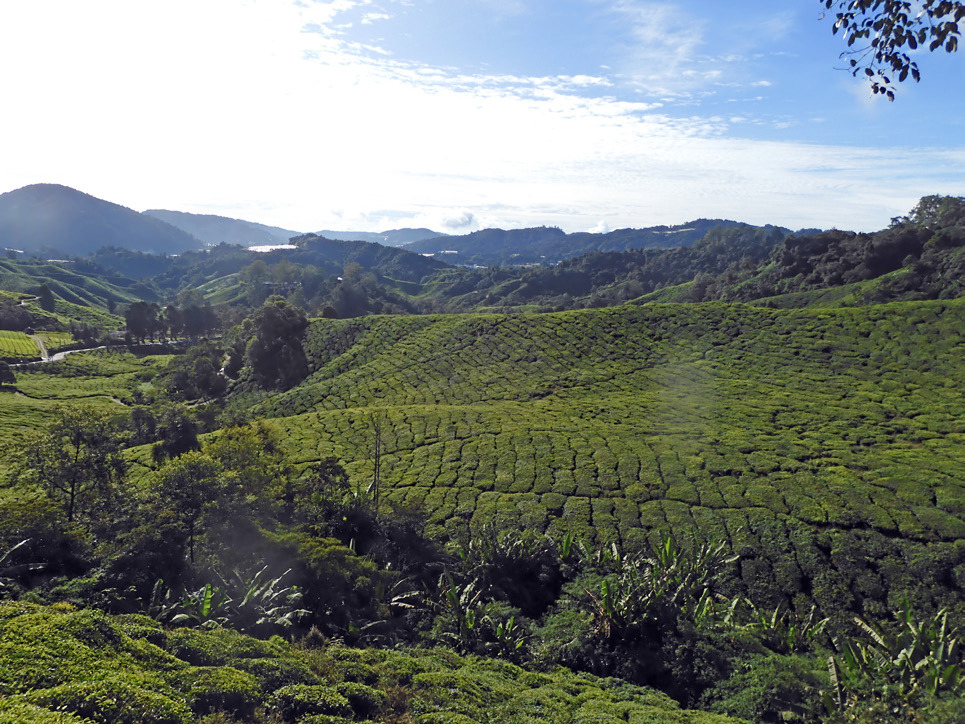
Next, we visited the BOH (Best of Highlands) tea facility. BOH is a century- old tea operation founded by British investor J.A. Russell. They specialize in black tea, but also make some green. On 3,000 acres of land, they produce 4 million kilograms of tea per year. This amounts to 70% of Malaysian tea production.
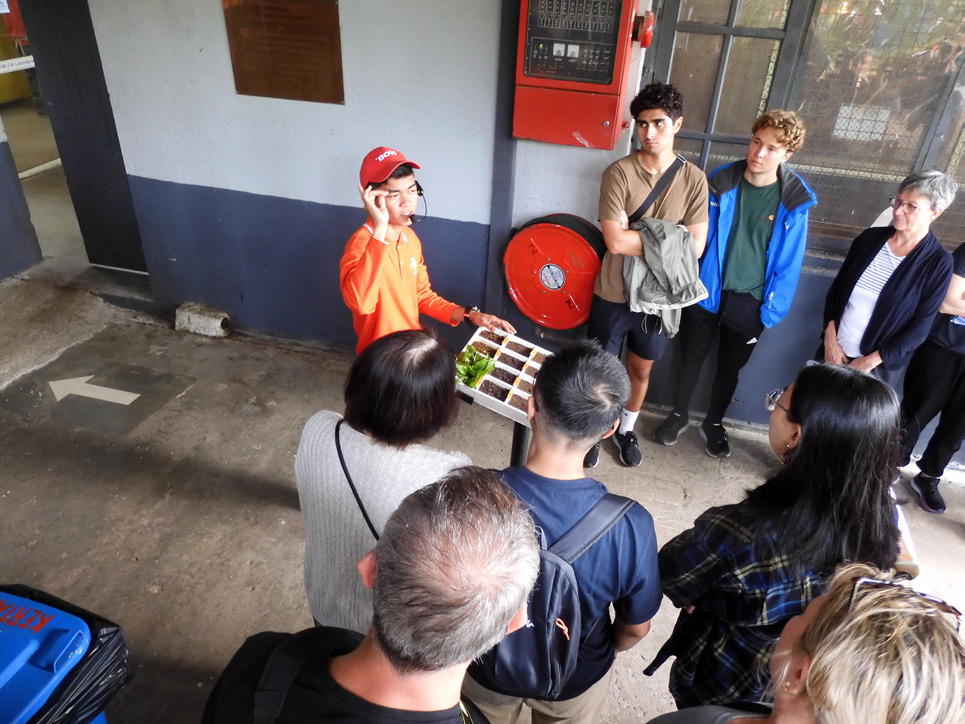
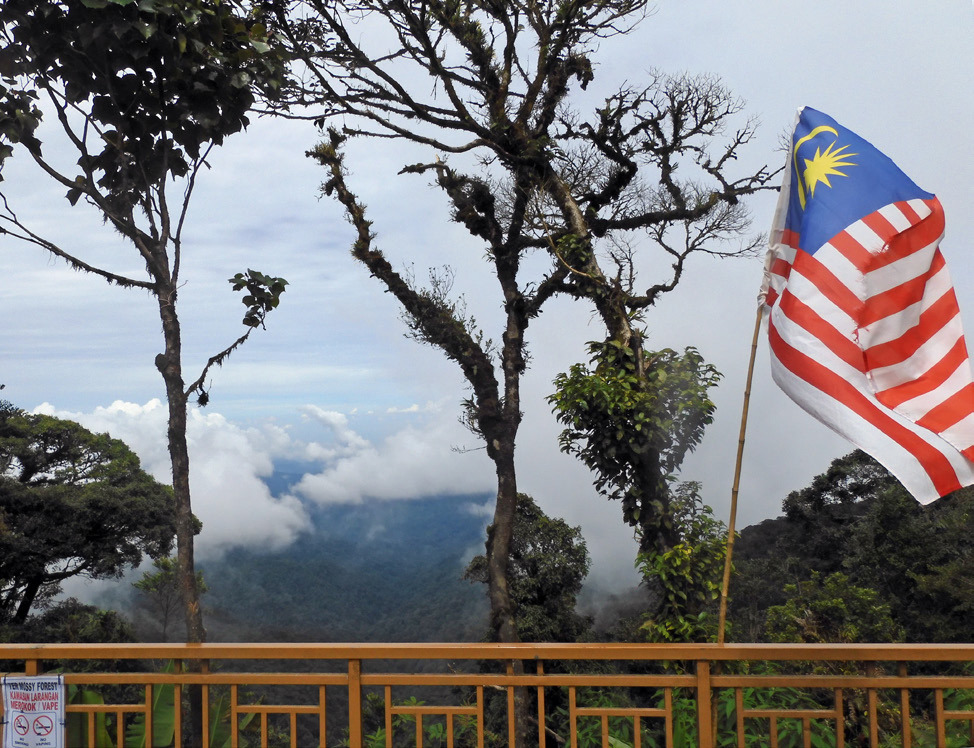
This is where people come to catch the gorgeous postcard views of the Cameron Highlands. Tea plantations spread out over rapidly rising and falling terrain. We took some photos of our own, and Caleb sampled some tea. We joined a free 10-minute tour of the factory that explained how tea was dried and prepared. That covered the basics. We were allowed another hour to gaze at the deep greens of the hillsides and buy things in the gift shop. The Mossy Forest national park was next. It was a little too muddy to hike when we were there—not that Caleb would have wanted to do that anyway. We drove up to the higher points, and then walked to a couple of lookouts. Most of the long-range views were obscured by clouds, but we were able to observe most of the flora. We got a briefing about edible and useful plants of the highlands, and ascended on the of highest points in Malaysia, at over 6,000 feet. The Tiger Balm was the most pungent, be we also sniffed some Mediterranean Cypress and citronella. There was an occasional peek-a-boo look at a more distant ridge. Being totally encapsulated by clouds was a unique sensation in itself.
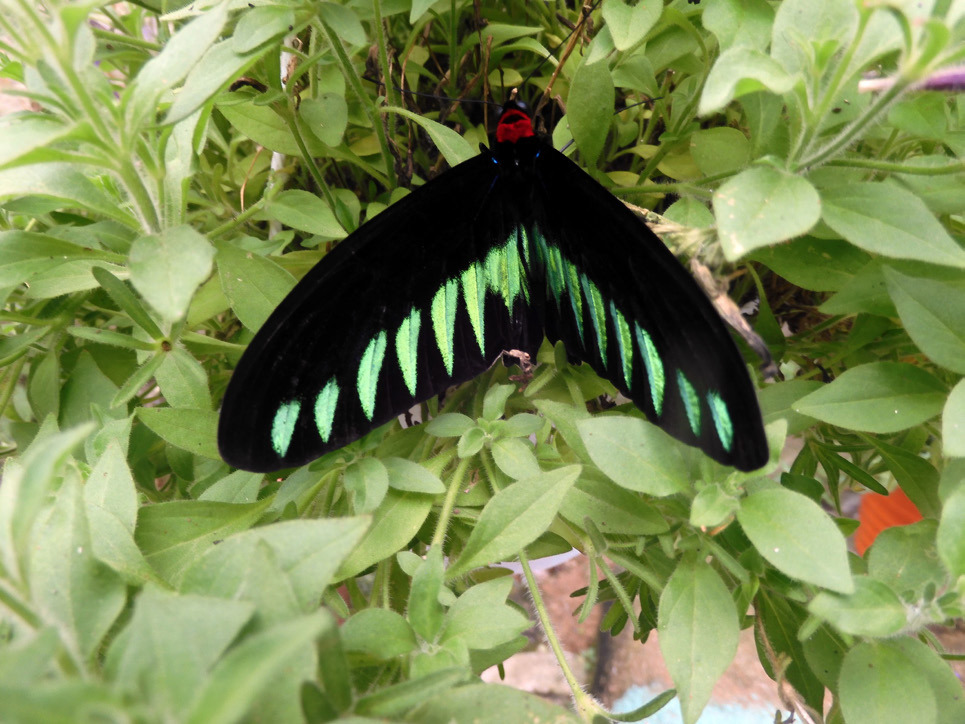
Back in town, we paid a visit to an apiary and a butterfly farm. The apiary was just a garden with some bee boxes in it, and a chance to buy local honey. They samples we tried were distinctly different from one another based on the kind of bees that made them and the environment from which the bees were operating. The butterfly farm was more interesting. The butterflies were bright and colorful. There were other insects and animals on display. We saw a huge walking stick, some giant beetles, and some snakes and lizards, but the butterflies were the highlight of this stop.
We spent a few minutes each at a flower and cactus market and a traditional local market. The flowers and cacti were impressive and shockingly colorful. I spent a few ringgit on some unique Malaysian fruits. They had fruits they called Malaysian apples, which looked purple like small eggplants but had the consistency of a kiwifruit. Some were not ripe and tasted about like cucumbers, but the ripe ones were sweet and juicy.
Our final stop was a Chinese Buddhist shrine. This seemed to be more like a working religious facility than the more historical commercialized Buddhist sites we had visited in Nepal and Thailand. There were colored papers that resembled the work of children in a Sunday morning Bible class. There were classrooms, and a monk on staff to teach and explain things. They even had something like a “tract rack” with free materials in English, Chinese, and some other languages. Early the next morning, we were on the bus to Kuala Lumpur.
