

CUISINE & CULTURE
Ah-choo! Sneezing, coughing, runny noses, and puffy, watery, itchy eyes. Sounds like a commercial for allergy medicine. What is it about spring in West Texas that summons all these symptoms? Allergies. Yes, but allergies to what?
Pollen. Trees that are blooming right now are shedding pollen, leaving many of us with these nuisance symptoms.
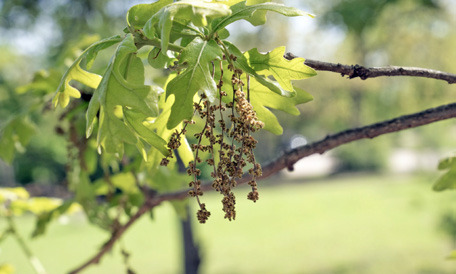
It is the worm-like structures that dangle from branches of many trees right now that produce copious amounts of pollen.
The flowers drooping from branches are catkins, also called tassels. The catkins that produce pollen are male flowers. Male catkins are loaded with pollen. Catkins are comprised of hundreds of tiny individual flowers packed into one extended cylindrical-shaped blossom called a spike. The weight of the catkin causes them to droop.
Pollen grains released from male catkins are carried in the air by the wind, filling the air with yellow pollen. Many trees produce catkins—willows, birches, mulberries, pecans, and every kind of oak.
The pollination mechanism of these trees is ingenious. Catkins mature and release pollen before leaves bud out. In this manner, leaves do not interfere with the movement of pollen to move freely in the air.
People allergic to these microscopic pollen grains have symptoms of itchy, watery, red and swollen eyes caused by swollen blood vessels in the eyes. The body responds by synthesizing histamines; it is the histamines that cause eyes to tear. Our bodies are magnificent defenders. Pollen is perceived as a harmful threat, kicking in a cascade of events when pollen is detected. Antibodies are made to counter the histamines, which results in eyes becoming inflamed, red, itchy and watery (webmd.com).
There is not much an individual can do with all the pollen in the air, except to avoid the outdoors. But homeowners can reduce catkin production of individual trees on their property with commercially available products.
Products that cause abscission of catkins are synthetic growth regulators. The product most often sold in greenhouses and nurseries is under the label Florel. Florel is a synthetic plant growth regulator that works by releasing the naturally produced hormone ethylene (eth-IH-lene).
Ethylene is the same gas that is used to accelerate coloring in tomatoes. As ethylene is absorbed by plant tissues, the maturation process is accelerated. When catkins are the targeted tissues, aging increases resulting in their abscission and fewer catkins.
Ellen Peffley Harp, a retired professor of horticulture at Texas Tech University, writes about gardening for several Texas newspapers.
