

National Arbor Day is the official day to plant and care for trees. It is celebrated each year on the last Friday in April. This year it is April 24.
The National Arbor Foundation (arborday.org) is a global nonprofit established to inspire people to plant, nurture, and celebrate trees. The goal of the foundation is to realize the planting of plant 500 million trees by 2027 in areas where they’re needed most.
By joining the Arbor Day Foundation, members can choose a limited number of free flowering trees and other trees that may be available based upon location.
Even, maybe especially, in our parched West Texas trees can be planted and add beauty wherever they are grown.
Trees are beneficial not only for their esthetic appeal, but for their proven role in ecosystems. They are critical in the air we breathe. Ambient, outdoor air is approximately 21% oxygen, 78% nitrogen, and trace amounts of other gases, including carbon dioxide (CO2). Current level of atmospheric CO2 is about 0.039%, 390 parts per million (imagine 390 dollar bills dyed red and mixed with one million green dollar bills). Trees and other green plants are the conduits for chemical gas exchange, taking minute amounts of CO2 out of the atmosphere and generating the oxygen we use to sustain life.
For those who are worried about elevated CO2 levels, trees alleviate those concerns. Almost 50 pounds of CO2 can be absorbed by one tree. With an average life of 40 years, one tree will have sequestered almost one ton of CO2, providing an oxygen supply for two people (Trees of Strength, NCSU).
A few evergreen and deciduous trees that are adapted to West Texas conditions are:
Afghanistan pine. Also marketed as Eldarica pine; a large tree, excellent windbreak and shelter for many bird species.
Arizona cypress. A large tree adapted to alkaline soils; is drought tolerant.
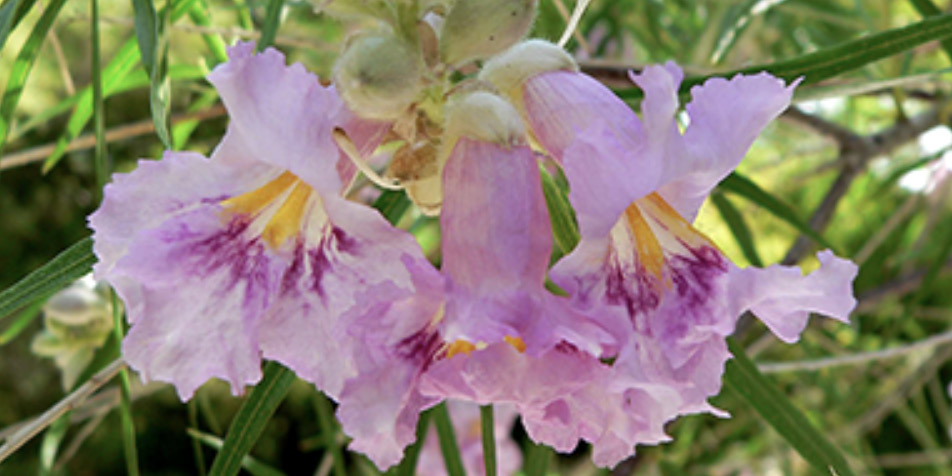
Desert willow. A medium-sized tree. One of the earliest to lose autumn leaves and one of the latest to bud in the spring. Seedling desert willows bear a proliferous number of seed pods that readily reseed. It is adapted to drought and poor soils. Flowers appear all summer and attract pollinators.
WesternSoapberry. A medium-sized, drought tolerant tree. The May and June flowers attract pollinators; it has golden autumn foliage and translucent, amber-colored fruit that persist into winter.
Ellen Peffley Harp, a retired professor of horticulture at Texas Tech University, writes about gardening for several Texas newspapers.
