
David Pafford of Spur and his son Caleb completed their circuit of foreign lands last week in Singapore before flying home across the Pacific to the U.S. “If you would like to see more photos and hear the ‘long version’ of our story,” wrote Pafford, “please visit the website www.farther-beyond. com/circumnavigation. I hope you will join us each week to hear the latest report.”
Singapore has some crazy strict laws. It is illegal to spit on the sidewalk, chew gum, or fail to flush the toilet. You can be fined for any of these crimes. An American kid who vandalized some cars and road signs was arrested and sentenced to be caned back in the ‘90s. The “caner” taking a running windup and whacks the perpetrator’s behind with a big stick. This made headlines in all of the U.S. news outlets.
Two diametric viewpoints formed. One group thought the United States should step in on behalf of the kid and prevent Singapore from implementing this arcane punishment. The other folks said, “The kid broke another country’s laws, let him face the consequences.” President Bill Clinton made a personal appeal to the Singaporean government, and in an unprecedented capitulation, they reduced the number of strokes from six to four, as a personal favor to Bill Clinton.
This appeased no one. The kid still got caned. His American supporters still believed the punishment arcane and unfair. Those who believed he should face the consequences in the Singaporean justice system were further shamed by the fact that the U.S. government would ask for an exception. Singaporeans were disgusted that their government compromised their principles at the behest of a powerful foreign politician. It made good news fodder back then, in the early days of 24 hour news.
Singapore’s eccentric system of laws and punishments has served it well. While you can be fined S$7,000 if you are caught importing chewing gum, you never encounter the disgusting residue of someone’s failure to properly dispose of the stuff on the city’s streets or public transportation. Singapore has one of the world’s lowest crime rates. It is an extremely modern, clean, efficient place.
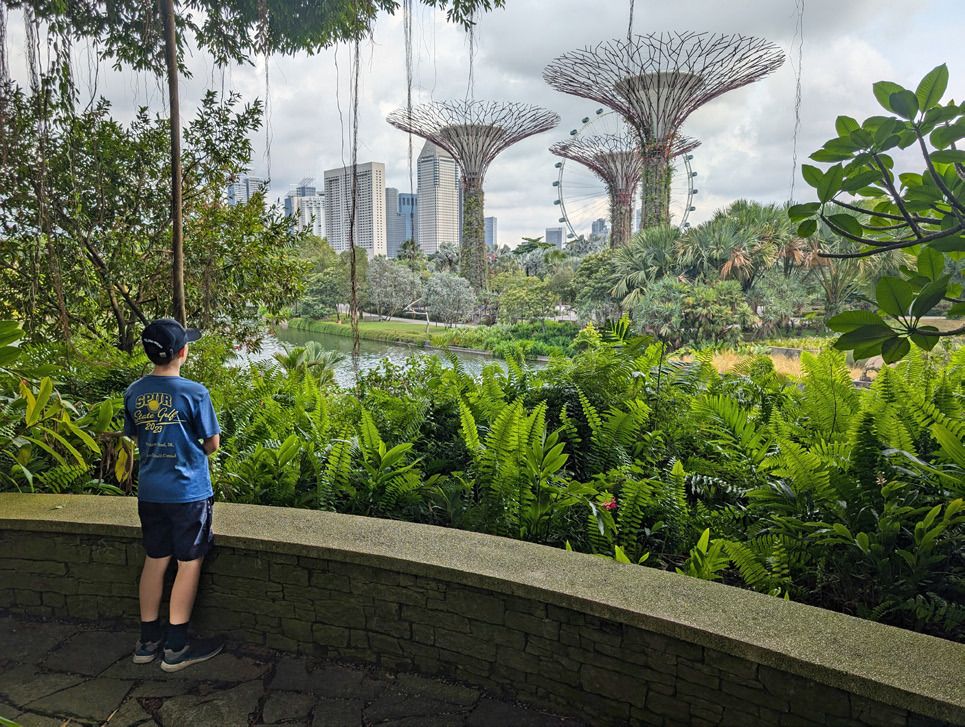
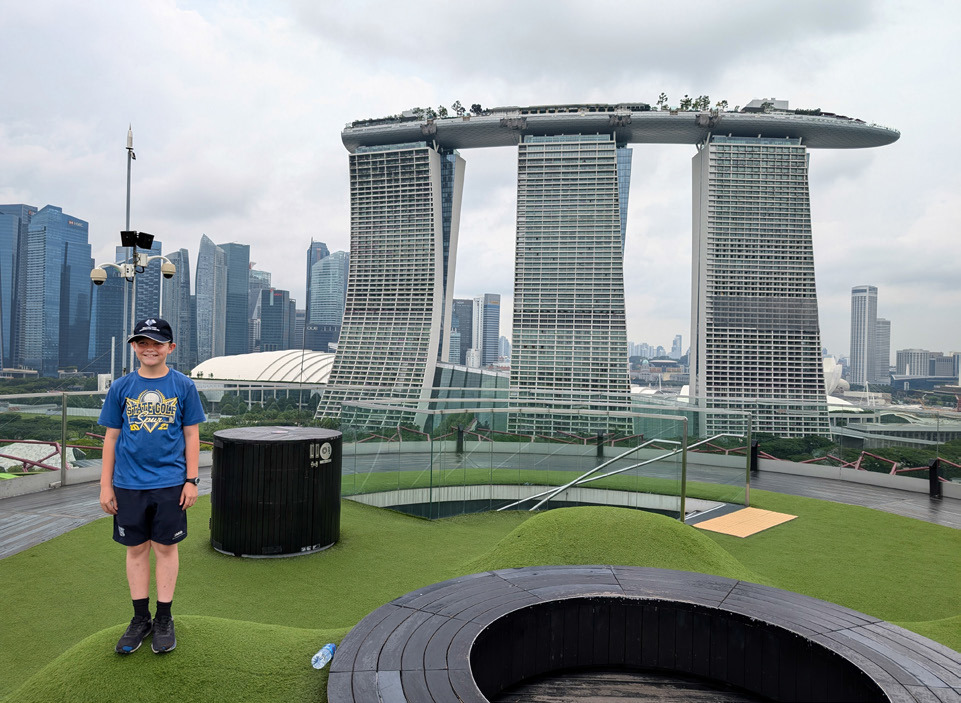
Because it is just a city on an island, Singapore puts a lot of effort into green space. The Gardens by the Bay and Botanic Garden are two notable examples. Gardens by the Bay is a highly developed park near the coast right next to the iconic Marina Sands Hotel. It features two indoor domes. One houses a cloud forest, complete with waterfall, and climate specific plants from cloud forests around the world. You can walk the bottom in the cool air, or climb up to walk through the waterfall. The second dome is a floral display. We were overwhelmed by the diversity of the plants and their bright colors. There was a special exhibit dedicated to Claude Monet, who was famous for using watercolors to depict scenes from prepared landscapes like his garden.
The park itself runs over a kilometer in every direction, with outdoor sections replicating garden styles from other parts of the world. This park is also home to the famous “super tree grove,” of artificial trees that light up. We ascended the tallest one and spent half an hour gazing at the straits, the barges, and the city skyline from this bird’s eye view.
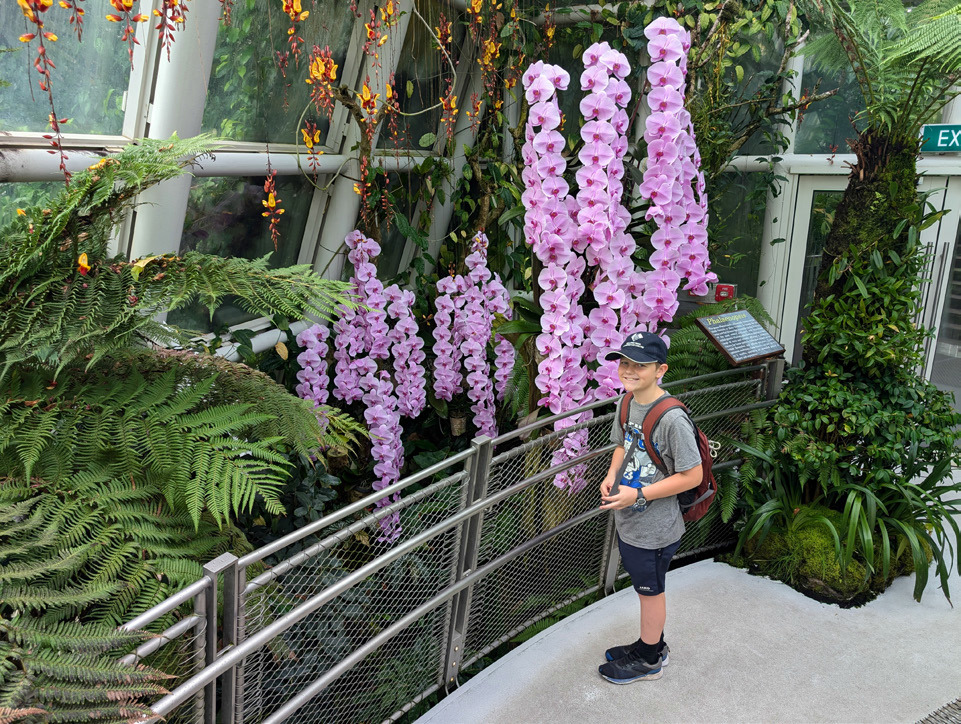
The Botanical Gardens and National Orchid Garden is a more natural appearing green space. The palms, ponds, and greenery are beautiful, but the highlight is the orchid garden. There are orchids of every color; striped and spotted orchids, and long vertical strands of moth orchids. There are naturally occurring orchids from all over the world, and hybrids developed specifically for floral competitions and named for celebrities or diplomatic visitors. Flower gardens are not really my thing, but these were worth seeing, even if horticulture isn’t your primary interest.
Singapore is famous for covered open air cafeterias called hawker centers. A large common area contains tables. There are never enough for everyone, so you end up sharing tables and visiting with other groups. These seating areas are surrounded by narrow aisles and paths usually lined on both sides with food booths. You walk around and order one thing from this hawker, and another from that, building your own a la carte meal. There are hawkers specializing in Korean, Chinese, Malay, Indian, and Arab or Halal food. Among those, there are desert peddlers, fruit peddlers, and peddlers of all sorts of different specialty items. These hawker centers are all over town, and each has its own “flavor.”
Hawker center food was absolutely delicious. I learned several new favorite dishes that I hope Stephanie will try. I especially enjoyed Kwae Teow Sambal, soft oily noodles stir fried with an egg like fried rice, and a couple of shrimp thrown in. Pao Fan was another tasty discovery. Hawker centers are an especially fun way to try new foods. The only hawker center that did not quite meet expectations was the most famous one, Lau Pa Sat. This is the most upscale, modern looking venue. It sits in the fanciest, most upscale part of downtown. Several of the booths actually have Michelin stars. I saved this one for the grand finale, our last meal of the trip. I expected the booths at Lau Pa Sat to be more expensive, but they weren’t. The food was more bland, probably as a nod to Western tourists. I had grown used to the Malay and Indian influences, which often use chili pastes and other means of adding some heat.
Singapore has several great museums. The National Museum was one of the least expensive museums we visited, but it was the most impressive, in part due to our superior tour guide. He showed us the highlights of the museum in about an hour and a half, while seamlessly weaving in the story of Singapore from the arrival of the first seafarers through the colonial period, right into independence. Telling the story of the history of Singapore can be done concisely because of its small area and relatively compact timeframe. Little is known of the inhabitants of pre-European exploration Singaporeans. For much of that time, it was a backwater, controlled by Malay rulers. There was nearly always sea traffic here because of the location. The detailed story of Singapore can start with the sea lane version of the silk and spice trade, discuss Portuguese and Dutch interaction with the far east, and then move to the arrival of the British in the early 19th century. British colonization must be discussed, along with their disputes with the Netherlands. Eventually, a brief discussion of Japan’s expansion must be made, then their attack and occupation of Singapore. Ultimately, British management of the Straits Settlements during and after the war put Singapore and Malaysia on track for independence. So the tour concludes with an explanation of how planning turned an under educated, over populated city into a developed model economy of information and finance. It really is a massive success story, that was done in a way very specific to Singapore.
Caleb really wanted to see the Singapore Air Force museum, so we visited that, too. It was a small museum that had a dozen or so planes. The emphasis was more on what they had done to support aid and rescue efforts than any strictly military action. I did not want to miss the Asian Civilizations Museum. We missed the guided tours by going to the air museum, but we got to see several nice collections. The highlight was a collection of artifacts from a 9th century shipwreck discovered off the coast of Indonesia in 1998. Over 60,000 pieces of pottery and other trade items were recovered. Many of them had not even suffered a chip.
This display was eye opening for several reasons. The simplified story of the silk and spice trade is that the Far East trade routes went mostly over land until the Ottomans defeated the Byzantine Empire and closed off much of that activity to the West. This drove European explorers and traders to put more effort into searching for sea routes to the Far East. The Portuguese went around Africa, and the Spanish went west. There is a lot of truth to that, but it is a very Western narrative. Just because Italian city states and the Dutch traders weren’t running sea routes to the Far East didn’t mean others weren’t doing it.
The wrecked ship was Arabic, probably from what is now Iran or Iraq. Islamic traders were doing some pretty serious commercial cargo runs to China in the 9th century. The Chinese were mass producing ceramic bowls by then. This means there was enough of a market to drive them to do it, and they had the ability to mass produce similar items. The merchandise was all traded by cash systems instead of barter, another mark of some pretty advanced trade. There was a lot of commerce going on with the Far East, with a significant portion of that happening by sea long before the Portuguese and Dutch arrived on the scene in the Renaissance era.
The museum housed also items from 16th – 19th century shipwrecks. They had various religious artifacts, and a special wing dedicated to pagodas. The most interesting item in the religions section to me was a rubbing from a 7th century stela. This stone was from China and it indicated the authorization of Christians to operate in China back then. China was subsequently closed off, as was Japan for several centuries. But there had been evangelists working and planting churches as far east as China long before the missionaries who arrived with the Portuguese traders at Macao and Nagasaki.
After supper at Lau Pa Sat, we strolled through Chinatown looking for souvenirs. We packed our things in the little backpacks that had housed everything we had with us for the last 100 days and contemplated going home. Caleb had been a little tired and moody lately, but he seemed sad to be going home. That may have been primarily due to an unwillingness to return to school. I miss Stephanie, my other family members, and my friends in Spur for sure. There are also some things about West Texas that I am really looking forward to returning to as well. High school and college football will be fun. For all the good food I have learned and tried, it will also be nice to have a brisket.
