
From the garden
Summer months have taken a toll on many tomato plants. What is a gardener to do about tomatoes that have flowers but no fruit. But before we get to a solution, we need to look at the flowers that produce the fruit.
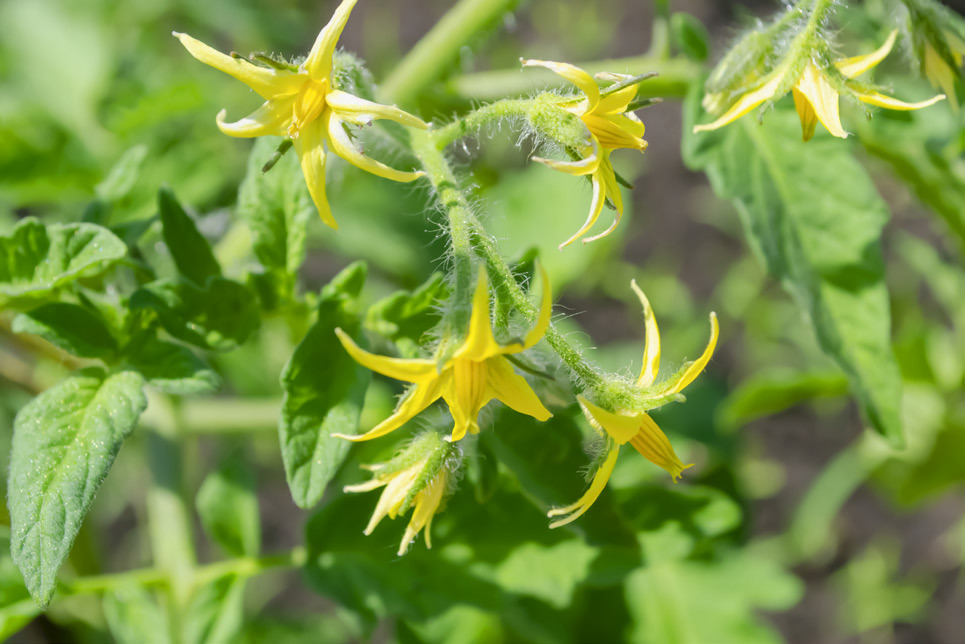
Tomato flowers are pendant, pointing downward vertically, and are “perfect”, meaning each flower has male and female parts. A green calyx (KAY-licks) with six sepals surrounds six golden yellow petals that bend backwards as they expand. Inside the petals are male parts that form tubes of six stamens united by the fusing of their yellow anthers. In the flower center, surrounded by the male stamens and anthers, is a female pistil.
Tomatoes are self-pollinating—each female part can be pollinated by the pollen released by its own anthers. How the pollination is done is critical in understanding why tomatoes sometime need to be “thumped.”
The female reproductive part has three distinct structures: the ovary, a bulbous structure that contains eggs that develop into seed; the style that sits on top of the ovary; and the stigma that will receive the pollen. As the flower develops the style elongates at the same time the stamen matures, releasing pollen from the anthers.
Now comes the fascinating series of timed events. The stigma that sits on top of the elongating style becomes gelatinous and as it elongates it brushes through and against the anthers that have just released pollen; the slight movement causes the anthers to vibrate and send a rain of pollen that lands on the sticky stigma surface, effecting pollination. The pollen grain germinates, grows the length of the style into the ovary where the pollen unites with the eggs, completing the fertilization process.
After pollination and fertilization, soon a tiny tomato fruit will be visible, which then expands, elongates, and a fruit develops. However, if anthers do not vibrate, releasing pollen, there is no pollen to effect pollination.
Without pollination flowers drop and no tomatoes develop.
Flowers need help pollinating in hot, humid conditions or when crowded plants have little flower movement limiting pollen dispersal. Which is when “thumping” becomes necessary.
“Thump” tomatoes by flicking a finger and thumb against an open flower. The impact of the finger hitting the flower dislodges pollen, which floats down onto the stigma surface and pollination is accomplished. Soon you’ll enjoy a red ripe tomato.
Ellen Peffley Harp, a retired professor of horticulture at Texas Tech University, writes about gardening for several Texas newspapers.