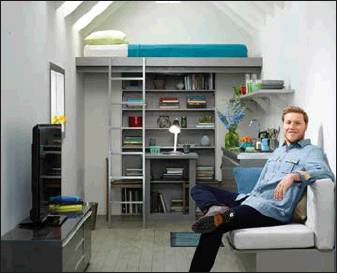
Five years ago, the same year Spur, Texas, proclaimed itself a tiny house–friendly city in 2014, “Tiny House Nation” launched on cable TV. Since that time both have become sensations.
As A&E’s “Tiny House Nation” debuts its fifth season this month, host Zack Giffin welcomed the opportunity to talk “tiny” with The Texas Spur. We caught up with Giffin via email from his filming location to ask about trends and topics from his rise to tiny-house stardom, to ways tiny houses are aiding veterans, to advice for prospective residents and communities.
Giffin knows his stuff — and he’s answered us with both charm and candor.
THE TEXAS SPUR: Zack, we assume you’ve heard about Spur, Texas, and its role in the tiny-house movement.
ZACK GIFFIN: Yes, I have heard of Spur, and I think it is great what has happened and it’s a fantastic first step. (Editor’s note: Giffin added that he wished that Spur would allow tiny houses on wheels.)
What got you started in the tiny house movement, Zack?
I was drawn to the tiny home movement because I saw the value of having a nice home that was on wheels. An RV is fine, but I am a carpenter and I appreciate beautifully built homes. When I first learned of Jay Shaffer’s tiny house it was the first time that I knew it was legal to have both. I built mine in less than six months after seeing my first tiny. It was just as much a desire for the freedom to remain unchained as it was a financial decision.
What is your background? Where did you grow up, and what has your career path been?
I have been an artist and an athlete all my life, and I always knew that I wanted to use my artistic ability in some way as a professional. Woodworking and homebuilding were the closest thing I could find to an artistic occupation that would also put food on the table.
Carpentry also allowed me to take time off during the winter so I could spend chunks of time skiing in the mountains. I always dreamed of being a skier that travels the world and skied in the movies and after many years of living very minimally I was able to experience that dream. I worked as a professional skier in the winter and built homes all summer, and although there was very little future or security, it was an accomplishment that I will forever be proud of.
The tiny home as well as my minimalist lifestyle was an important tool that I used to follow and realize my dreams. At the core, that is what makes me such a passionate advocate for tiny homes. I know what it feels like to be without a safe place to sleep and I know the difference that having even a small home makes. Sometimes it’s the difference between ever-present stress and positive self-esteem that manifests into all aspects of life.
I understand that the fifth season of “Tiny House Nation” launched this week on A&E. What has it been like being the star of national cable TV show?
It's a little bit surreal that “Tiny House Nation” has been such a hit, but it is a great program about an important topic, so I can see why.
After 84 episodes we are still going strong, and now we are on a bigger network (A&E, and Netflix in August). I always believed that my job was to remain authentic to the movement and that it is a great honor and indeed privilege to be the one to bring new perspectives into American homes.
I actually feel a responsibility to be a positive face for the movement and ensure that the merits of the messages get to be considered free of bias. So, I try to be as clean cut as I can … however, I work hard, I play hard, and I can only manage to stay so clean. My wife and I don’t own a television, and the community we live in is really focused on the outdoors. So, people around here may know I’m on TV but there are not many people who treat it as a big deal. I definitely prefer it that way.
What advice do you have for people thinking about downsizing to the tiny house lifestyle?
Who cares what the square footage is? The questions you need to ask yourself are: Is this space really sufficient to fit my life comfortably, and can I afford it?
The truth is that most Americans cannot afford the homes they think they need … this is what leaves so many people treading water financially. It leaves people trapped in life, unable to move forward or back and basically stressed all the time.
The other side of this is when people flip and say, “I will never take on debt.” Many people limit their tiny home’s cost to their current savings and then end up with a tiny home they don’t care for. The truth is that for most people a balance is the best option. Use the $15-20K as a down payment and then secure a modest and small home that you will comfortably be able to pay off. There is no right or wrong way to live tiny and in truth, even the word tiny is meaningless without the perspective. So, make sure your home works for you. Then go live your life!
What advice do you have for communities thinking of welcoming tiny houses?
I’d say that America has bigger things to worry about than small homes.
Now three-fifths of the homes in America are owned by people 54 years and older … the baby boomers own two-fifths of the homes in America, and they are on average the bigger, more expensive homes.
To further exasperate the problem, tract homes are about to turn into the shag carpet of the 1970s. McMansion developments are already starting to fall out of favor with home buyers who are well aware of the cheap construction methods used to minimize cost and maximize square footage. Many of the earlier developments are now around 20 to 30 years old, and that is when maintenance becomes a real issue. How many people what to buy a home that immediately needs $15K for a new roof?
Ten thousand baby boomers are moving into retirement every day, and in the coming decade more and more will be forced to sell their homes to pay for retirement and increasing medical expenses. There are mathematically not enough qualified younger buyers to absorb the large quantities of expensive homes owned by the baby-boomer generation. Everything I see seems to point towards another looming housing crisis if we don't act to find ways for older Americans to age in place.
What I would tell city planners is: Do you want to be reactive or proactive? Do you wait until there’s another crisis or do you adjust your policies now to lessen the impact of impending change? Remember in 2008 when everyone said, “Why didn't anybody see this coming?” Well, they did. They just choose to ignore it because profits were up.
I understand that you are very active with an organization that helps military veterans obtain housing. Can you tell us about that?
For the past four years, Operation Tiny Home and I have been working to construct tiny-home villages for veterans around the country. We are a nonprofit dedicated to assisting people who are disproportionately affected by housing insecurity.
I teach workshops to veterans who intend to help local organizations start villages of tiny homes for homeless veterans. The program is something that I believe is just good return on investment. It is basically recognizing the dignity that comes from having one’s own space.
To the occupants of these villages a tiny home means independence, security and privacy, and these homes are designed to connect the inhabitants with the greater community. They are placed in an attractive village, and it means veterans can gain access to socialization at a pace that is comfortable.
It is about leveraging the self-esteem that is generated when someone feels dignified, and also harnessing the healing power of community and recognizing that social interaction is an absolute necessity for a positive human experience.
Homeless shelters are an important intervention but have proven to be ineffective as a way to rehabilitate people long-term. Tiny-home communities are a more cost-effective method of assistance than large apartment-style shelters, and they leave the participants feeling cared for and not rejected to the lowest category of our society.
I believe that for most homeless veterans the problem is 30 percent lack of housing and 70 percent isolation and depression. You have got to start with dignified housing and then move to address the stress, PTSD, or other mental hardships. Putting a roof over someone’s head is an important first step, but it is an ineffective long-term solution. At Operation Tiny Home we see our role as the ones to be an injection of energy at a critical moment in an organization’s infancy.
The thing is, everybody wants to support a veterans’ organization once they are up and running, but at Operation Tiny Home we are the ones who will write the first check. I have now done 15 workshops around the country, and the villages we have helped get going are now serving as a template for other cities to emulate. You can learn more at www.OperationTinyHome.org
What’s on the horizon for tiny houses?
The future of all home construction in general is about to be majorly disrupted by prefab companies. Things like 3D printing, modular construction, consumer-focused home-design programs, advanced wall construction methods — all of these things are at a tipping point and about to enter the market in a real way. Tiny homes are part of that technology-based shift, and what it means is that homes of the future will become less expensive and more accessible to more people. Doing more with small spaces is the essence of tiny-house design, and as cities grow and our population expands the need for higher-functioning homes will only increase. The industry is ready to supply truly affordable housing, and now it’s just a matter of time before public demand triggers city councils into rethinking restrictive policies to new technologies.
What’s on the horizon for Zack Giffin?
I’ll be here building tiny homes and working for veterans.
However, I have been working the past two years with my father to release a tool he invented called the Zack Rabbit™! It's actually a brilliantly designed quick-change countersink that makes using wood screws super convenient, and I use it every day on the job. It’s 100 percent American made.
The main parts of the tool are actually machined by a family in Pilot Point, Texas, about four hours east of Spur. The assembly will be done by a veterans’ organizations in Kansas City that I’ve worked with called the Veterans Community Project. They will provide the jobs to formerly homeless veterans going through their program.
Many formerly homeless veterans have trouble holding traditional jobs, and piece-rate work is very flexible to their needs. I’m very excited because I get to work with my father on a tool that is the most exceptional countersink system in the world and it has massive potential to change the industry. I want to see it succeed for my dad and my mom, and I want to do my part to bring manufacturing jobs back to the States.
Do you think “Tiny House Nation” might ever come to Spur?
Heck yeah! Have people write to casting@itv.com. Also make sure to watch our show on Wednesdays at 10 p.m. on A&E so we get picked up for another season!
- Log in or Subscribe to post comments.