
David Pafford of Spur and his son Caleb continue their travels, heading to the Arabian peninsula. For a fuller article on Oman (and more on every country they’ve visited on this journey, including the United Arab Emirates), Pafford steers readers to his website, visit www.farther-beyond. com/circumnavigation.
***
All of the buses to Muscat, Oman, were canceled for no apparent reason, so Caleb and I flew in from Sharjah, UAC. Muscat is on the Persian Gulf Coast, so it is humid as well as hot. Muscat is more a region than a contiguous city. It stretches out along the coast over 20 miles or so. There are several neighborhoods with vacant stretches between them. It is far less crowded than either Dubai or Abu Dhabi. They even have a law against skyscrapers to ensure that the main mosque remains the country’s highest building. There are few tourists, and almost no Americans. We found people extremely welcoming and hospitable.
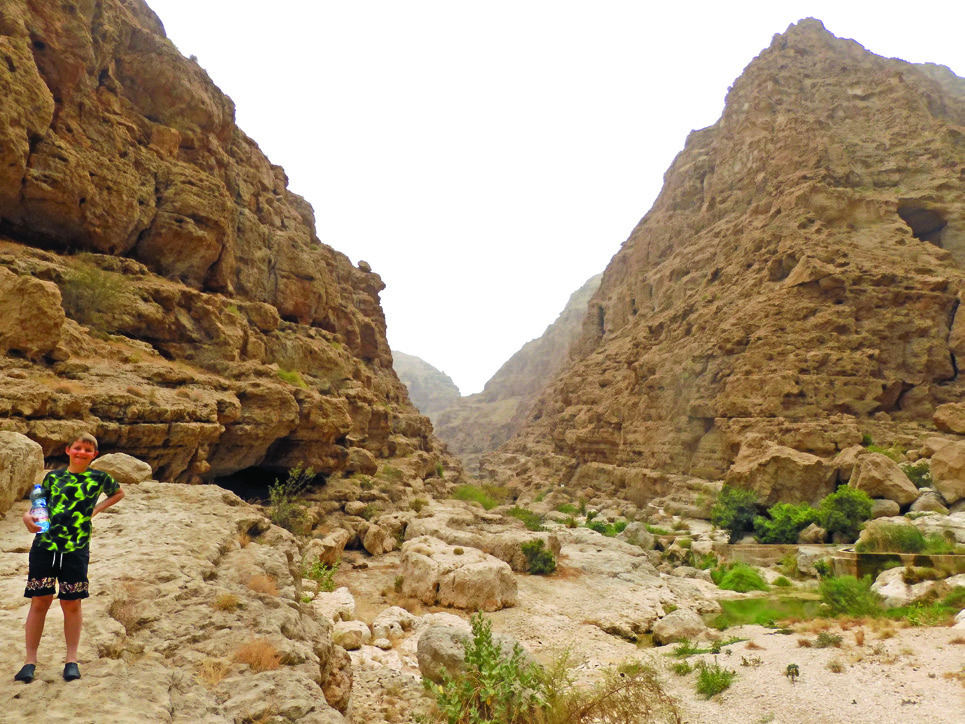
If El Paso were on the coast, it would look a lot like Muscat. There are high, barren, steep ridges and mountains all around. Some of the mountains in this part of Oman top 9,000 feet, creating an entirely different environment. Because of its proximity to the coast, Muscat has a maritime history and surprisingly good seafood. The Arabic dishes, with their succulent soft lamb buried in differently flavored beds of rice, are tantalizing. Beef, on the other hand, was rare in Oman.
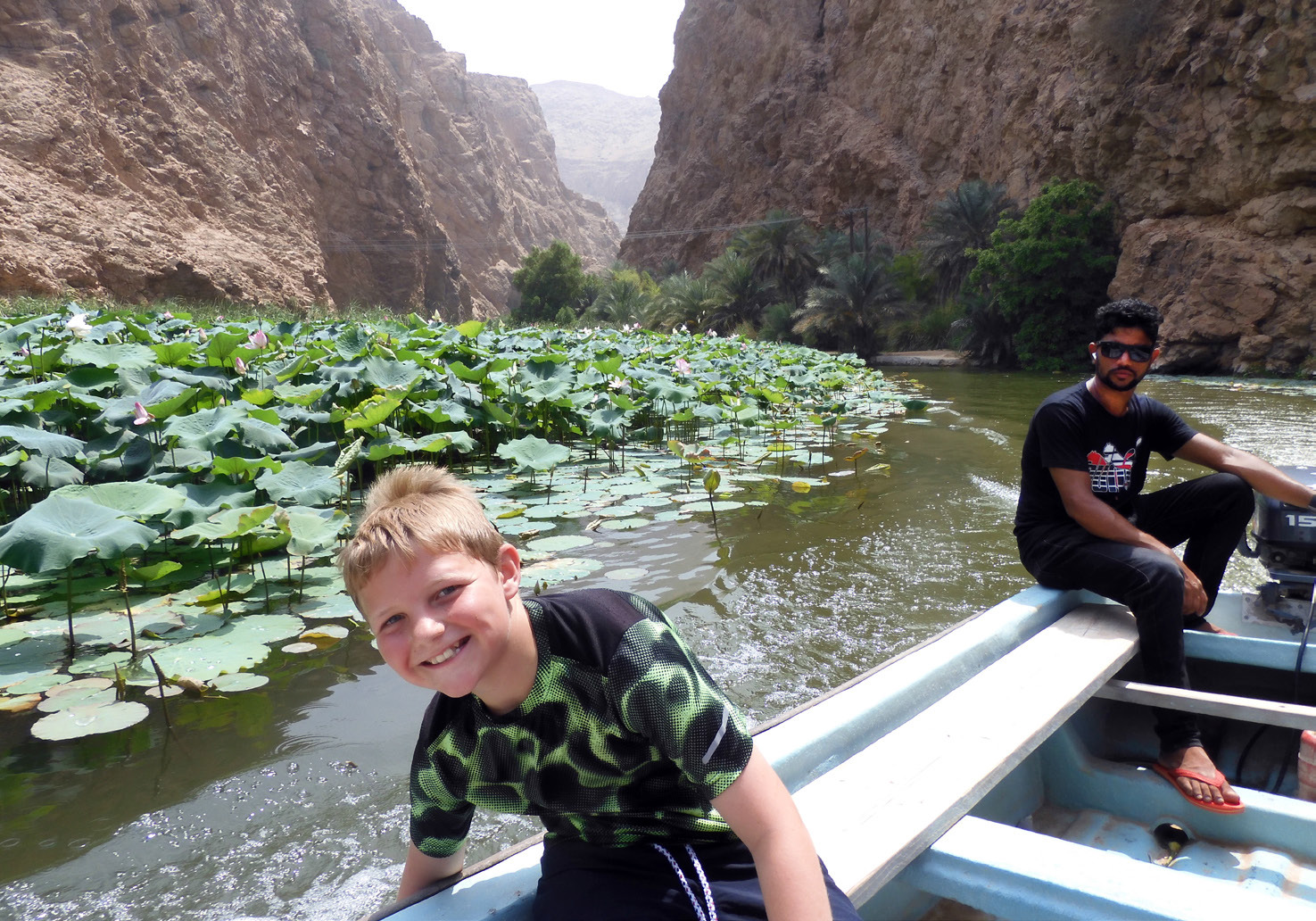
For me, Wadi Shab was the highlight of our Oman visit. Wadis are valleys or draws that slice through the tan ridges running steams of water toward the coast. The greenery at the bottom gives an appearance like an oasis. There are date palms and other greenery along the wadi floors, creating a very distinct palette of colors. Wadi Shab has enough water to grow lily pads at its mouth.
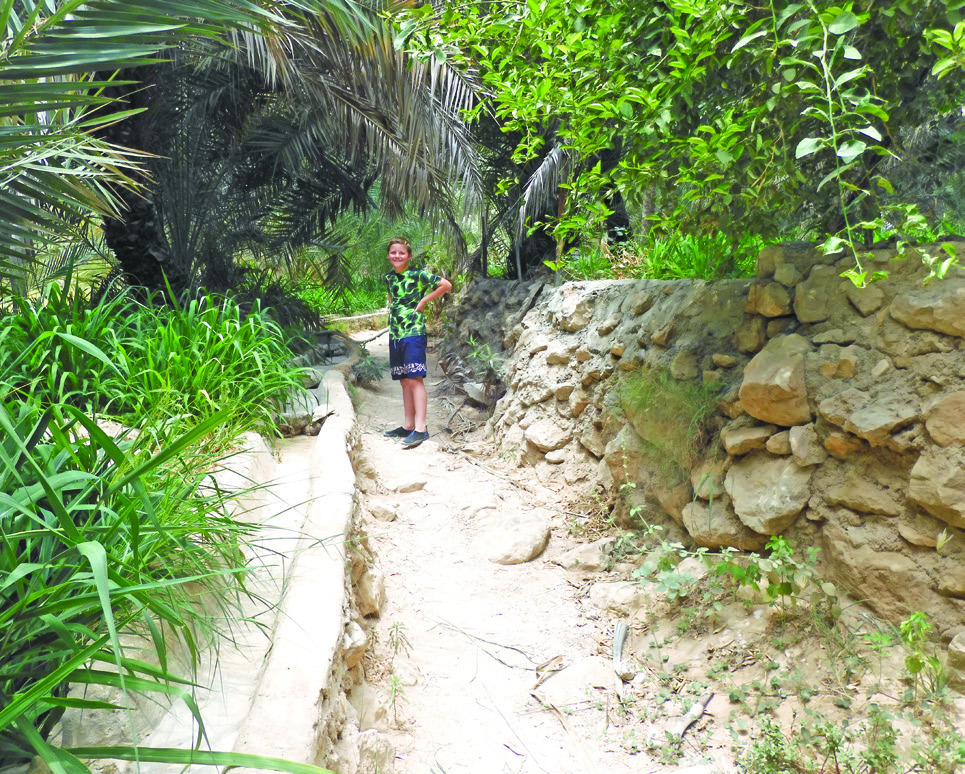
We found the Wadi Shab trailhead under a bridge along the coast. We paid a fellow with a wooden dinghy one rial to haul us across the murky. lily pad–filled area to the dry ground on the far side. It didn’t take much hiking to work up a sweat, though the hike was not particularly taxing. We walked slowly and the terrain was not steep. We made our way through small, semiabandoned date palm plantations with channels like acequias diverting bits of water to them. We hugged the canyon edges where smooth, slick rocks marked occasionally by spray-painted arrows directed us upstream. We saw a few green pools here and there. Sometimes we had to cross the creek or wade up it in ankle-deep water for a few yards. The scuba shoes I bought in Muscat paid off here.
After about 3 kilometers, we came upon the first big pool. By this point, the wa- ter was clear enough to see the pebbles at the bottom of the stream even though the water was in some places over my head. Here, you abandon your pack unless it is waterproof and swim the first pool. The canyon is too narrow to walk any farther. We desperately wanted in the water by this point anyway. We swam and tread our way across the long pool, through dark green water, with bits of moss along the rocks once we came to another shallow spot. It got shallow enough we walked again, though this time through water alternating between knee- and ankle-depth. The rocks were sometimes dangerously slick here. We picked our way carefully to the upper pool.
I really wished we had a waterproof camera to have captured the scenery of this upper pool. We got back into deep water and swam. At first, I would now and then find a rock where Caleb could stand and rest once in a while. Eventually, the water just stayed deep. At the far end of the now crisply emerald water, there was a tiny crack in the rock. I had read there was a cave at the head of the last pool. Caleb said he saw the cave, but it looked far too small for me to pass. I asked Caleb if he wanted to go, but he seemed reluctant. I swam over to the fissure. It looked skinnier than it was, because it meandered right and left a bit. Even so, the opening above the water was not twice the width of my head. Fortunately, the rocks widened out significantly below the water line so that even if my head or chest would not have fit, as long as I kept my mouth out of the water, I could get through just fine below the surface.
We continued this way for about 30-40 meters before the fissure opened up into a deep green pool fed by a waterfall for which we could not see the source. The stream seemed to come from nowhere down through an immense stack of light orange boulders bigger than buildings. The whole area was maybe a 20-meter circle. The water was a lot cooler in here. We stayed and enjoyed the crashing, cool water and the white noise, contemplating the uniqueness of the experience. What a place! I suppose it wasn’t the most beautiful place in the world, but I am certain it was the only place exactly like this.
Eventually, we tread and swam back down to the lower pool, where by now there were a few other swimmers. Caleb dragged the stay out as long as he could. It was going to be a hot hike back to the car, after all. We sat in the pool while
fish swarmed us every time we sat still. I understand people pay money to have these fish eat the dead skin off of their feet. At first, I could hardly stand to be still long enough for the fish to do their business. Eventually, I kind of got used to it. I don’t think I’ll ever understand why people pay money for skin-eating fish pedicures. We saw people paying for this treatment at Golden Sands, Bulgaria. I couldn’t tell that it did anything really, except kind of tickle. I started nagging Caleb to leave after a while and we began our backtracking. My clothes were wet with creek water when we left the pool, and they were still wet—from perspiration— when we arrived at the boatman’s launch.
